
What a Professional Trademark Search Actually Covers
Most people who come to trademark research for the first time assume the process is simple: type the name into the USPTO database, see if anything comes up, and move forward if it looks clear. It’s an understandable assumption — but it significantly underestimates what a real trademark clearance search involves.
A professional trademark availability search doesn’t stop at federal records. It moves through multiple layers of data, looking for conflicts in places most business owners don’t even think to check. Understanding what those layers are — and why each one matters — puts you in a much better position before you invest in a filing.
The USPTO Database: Where Every Search Starts
The USPTO’s Trademark search system is the obvious starting point, and it’s an important one. It contains every pending and registered federal trademark on record — which is a substantial pool of potential conflicts.
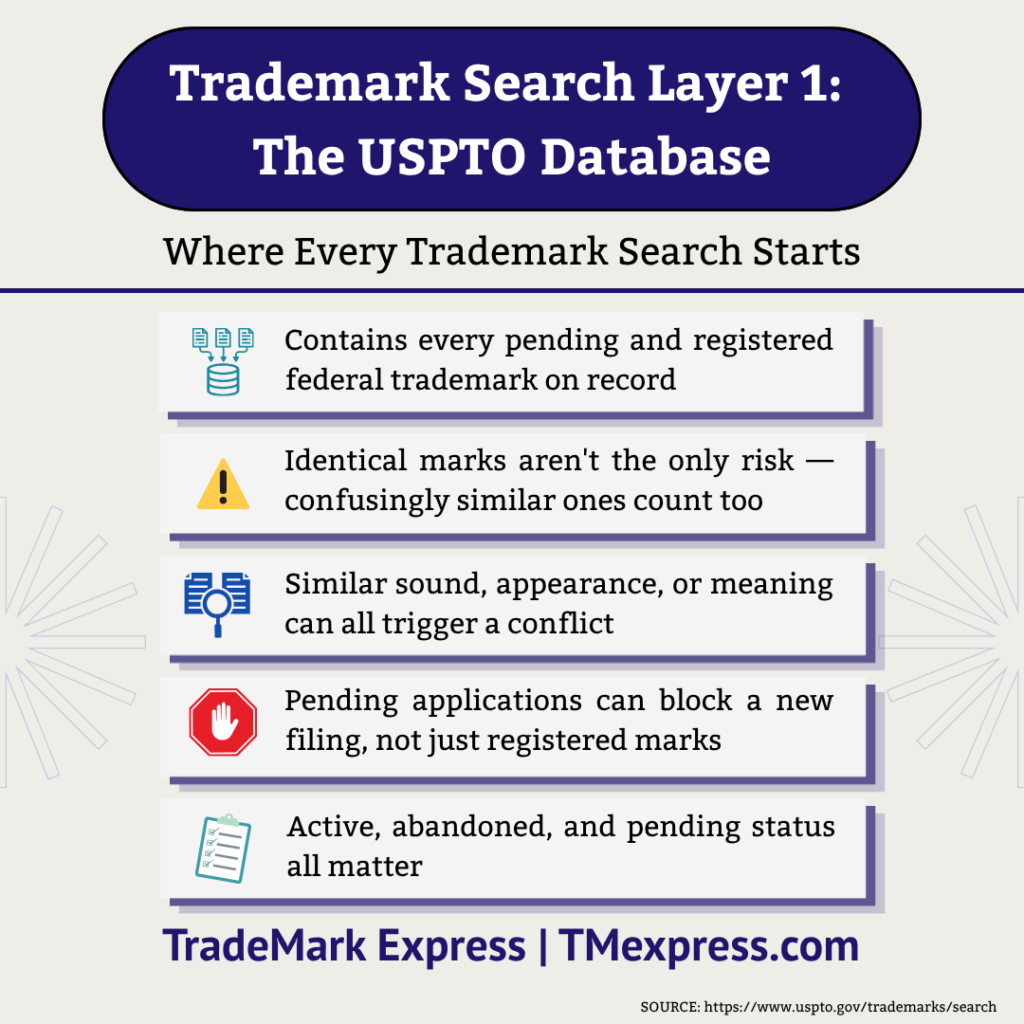
But even within the federal database, a thorough search goes beyond typing in your exact name and checking for an identical match. The USPTO doesn’t reject applications only when two marks are identical. The legal standard is whether a mark is confusingly similar — a much broader concept that catches marks with similar sound, appearance, or meaning. That means a comprehensive trademark search has to look for variations, not just matches.
More on that shortly. First, the database itself: a careful federal search also looks at the status of existing marks. A pending application can block a new filing just as effectively as a registered mark.
Understanding what’s active, what’s abandoned, and what’s still alive in the pipeline is part of reading the federal landscape correctly.
State Trademark Databases
Federal registration isn’t the only official trademark system in the United States. Every state maintains its own trademark registration database, and marks registered at the state level don’t appear in the USPTO’s records.
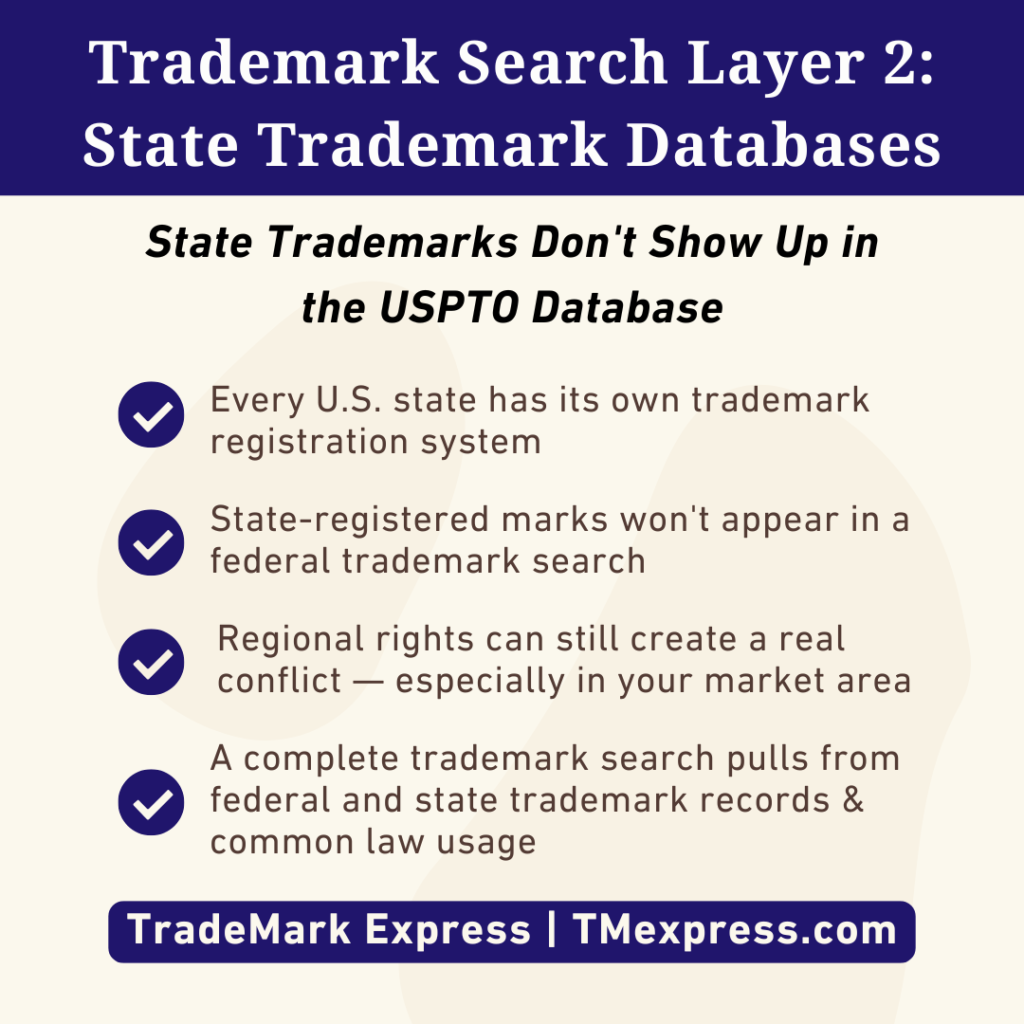
A business that registered its mark in California, Texas, or New York may have limited geographic rights that still create a real conflict — particularly if you’re planning to operate in that same region. A trademark search that skips state records is leaving a significant blind spot open.
State trademark registration is its own topic, but the short version is this: state registrations are narrower in scope than federal ones, but they’re not irrelevant. A full trademark search pulls from both.
Common Law: The Hardest Layer to Find
This is where most DIY searches fall shortest. Common law trademark rights arise from actual use of a mark in commerce — not from registration. A business that has been operating under a name for years may have legitimate, enforceable rights in its region without ever filing anything with the USPTO or a state agency.
These marks don’t appear in any official database. They show up in business directories, state incorporation filings, trade publications, domain registrations, and online presence. Finding them requires active investigation, not a database query.
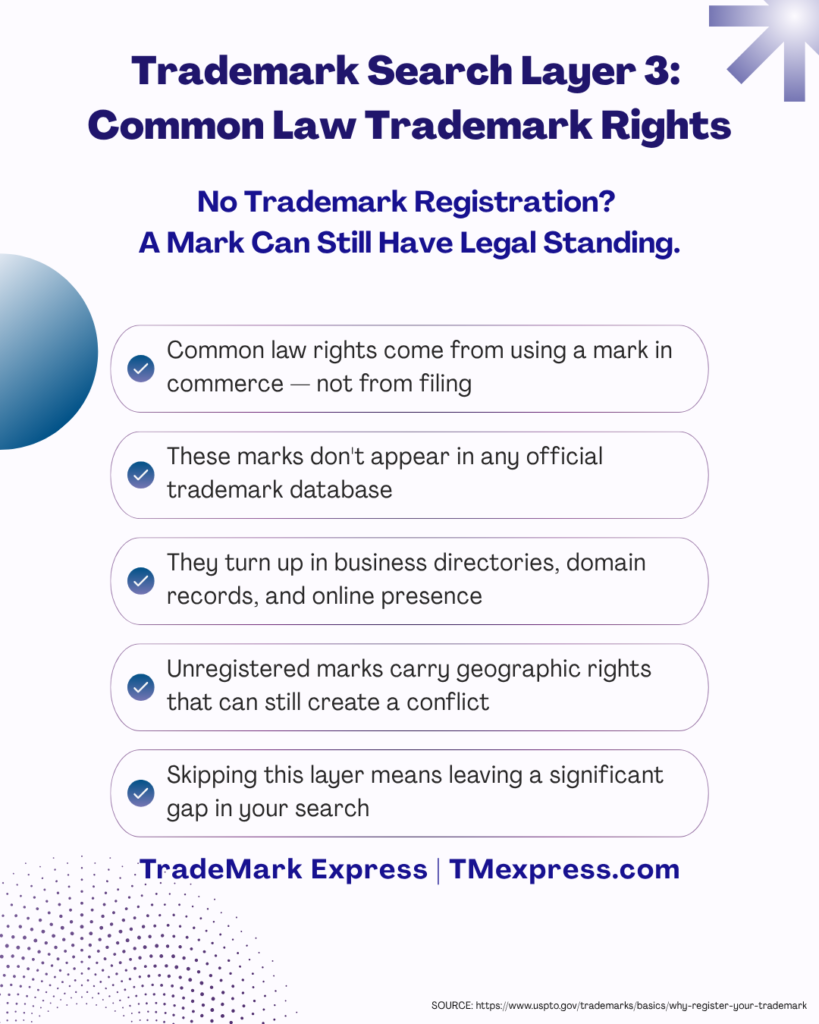
Why does this matter? Because common law rights are geographically based. A business using a mark in the Pacific Northwest may have protectable rights in that area even though no registration exists anywhere. If you’re planning to operate in that market — or expand into it — an unregistered mark can still create a conflict.
Skipping common law research means skipping the layer where many real-world conflicts actually live. The comprehensive trademark search process at TradeMark Express is specifically built to include this layer, not treat it as optional.
Sound-Alike and Phonetic Variations
Here’s one of the more nuanced parts of trademark clearance: two marks don’t have to be spelled the same to conflict. If they sound alike when spoken aloud, the USPTO may consider them confusingly similar.
This is why a professional trademark search doesn’t just look for your exact name — it searches for phonetic equivalents and sound-alike variations. A search for “Kairo” needs to account for “Cairo,” “Kyro,” “Kyrow,” and similar constructions. A search for “Faze” needs to look at “Phase,” “Fays,” and related sounds.
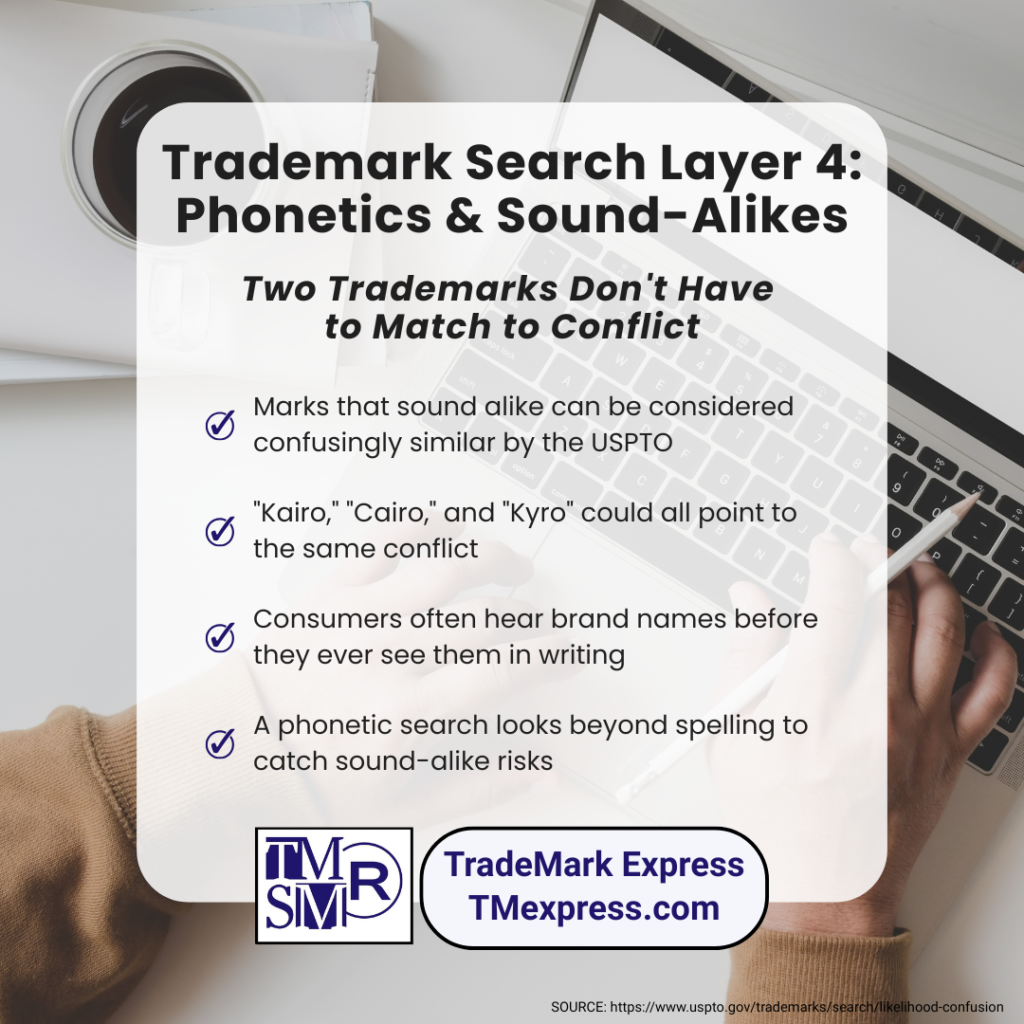
The reason this matters is practical: consumers often encounter brand names aurally — in conversation, on podcasts, in radio advertising — before they ever see them in writing. If two marks sound similar enough to cause confusion in that context, a conflict may exist regardless of how different the spellings are. A sound-alike search catches these risks before they become problems. You can read more about how this works in our post on why two trademarks don’t have to match to conflict.
Visual Similarity and Stylized Marks
Sound isn’t the only vector for confusion. Visual similarity matters too — and if your brand includes a logo or stylized design, it warrants its own dedicated search.
A logo trademark search is a separate process from a name search. Rather than searching by text, it searches federal trademark records by design element — using a classification system that categorizes visual components like geometric shapes, animals, objects, human or supernatural beings, and more. The goal is to identify existing marks with visual characteristics similar enough to create confusion in the marketplace.
Two marks can use completely different words and still conflict if their visual presentation is similar enough that consumers are likely to confuse them. That’s why businesses filing both a name and a logo trademark typically need two separate searches — one scoped to the word mark, one scoped to the design.
Misspellings and Alternate Spellings
Closely related to phonetic searching is the examination of alternate spellings and common misspellings. Trademark analysis is not limited to one precise spelling of a word. If a mark is likely to be confused with another despite a spelling difference, that’s still a conflict under USPTO standards.
A search for “Brightlee” needs to look at “Brightly,” “Brightli,” “Brightley,” “Bryte Le,” and other plausible variants.
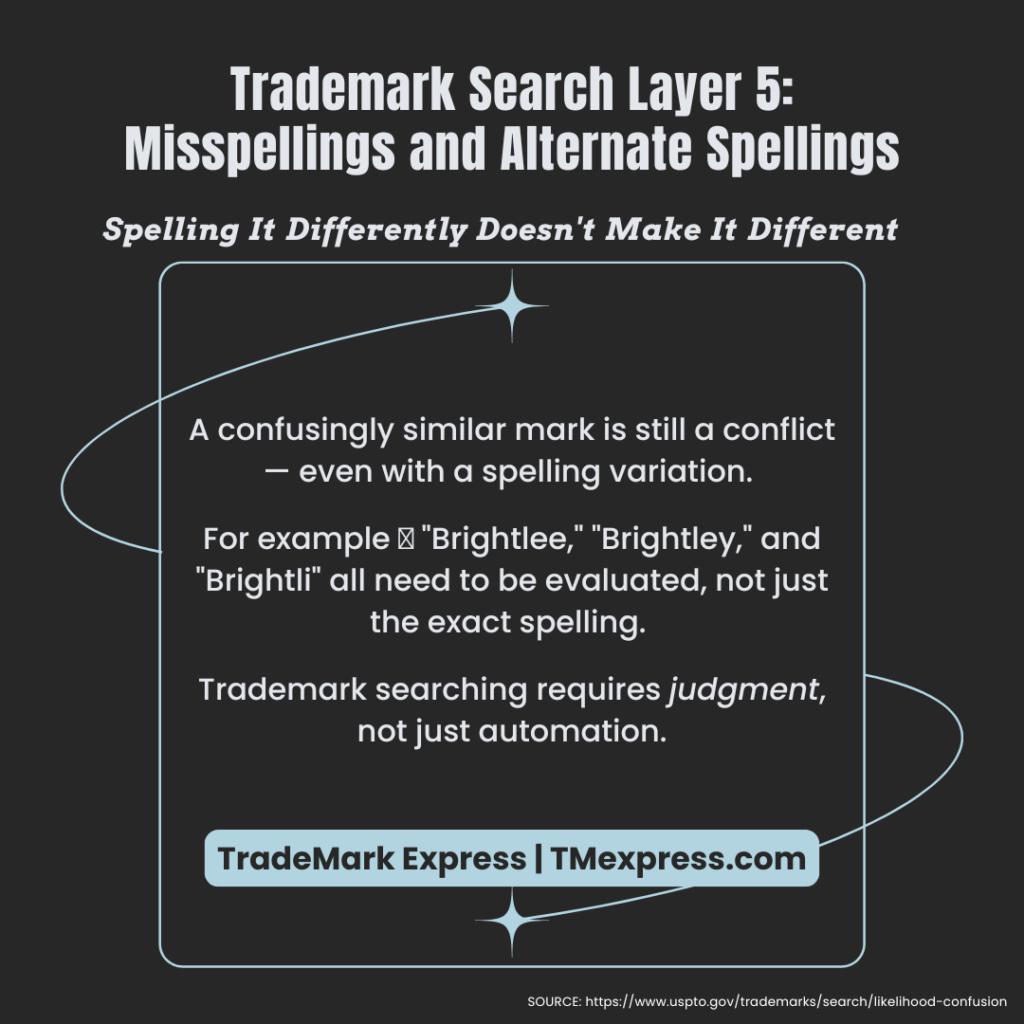
This is one of the reasons trademark searching just isn’t something that can or should be fully automated — evaluating which variations are relevant requires judgment, not just pattern matching.
Domain Names and Social Media Handles
A comprehensive trademark clearance search is primarily a legal exercise, but good due diligence doesn’t stop at legal records. Domain names and social media handles are worth examining as part of the broader brand availability picture.
A name that clears trademark searches but has an active domain under the same name — used by a competing business — is worth knowing about before you build a brand around it. Social media presence can also surface evidence of common law use that wouldn’t otherwise show up in a database search.
These aren’t trademark registrations, and what’s found here doesn’t carry the same legal weight as a conflicting federal mark. But they’re part of the full picture a smart business owner wants before making a final decision.
How Goods and Services Scope Shapes the Search
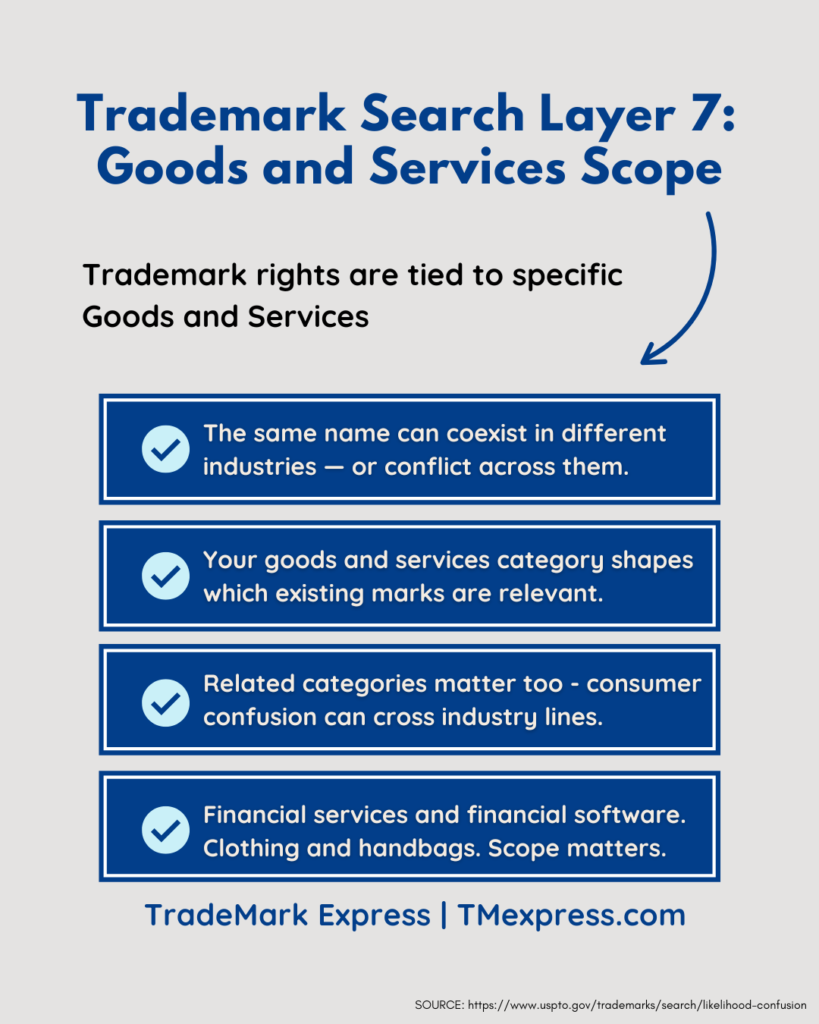
Trademark rights don’t exist in a vacuum — they exist in relation to specific goods and services. A mark that’s registered for coffee products doesn’t automatically block the same name from being used for software. The question is always whether the goods or services are related enough that consumers might be confused.
This is why the scope of a trademark search isn’t one-size-fits-all. The goods and services your mark will cover directly shape which existing marks are relevant — and which aren’t. A thorough search is scoped to your specific category, and then expanded to look at related categories where consumer confusion could still be an issue.
The USPTO has found conflicts across categories that seem distinct at first glance. A word used for financial services might conflict with the same word used for financial software. A name used for clothing might conflict with one used for a handbag line. Understanding how the USPTO evaluates relatedness is essential to understanding what actually gets flagged in a proper search.
REAL-WORLD EXAMPLE:
A real USPTO Office Action illustrates this well. An application for the mark CLOVER covering handbags, luggage, purses, and wallets in Class 18 was refused based on a likelihood of confusion with an existing registration for jewelry in Class 14 — a completely different class.
The examining attorney’s reasoning: these goods are often produced by the same entities, travel in the same channels of trade, and reach the same consumers. Third-party registrations in the USPTO database confirmed that handbags, luggage, purses, wallets, and jewelry commonly emanate from a single source under a single mark. Think of brands like Marc Jacobs, Prada, Coach, and more.
Different class. Still a conflict.
For a deeper look at how trademark classes factor into search scope, see our trademark classes guide.
Why a Name Search Isn't a Trademark Search
This distinction matters, and it’s worth being direct about it.
Running your name through Google, checking your state’s business entity database, and searching Instagram and GoDaddy for availability is a name search. It tells you whether your name is being used publicly in obvious ways. It does not tell you whether your name conflicts with an existing trademark.
The USPTO search covers pending and registered marks that may not have a significant online presence. Common law rights can exist for businesses that haven’t been indexed in a way that a Google search would surface. A mark with little to no online presence may still be registered and active in the USPTO system.
More importantly, none of these name search methods apply the confusingly similar standard — the actual legal test. A name search only finds exact or near-exact matches. A trademark clearance search is specifically designed to find everything that could be considered confusingly similar under the standards the USPTO applies. Those are genuinely different things, and the gap between them is where most trademark application problems originate.
Scope of Conflict Isn't the Only Consideration
The layers covered in this post focus primarily on one central question: does a confusingly similar mark already exist? But a comprehensive trademark search and the examination process involve additional considerations that go beyond conflict searching.
Factors like whether a mark is primarily merely a surname, whether it’s descriptive of the goods or services it covers, whether it involves geographic terms, whether it could be considered deceptive, and whether it may conflict with a famous mark, and so much more — these are all grounds the USPTO evaluates independently of likelihood of confusion. They speak to the registrability of the mark itself, not just whether it conflicts with something already on the register.
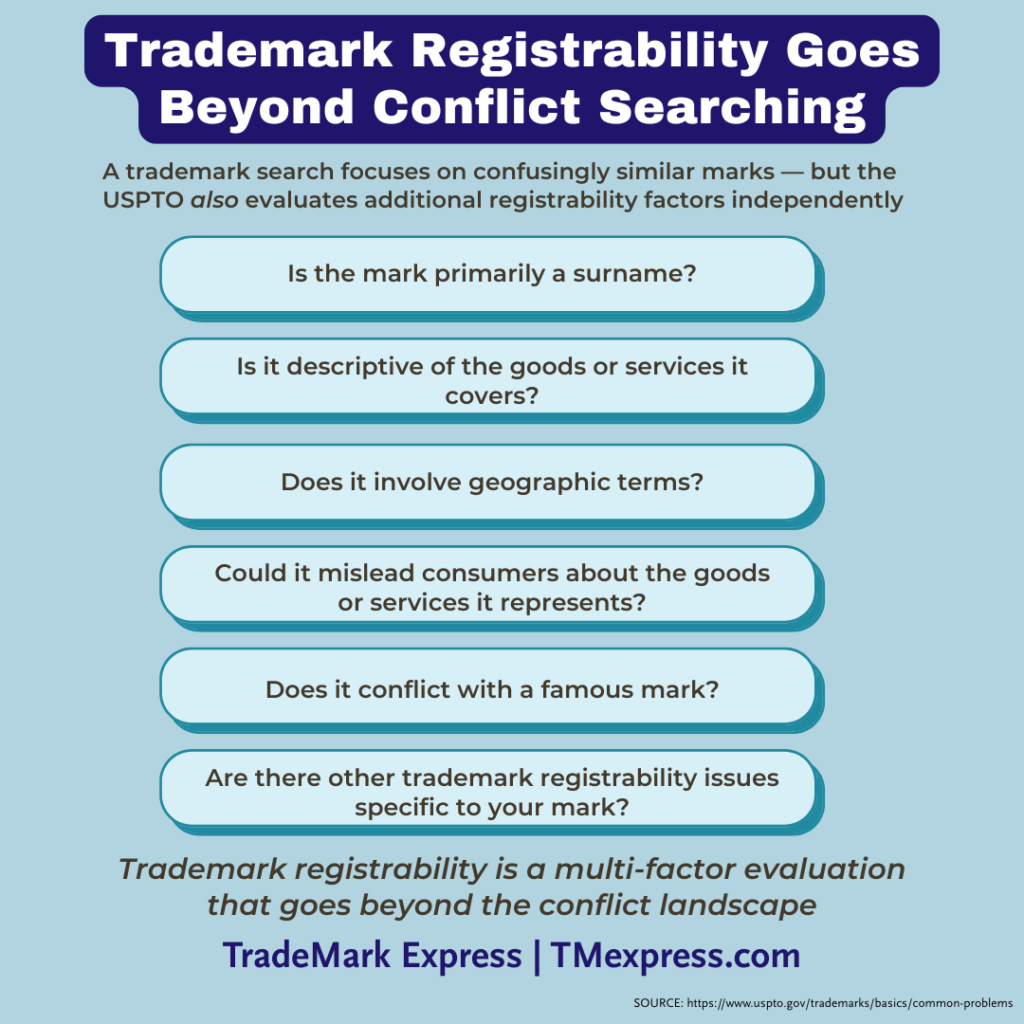
A professional search report addresses the conflict landscape. But understanding the full picture of trademark registrability means looking at these additional factors as well — which is another reason working with experienced trademark professionals matters before you file.
What a Search Report Brings Together
After all of these layers are searched, a professional search report organizes the findings in a way that’s actually useful. It doesn’t just list every possible hit — it contextualizes them, so you understand which marks represent genuine risk, which are unlikely to create a conflict based on scope or geography, and where the biggest concerns lie.
That’s the difference between raw data and a workable picture of risk. A well-structured search report helps you and any advisors you’re working with make an informed decision about how to proceed.
Ready to See the Full Picture Before You File?
If you’re preparing to file a trademark application — or even still choosing between names — a professional trademark search is one of the most valuable steps you can take before committing to a brand. It replaces guesswork with information, and it covers ground that a quick USPTO lookup simply can’t reach.
TradeMark Express provides comprehensive trademark searches across federal records, state databases, and common law sources, with professional search reports that give you a clear view of what’s out there. Contact TradeMark Express to get started.
DISCLAIMER: References to particular trademarks, service marks, products, services, companies, or organizations appearing on this page are for illustrative and educational purposes only and do not constitute or imply endorsement.