
5 Trademark Questions Every Business Should Ask
Filing a trademark application is one of the most important steps you can take to protect your brand — but it’s not the first step. Before you submit anything to the USPTO, there are five questions worth asking. The answers will help you file smarter, avoid common pitfalls, and give your mark the best possible chance of success.
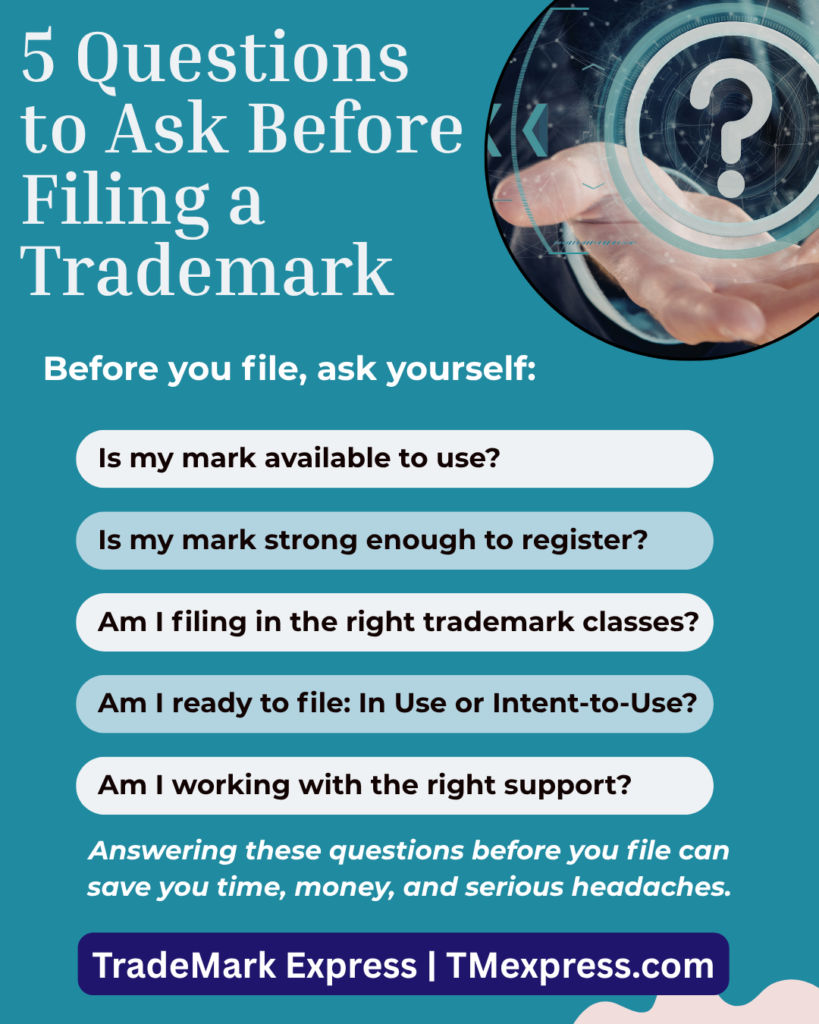
Question 1: Is My Mark Actually Available to Use?
This is the foundational question, and it’s the one most people skip — or answer too quickly.
Many business owners check whether their desired name is available as a domain or social media handle, assume the coast is clear, and move on.
But trademark availability is a different question entirely. A mark can be wide open online and still be claimed by someone else in the trademark world — through a federal registration, a pending application, or common law rights built through years of actual use in commerce.
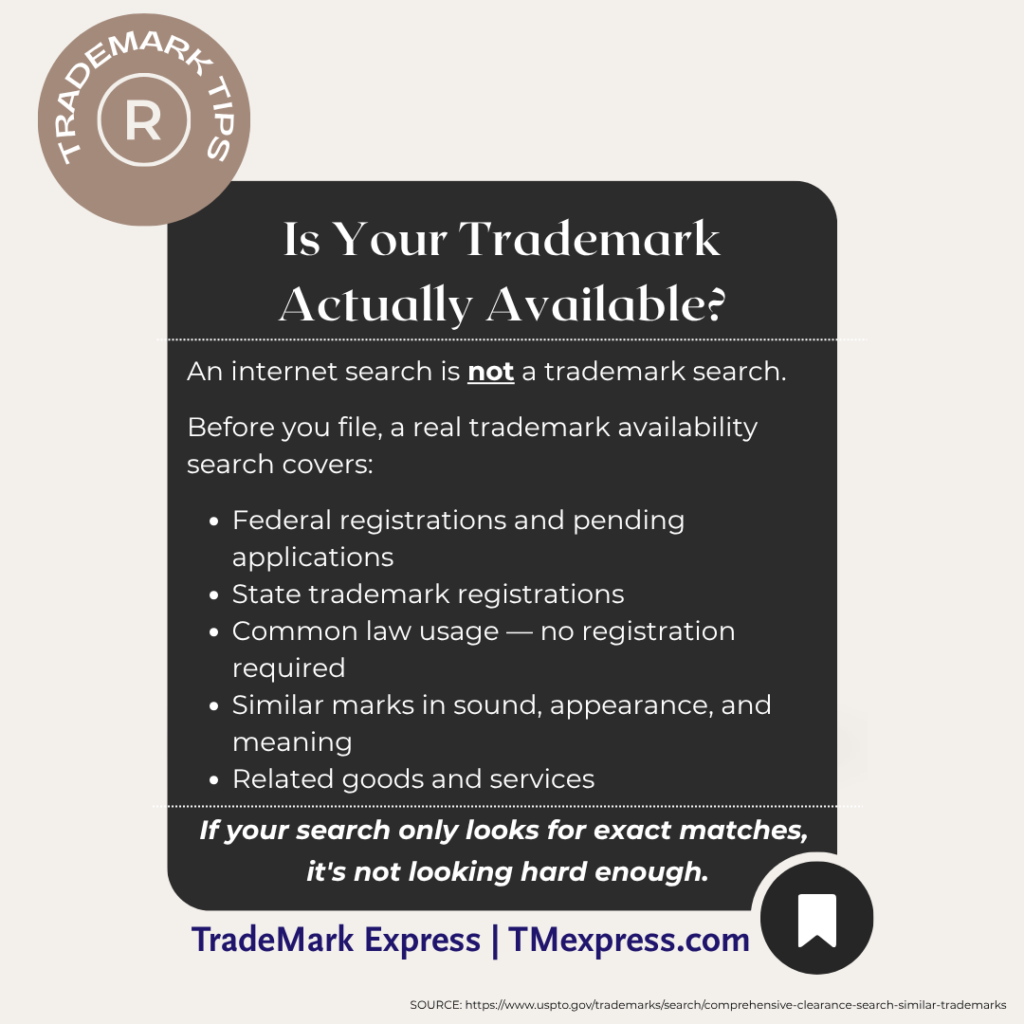
Before you file, a thorough trademark availability search should cover:
- Federal trademark records — both registered marks and pending applications in the USPTO database. A pending application that was filed before yours can block your registration even if it hasn’t been approved yet.
- State trademark registrations — businesses that register at the state level have rights within that state, and those registrations won’t show up in a federal database search.
- Common law usage — businesses that use a mark in commerce may hold enforceable rights in their geographic area even without any registration at all. These rights won’t appear in any single official database, which is why common law searches require digging into business directories, websites, social media, trade publications, and other sources.
- Similar marks — not just identical ones — the USPTO doesn’t just look for exact matches. The legal standard is whether a mark is confusingly similar to an existing one. That means a full trademark clearance search needs to catch marks that sound alike, look alike, or carry the same meaning, even if the spelling is completely different.
- Related goods and services — trademark conflicts aren’t limited to the same industry. If another business uses a similar mark on goods or services that consumers might associate with yours, a conflict can exist. A comprehensive trademark search looks beyond your specific category to identify these potential issues before they become real ones.
Skipping this step — or relying on a surface-level search — is one of the most common and costly mistakes brand owners make.
Question 2: Is My Trademark Strong Enough to Register?
Not every name qualifies for federal trademark protection. Before you file, it’s worth understanding where your mark falls on the spectrum of trademark strength.
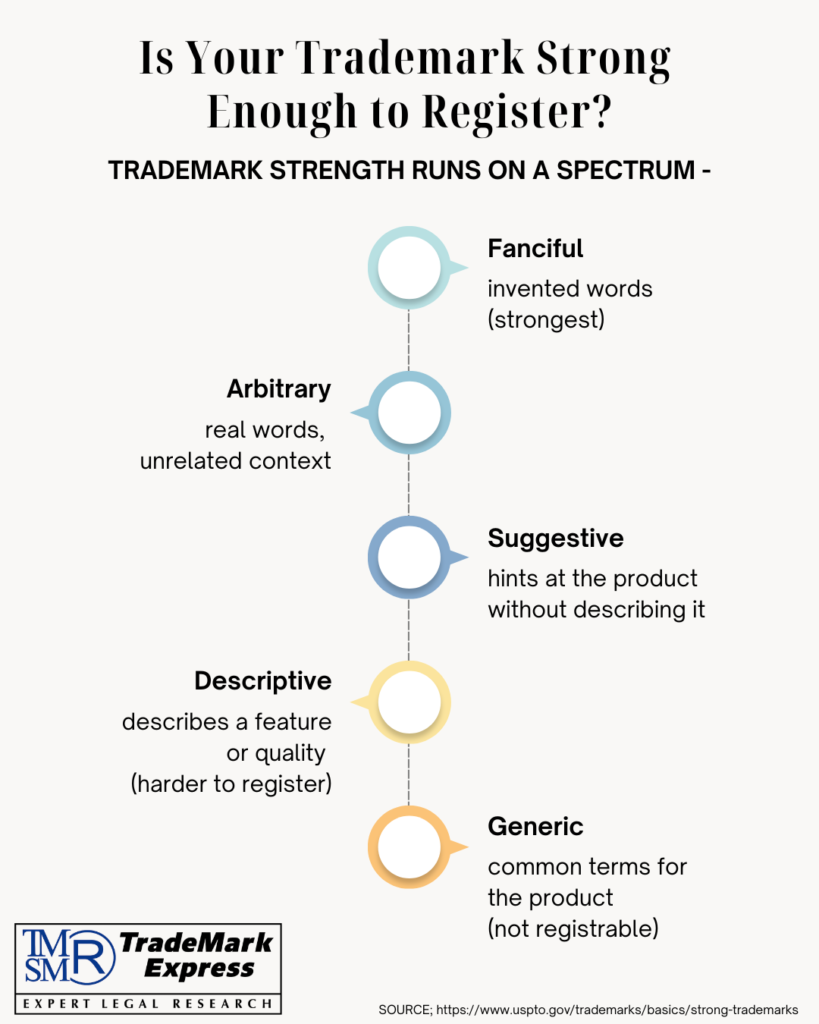
Trademarks are generally categorized from strongest to weakest as:
- Fanciful — invented words with no prior meaning (e.g., Xerox, Kodak)
- Arbitrary — real words applied in an unrelated context (e.g., Apple for computers)
- Suggestive — words that hint at a product’s qualities without directly describing them
- Descriptive — words that describe a feature, quality, or characteristic of the goods or services
- Generic — common terms for the product or service itself
Fanciful, arbitrary, and suggestive marks are the most registrable. Descriptive marks face an uphill battle and often require proof that the public has come to associate the mark with a specific source — a standard that takes years to establish. Generic terms can’t be registered at all.
If your mark describes what your business does or sells, that’s worth knowing before you invest in a filing. It may be worth rethinking the name, or at least going in with realistic expectations.
Question 3: Have I Identified the Right Trademark Classes?
Trademarks are registered for specific goods and services, organized into 45 international categories called trademark classes. The class (or classes) you file in will determine the scope of your protection — and getting this wrong can leave meaningful gaps in your coverage.
Before filing, think carefully about everything your brand touches — or will touch — in the next three years or so. A software company that also offers consulting services may need coverage in more than one class. A product brand planning to expand into apparel down the road might benefit from filing in that class early rather than returning to the USPTO later.

Filing in the wrong class, or too few classes, means going back to the USPTO with an entirely new application — there’s no way to add coverage to an existing one after it’s filed. Getting this right upfront is much more efficient.
Question 4: Can I Prove I'm Using the Trademark in Commerce (or Am I Ready to)?
The USPTO requires that your mark be in actual use in commerce — meaning it must be used on goods sold or transported, or in connection with services rendered — in order to register it. If your brand is already live and in use, that’s straightforward. But if your business hasn’t launched yet, you have options.
An Intent-to-Use (ITU) application allows you to file before your brand goes live, as long as you have a genuine, good-faith intent to use the mark. This locks in your filing date while your business gets off the ground. You’ll need to submit proof of use, aka a specimen, before your registration is finalized, but you don’t need to be live at the time of filing.
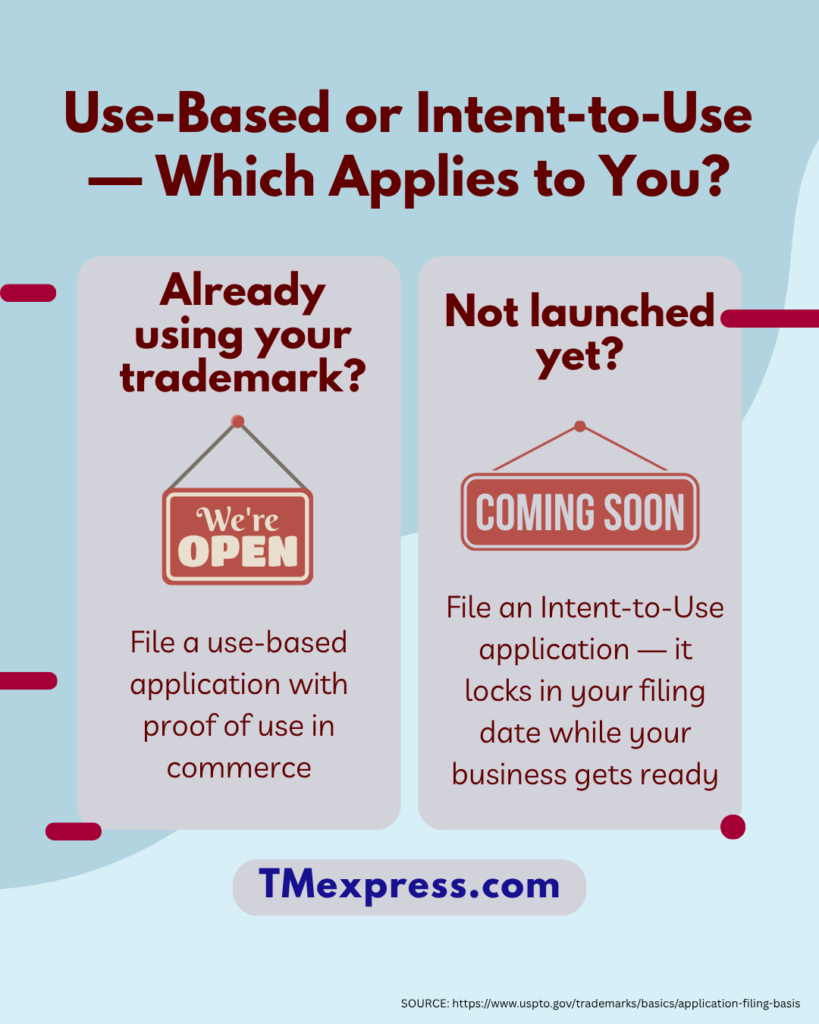
Understanding where you stand on this — currently in use vs. not yet launched — affects how your application is structured and what documentation you’ll need to prepare.
Question 5: Am I Working With the Right Support?
Filing a trademark application is a legal process with real consequences if handled incorrectly. Errors in how the goods and services are described, how the specimen is presented, or how the application is structured can lead to office actions, refusals, or registrations that don’t provide the protection you were expecting.
There’s an important distinction worth understanding here.
Legitimate trademark research and application preparation services — like TradeMark Express — can handle the substantial legwork: running a comprehensive trademark search, organizing the findings into a clear report that clients can review with a trademark attorney, and preparing your application materials so you’re ready to file directly with the USPTO.
But if your situation involves legal complexity, a conflict that needs to be argued, or an office action requiring legal strategy, a trademark attorney is the right resource.
The key question isn’t whether you need help — it’s whether you’re working with professionals who are upfront about what they do and what falls outside their scope. Beware of services that promise legal outcomes without legal credentials, or that rush you through the process without a thorough trademark and common law search first.
FAQ
What should I check before filing a trademark? Before filing, you should conduct a comprehensive trademark search covering federal and state trademark records, common law usage, and marks that are similar in sound, appearance, or meaning. You should also confirm your mark is distinctive enough to register and identify the correct trademark classes for your goods or services.
Is an internet search enough to check trademark availability? No. A search on Google or Bing won’t surface pending USPTO applications, state trademark registrations, or common law rights held by businesses that may not have a strong web presence. A proper trademark availability search requires searching multiple databases and sources.
What is a trademark class and why does it matter? Trademark classes are the 45 international categories used to organize goods and services in the trademark system. The class or classes you file in define the scope of your protection. Filing in the wrong class — or too few — can leave your brand without coverage in areas where you actually operate.
Can I file a trademark if my business isn’t open yet? Yes. An Intent-to-Use (ITU) trademark application allows you to file before your brand is in use, as long as you have a genuine plan to use the mark. You’ll need to submit proof of use before the registration is finalized.
Ready to Trademark Smarter?
These five questions don’t have to be hard to answer — they just have to be asked. If you’re preparing to file and want confidence that your brand is clear to use and structured for the best possible outcome, TradeMark Express can help.
We provide comprehensive trademark searches, clear and detailed research reports, trademark attorney referrals, and application preparation assistance. Reach out today to get started — and go into your filing informed.
The information provided on this site is for general informational purposes only. All information on the Site is provided in good faith; however, we make no representation or warranty of any kind, express or implied, regarding the accuracy, validity, or completeness of any information on the Site. The Site cannot and does not contain legal advice. The legal information is provided for general informational and educational purposes only, and is not a substitute for legal advice. Consult a licensed attorney for legal advice.