
Trademark Your Meditation Business Name the Right Way
You have built something real — a practice, a teaching approach, a community. Your business name is the anchor of all of it. But if you have not taken steps to protect that name, someone else could start using something similar, and you could lose the brand you have worked hard to establish.
Trademarking your meditation business name gives you exclusive rights to use it in connection with your services, puts the public on notice that the name is yours, and gives you legal standing to stop others from trading on your reputation.
This guide walks you through everything you need to know — from choosing a protectable name to filing with the USPTO and keeping your registration in good standing.
Why a Trademark Matters for Your Meditation Brand
The global meditation market is on a steep growth curve — Coherent Market Insights estimates it will climb from $8.51 billion in 2026 to $20.39 billion by 2033 , fueled by rising demand for mental wellness, stress relief, and mindfulness. That kind of growth attracts opportunity — and competition.
A registered trademark helps you stand out and stay protected in several concrete ways:
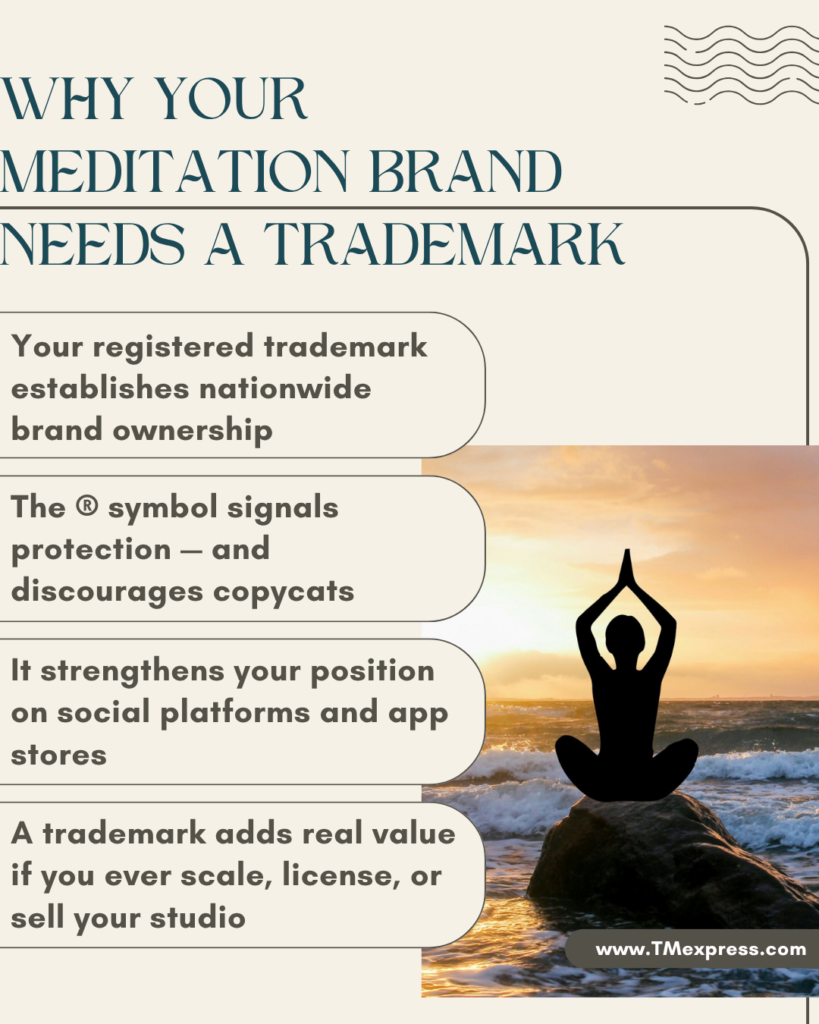
- Brand ownership: A federal registration establishes you as the owner of your name in your category of services, nationwide.
- Deterrence: The ® symbol signals that your brand is protected, which discourages others from copying it.
- Digital and platform leverage: Registered trademarks give you stronger standing when filing complaints on social media platforms, app stores, and domain registrars.
- Business value: If you plan to scale, franchise, license, or sell your business one day, a registered trademark adds tangible value to your brand assets.
Without protection, another teacher or studio could start using a similar name in your market — and you would have limited options to stop them.
How to Trademark Your Meditation Brand Step by Step
Choose a Strong Name
Not every name qualifies for trademark protection. The USPTO evaluate names along what is known as the Distinctiveness Continuum — a spectrum that runs from the most protectable to the least.
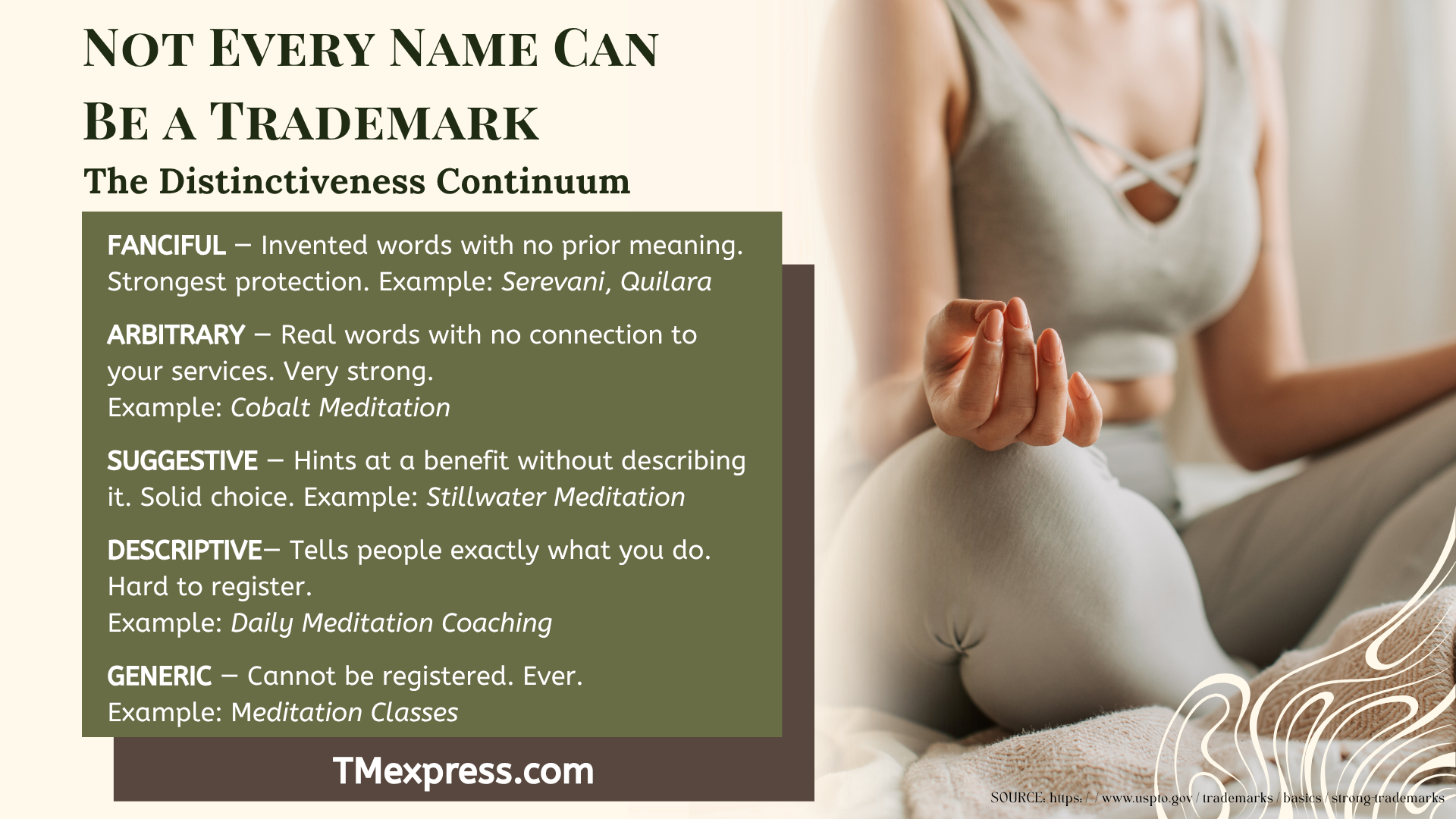
Fanciful marks are invented words with no prior meaning. They are the strongest. For a meditation brand, something like Serevani or Quilara would fall here.
Arbitrary marks are real words applied to unrelated goods or services. Cobalt Meditation could work here — “cobalt” has nothing to do with meditation, making the combination distinctive.
Suggestive marks hint at a quality or benefit without describing it outright. Stillwater Meditation suggests calm without directly describing what you offer. These are strong and commonly used in wellness branding.
Descriptive marks tell you exactly what the business does — like Daily Meditation Coaching or Corporate Stress Relief Training, for example. These are only registrable after gaining distinctiveness through extensive use in commerce over many years — a high bar for any new brand.
Generic terms — like Meditation Classes — cannot be registered at all.
For a meditation business, you want to aim for fanciful, arbitrary, or suggestive territory. Names that lean too heavily on words like “mindful,” “calm,” “breathe,” or “Zen” in combination with descriptive terms can face serious obstacles at the USPTO.
Conduct Comprehensive Trademark Research
Before you invest any more in your brand — website, signage, marketing materials, merchandise — you need to know whether your name is actually available to use and register.
A comprehensive trademark search goes well beyond a quick Google search. It covers:
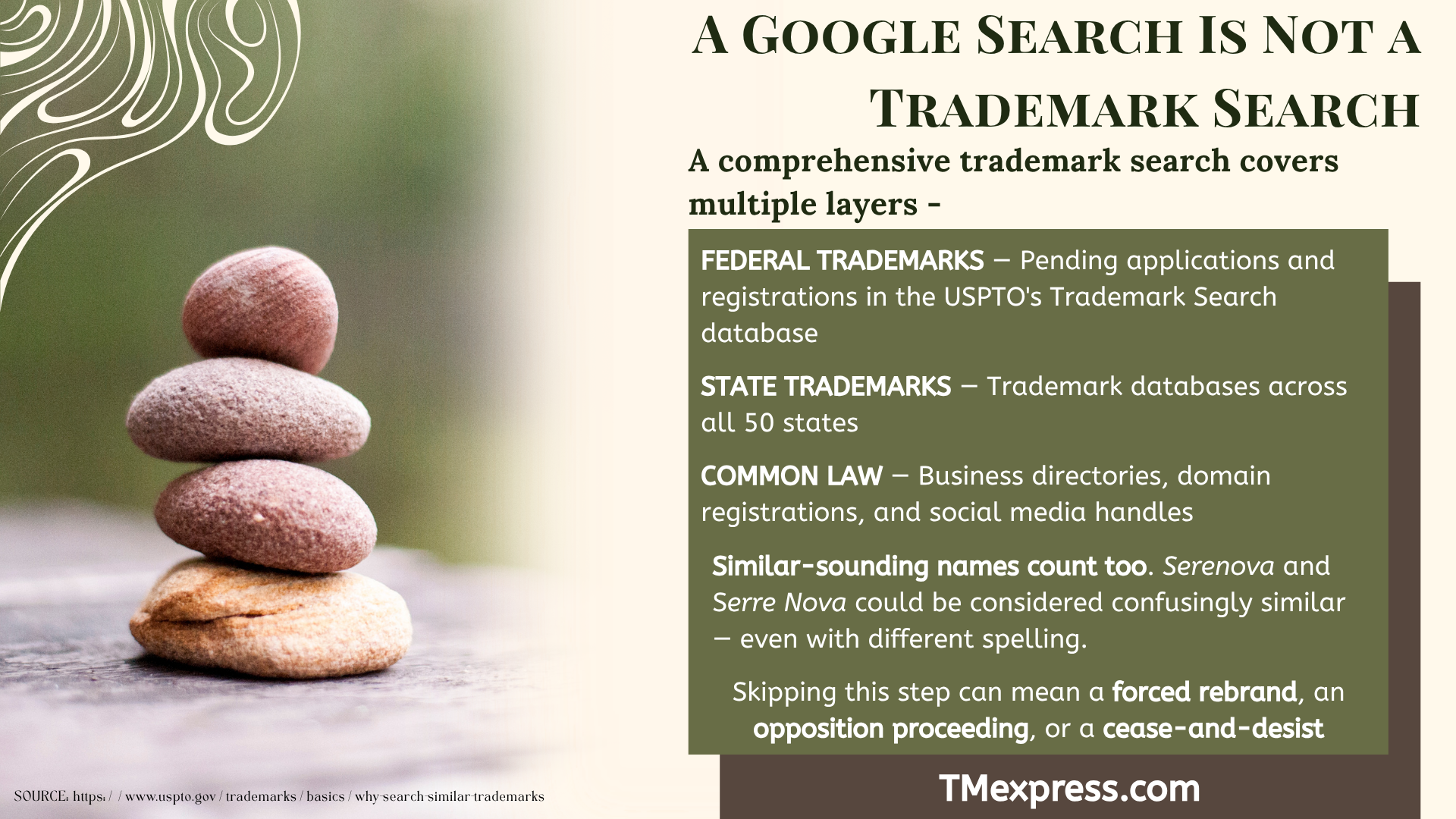
- Federal trademark records in the USPTO’s Trademark Search database, including pending applications and registrations
- State trademark databases across all 50 states
- Common law sources, including business directories, domain registrations, and social media handles, where unregistered brands may still have enforceable rights
Critically, the search needs to evaluate not just identical matches but also names that are similar in sound, appearance, or meaning. A meditation brand called Serenova and an existing brand called Serre Nova could be considered confusingly similar — even though the spelling is different.
You also need to evaluate the right NICE classes and the specific description of your services. The USPTO’s classification system organizes goods and services into 45 international classes. For a meditation business, the most relevant include:

Skipping a thorough search is one of the costliest mistakes a business owner can make. If you file an application and a prior rights holder objects, you could face an opposition proceeding, be forced to rebrand, or — in the worst case — receive a cease-and-desist demand after you have already built your audience around that name.
File the Trademark Application
Once your search clears, you are ready to file with the USPTO. You will file through the Trademark Center, the USPTO’s electronic filing system. The USPTO currently charges $350 per class for a base application. You can confirm current fees at the USPTO fee schedule.

NICE Class | What It Covers |
Education and instruction services, meditation and mindfulness training, workshops, retreats, online courses | |
Downloadable apps, guided meditation recordings, downloadable audio/video content | |
Printed materials — journals, workbooks, affirmation cards | |
Mental health and wellness consulting, stress reduction therapy, mental health services | |
Software as a service, online meditation platforms |
During the application, you will need to:
- Identify the mark (word mark, logo, or both)
- Select the correct NICE class or classes
- Write an accurate description of your goods or services
- Declare the basis for filing — either use in commerce or intent to use
Your description of services matters more than most applicants realize. Vague or overly broad descriptions get rejected. Overly narrow ones may leave gaps in your protection. Getting this right from the start saves time and money.
Intent to Use vs. Use in Commerce
When you file, you will choose one of two filing bases.
Use in Commerce means you are already using the name in connection with your services — you have a live class, an active website, or another commercial use. You will need to submit a specimen showing that use.
Intent to Use means you have a genuine intention to use the mark but have not launched yet. This lets you secure your priority date before going public. You will need to file a Statement of Use (or request an extension) once you are actually using the mark commercially.
For a meditation instructor who is still building out a course or preparing to launch a studio, Intent to Use is often the right path. It reserves your place in line while you complete your launch.
Monitor Your Trademark Application
Filing the application is not the finish line. The USPTO examination process typically takes 8 to 12 months or longer. During that time, your application moves through examination, potential office actions, and a 30-day publication period during which third parties can oppose your registration.

Monitoring keeps you informed. You will want to watch for:
- USPTO office actions requiring a response (usually within 3 months)
- Third-party opposition filings during the publication window
- New applications that might conflict with your mark once you are registered
Staying on top of your application status through the USPTO’s TSDR portal helps you respond quickly and keep the process on track.
Maintain Your Registered Trademark
A trademark registration does not last forever on its own — you have to maintain it. Here are the key deadlines:

Filing | When Due |
Between years 5 and 6 after registration | |
Section 15 Declaration (optional) | After 5 years of continuous use — establishes incontestability |
Years 5–6, filed together | |
Every 10 years after registration |
Missing a maintenance deadline can result in cancellation of your registration. Mark these dates as soon as your certificate issues.
Proper use also matters for long-term protection. Use the ® symbol once registered, and keep your use consistent across platforms.
Trademark Considerations for Meditation Brands
The mindfulness space has a few characteristics that make trademark strategy worth thinking through carefully.
Your name travels across many platforms at once. Meditation instructors typically build their brand across Instagram, YouTube, podcast directories, app stores, and their own website simultaneously. Name conflicts can surface on any of these channels — and a registered trademark gives you a clear path to address them.
Descriptive wellness terms are everywhere. Words like “mindful” — “calm” — “breathe” — “zen” — “peace” — “stillness” — “presence” are used constantly across the meditation industry. If your brand leans on these terms, you may run into crowded trademark territory. A comprehensive search will show you how much competition exists around your chosen name before you commit.
Retreat and workshop businesses face geographic complexity. If you run in-person retreats in multiple states — or plan to — your trademark provides nationwide priority, which matters when local studios or instructors start using similar names in markets you are expanding into.
Digital products require separate consideration. If you sell downloadable guided meditations, a meditation app, or subscription-based online courses, those products may fall under different NICE classes than your instruction services –
Downloadable content and mobile app → Class 9
SaaS and online platforms → Class 42
Protecting your brand across the right classes from the start avoids having to file additional applications later.
Trademark Your Meditation Brand Today
Your brand name represents everything you bring to your practice — your approach, your community, and your credibility. Protecting it is not just a legal formality. It is a business investment that pays off every time someone finds you, refers you, or chooses you over a competitor.
Order your meditation business trademark search today with TradeMark Express. Our comprehensive search covers federal, state, and common law sources so you can move forward knowing exactly where you stand — before you pay a single dollar to the USPTO.