
Trademark a Bakery
To trademark a bakery, you register your brand name with the United States Patent and Trademark Office (USPTO) under the classes that match what you sell and the services you offer, such as baked goods, custom cake orders, or catering. Many bakery brands could benefit from more than one class, since retail sales, custom manufacturing, and food preparation are each treated separately under USPTO rules.
Getting this right from the start saves you time, money, and the risk of a refusal. Here’s what every bakery owner needs to know before filing.
Why Bakery Brands Need Trademark Protection
Federal registration gives you nationwide protection and the right to stop others from using a confusingly similar name for related goods or services. For a bakery that’s expanding into wholesale accounts, opening new locations, or selling online, that protection matters far more than it does for a strictly local shop with no growth plans.
Can a Single-Location Bakery Qualify for a Federal Trademark?
Yes. A single-location retail bakery can qualify for federal registration on a use-in-commerce basis, even without multiple stores or out-of-state shipping. “Commerce,” for trademark purposes, means all commerce that Congress can lawfully regulate, which is broader than many business owners expect.
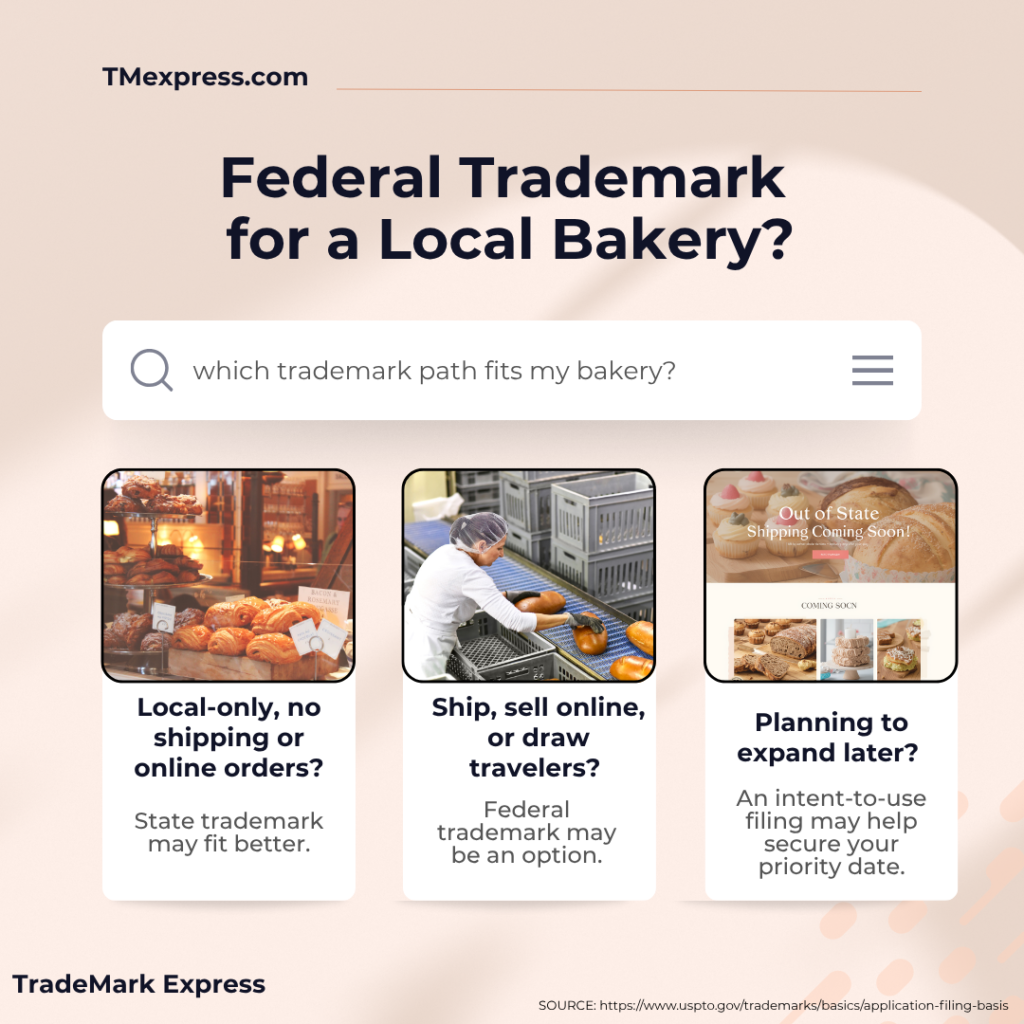
For retail services specifically, the USPTO looks at whether your bakery’s services involve interstate commerce in some demonstrable way.
This is typically satisfied if you ship goods out of state, take online, or mail orders from customers in other states, or regularly serve out-of-state or international travelers and tourists.
A bakery near a state line, a tourist destination, or a well-traveled highway often has an easier case for this than a shop that draws only its immediate local neighborhood.
If your bakery is genuinely local, with no online ordering, no out-of-state shipping, and no meaningful out-of-state or tourist customer base, and you expect that to stay true, a state trademark registration may be the better fit rather than a federal filing.
If you anticipate adding online ordering and out-of-state shipping down the road, an intent-to-use filing may let you get in line for the name federally now, ahead of that expansion. Either way, this is worth discussing with whoever is preparing your application.
Comprehensive Trademark Search Before You File
Before you file anything, run a comprehensive trademark search. This search checks the USPTO/Federal trademark database, state filings, and common law sources (like business directories and social media) for names similar to yours, across every class that might apply to your bakery.
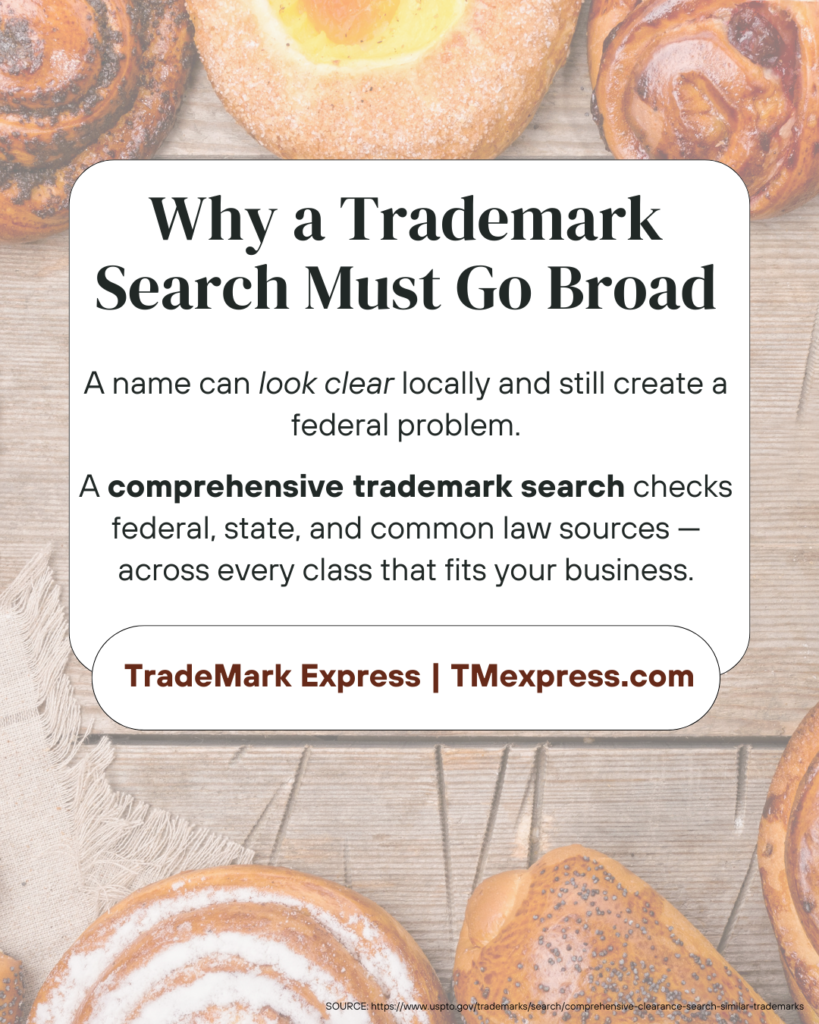
Skipping this step is one of the most common — and costly — mistakes bakery owners make. A name might look clear in your local market but still create a problem at the federal level. For example, a bakery in Austin might choose a name already registered Federally by a bakery in Maine, simply because nobody checked beyond their own city.
If you’re deciding between trademark search services or comparing trademark attorneys, look for a few specific things:
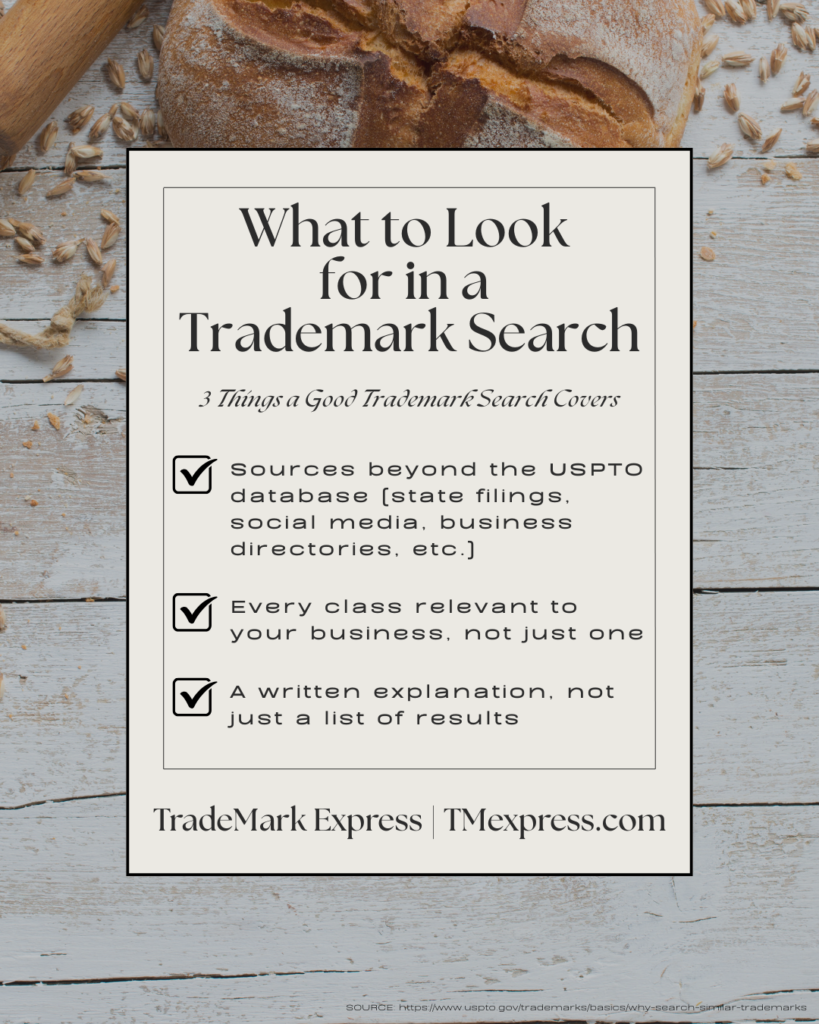
- Coverage beyond the USPTO database. A search limited to federal registrations misses common law users (unregistered businesses already operating under a similar name) and pending applications that haven’t published yet. Ask whether the search includes state trademark filings and common law sources like business directories, social media, and domain registrations.
- Class-by-class analysis, not just a name match. A name can be clear in one class and conflict in another. Make sure whoever runs your search reviews every class relevant to your bakery, not only the class you assume applies.
- A written explanation of risk, not just a list of results. A useful search report tells you which results matter, why, and how examining attorneys have treated similar marks in the past. A long list of hits with no analysis isn’t enough to make an informed decision.
Which Trademark Classes Apply to a Bakery
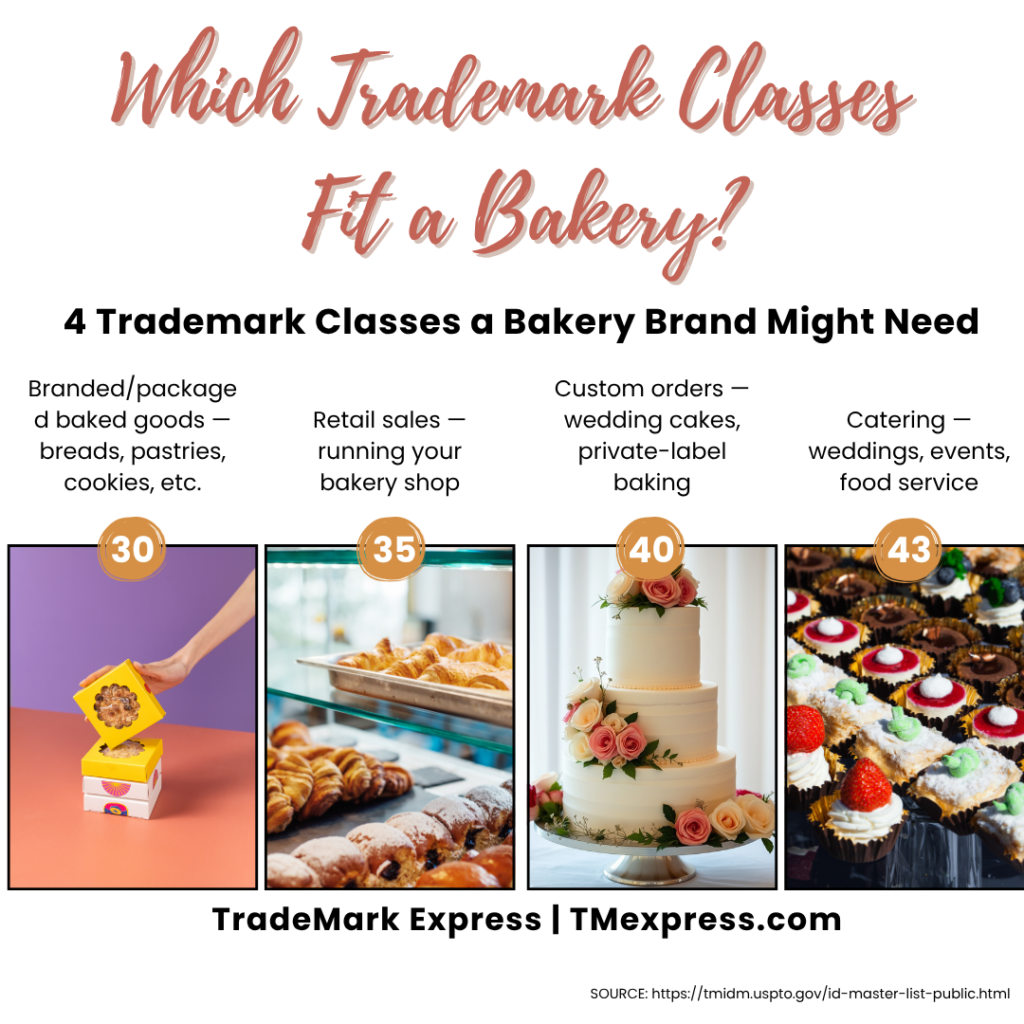
Most bakery brands need to think across several classes, since the USPTO classifies goods and services separately. Filing fees apply per class, currently $350 per class, and you can include multiple classes in a single application through the USPTO’s online filing system, Trademark Center.
Class 30: Bakery Goods
Class 30 covers the branded baked goods themselves. A typical identification might read: “Bakery goods, namely, bread.”
If your bakery specializes in gluten-free or allergen-specific items, be specific. An identification like “Gluten-free desserts, namely, cookies” describes your actual product line and avoids the kind of vague wording that invites an Office Action.
For Class 30, your mark also has to function as a source indicator on the goods themselves, meaning customers need to see it and associate it directly with your baked goods line, not just with the bakery in general.
This is where your specimen comes in: proof that you’re actually using the mark on the goods or their packaging.
As the USPTO explains, “to register your trademark for goods, your specimen might be a photograph showing your trademark on a label or hangtag attached to your goods. It could also be a photograph of your trademark on the packaging for your goods or on the goods themselves. Customers must directly associate your trademark with your goods.”
For baked goods, that typically means your logo or brand name on a box, bag, sticker, or wrapper, not just on your storefront sign or website.
Class 35: Retail Bakery Shops
Class 35 covers retail sales services, including operating a retail bakery shop. This class protects the business of selling baked goods to the public, separate from the goods themselves. If customers walk into your shop or order from your storefront website, Class 35 is typically the right fit.
Class 40: Custom Manufacturing of Baked Goods for Others
Class 40 applies when you make baked goods to a customer’s specifications rather than selling pre-made items off a shelf. A wedding cake designer, a custom cookie business, or a bakery that produces private-label bread for other companies falls under this class.
A precise identification might read: “Custom manufacturing of baked goods in the nature of wedding cakes for others,” naming the specific baked goods you produce on a custom basis.
Class 43: Catering Services Provided by Bakeries
Class 43 covers food and drink services, including catering. If your bakery caters weddings, corporate events, or other functions, this class protects that service separately from your retail sales and your packaged goods.
Watch Out for Descriptive Terms
Names built around descriptive bakery terms face a harder path to registration. The USPTO has long held that a term that’s descriptive for a food or dish sold by a restaurant or café is also considered descriptive of that restaurant’s or café’s services, not just the food itself. This principle applies just as directly to bakeries: a name that simply describes what you sell, like “Sourdough Bakery” for a sourdough-focused shop, is likely to face a descriptiveness refusal.
That said, descriptiveness refusals depend on the evidence in the record. An examining attorney has to show that the term in question is actually used to describe similar goods or services elsewhere; a refusal isn’t automatic just because a name sounds descriptive on its face.

In In re Bayou Grande Coffee Roasting Co., the Federal Circuit reversed a descriptiveness and genericness refusal because the record contained no evidence that any café actually offered the specific beverage at issue.
There, the USPTO had refused to register KAHWA for café and coffee shop services, reasoning that the word refers to a type of Kashmiri tea and tea is something cafés commonly sell. The court disagreed, pointing out that no evidence in the record showed any U.S. café actually selling kahwa specifically — so the term couldn’t be called generic or descriptive of café services without that proof.
This same evidentiary standard, that a refusal needs proof, not assumption, applies whenever the USPTO claims a term is generic or descriptive of your goods or services, including a bakery’s. Per TMEP §1209.02, an examining attorney must support any such refusal with appropriate evidence.
This is part of why a comprehensive search and a careful look at existing USPTO treatment of similar terms matters before you commit to a name.
Steps to Trademark Your Bakery Brand
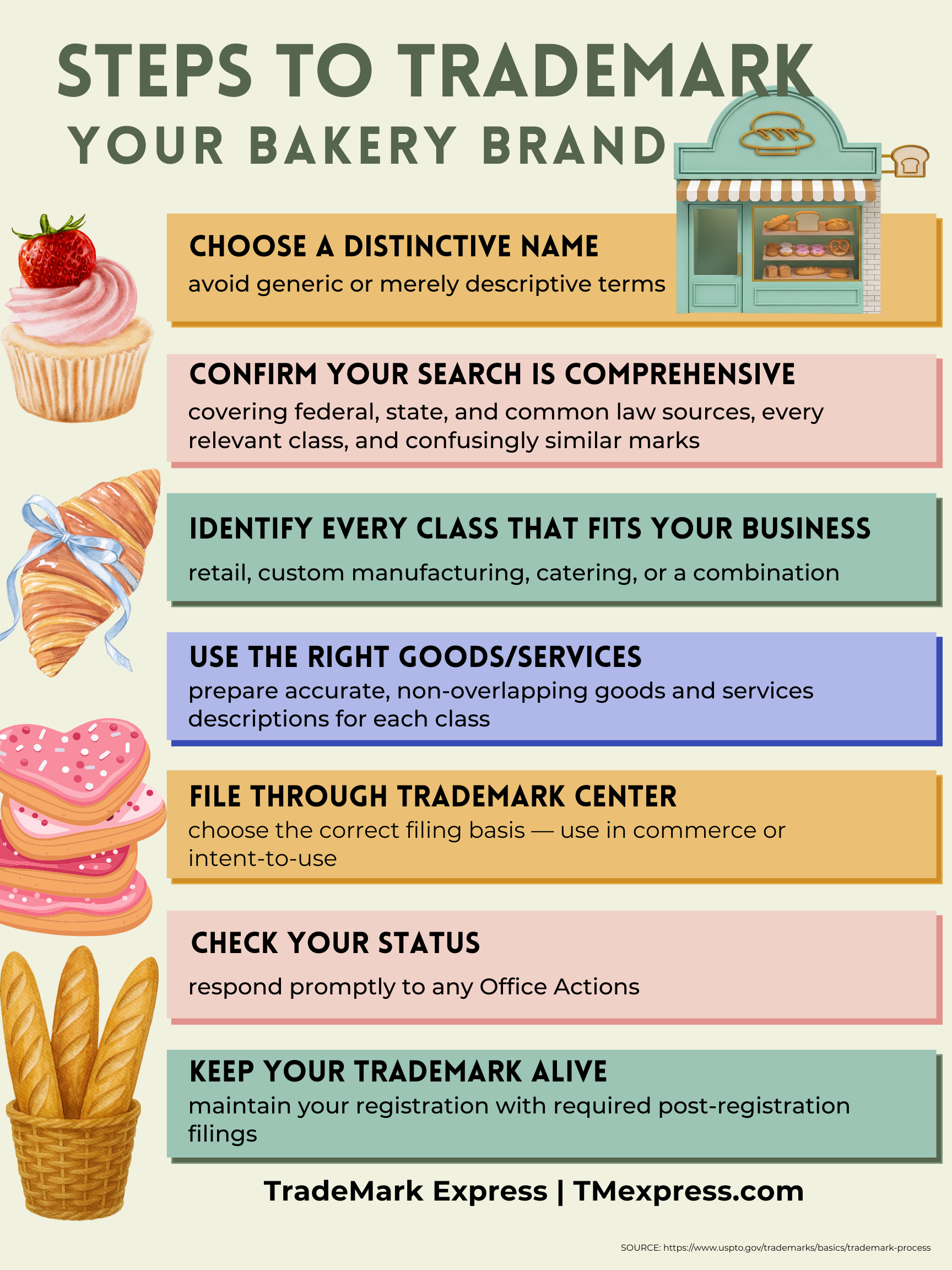
- Choose a distinctive name. Names that are suggestive, arbitrary, or fanciful register more easily than descriptive ones. It is not possible to trademark a generic mark.
- Confirm your trademark search is comprehensive. Whether you work with a trademark service or trademark attorney, make sure the search covers federal, state, and common law sources — not just the USPTO database — and checks every class relevant to your bakery, not only the obvious one — and looks for marks that may be seen as confusingly similar.
- Identify every class that applies to your specific business model, whether that’s retail, custom manufacturing, catering, or a combination.
- Prepare your application with accurate, non-overlapping goods and services descriptions for each class.
- File through Trademark Center, the USPTO’s online filing system, choosing the correct filing basis: use in commerce if you’re already selling under the name, or intent-to-use if you haven’t launched yet.
- Respond promptly to any Office Actions if the USPTO raises questions about your application.
- Maintain your registration with the required post-registration filings to keep it active.
Industry-Specific Considerations for Bakery Brands
Bakeries often grow in ways that change their trademark needs over time. A shop that starts with walk-in retail sales might add a custom cake division, start catering local events, or begin supplying wholesale accounts to grocery stores or cafes. Each of these additions can introduce a new class.
It’s worth reviewing your trademark coverage whenever your business model expands, rather than assuming your original registration covers every direction your bakery takes. A bakery that registered only in Class 30 for its packaged cookies, for instance, has no trademark protection for its catering services if it starts booking weddings under the same name.
Seasonal and limited-run products are common in this industry too. If a seasonal item becomes a signature part of your brand identity, consider whether it deserves its own protection or falls within your existing goods description.
FAQ
Do I need more than one trademark class for my bakery? It depends on how your bakery operates. If you only sell baked goods in-store or through a retail website, Class 35 (retail bakery shops) may be your main class. If you also sell branded, packaged goods that display your mark directly, take custom orders like wedding cakes, or cater events, you’ll likely need Class 30, 40, or 43 as well. A trademark service or attorney can help you understand which classes match your actual business.
Can I trademark a bakery name that describes what I sell? Names that simply describe your products, like “Fresh Bread Bakery,” are harder to register because they’re considered descriptive. A distinctive or suggestive name has a much smoother path through examination.
How much does it cost to trademark a bakery? The USPTO filing fee is $350 per class. Depending on how your bakery operates, you may need to file in more than one class. Total costs also depend on whether you handle the application yourself or work with a trademark service or attorney.
Should I trademark my bakery before or after I open? You can file based on intent-to-use before you open, which can help secure your name early, or based on use in commerce once you’re operating. Filing earlier under intent-to-use can prevent another business from claiming the name first.
What’s the difference between Class 30 and Class 40 for a custom cake business? Class 30 covers branded, packaged, or boxed goods that clearly display your mark, like a labeled box of cookies sold at retail. Class 40 covers the service of manufacturing baked goods to a customer’s specifications, which is the more accurate fit for custom orders like wedding cakes, where the goods themselves typically aren’t sold pre-packaged under your mark.
Protect Your Bakery Brand the Right Way
Choosing the right classes and writing accurate goods and services descriptions takes more than a quick search of your own business name.
TradeMark Express provides comprehensive trademark research across every class your bakery might need, along with application preparation assistance to help you file with confidence. If you’d like legal guidance on a specific refusal risk or descriptiveness issue, our trademark attorney referral network can connect you with an attorney who can advise on your situation.