
How to Trademark Your SaaS Brand
To trademark a SaaS brand, you file for protection in the class covering software-as-a-service — typically USPTO Trademark Class 42, which covers software provided online and complete a comprehensive trademark search first to confirm your brand name is available.
The process follows the same general path as any trademark application, but SaaS products have specific considerations around how use in commerce is established, what counts as an acceptable specimen, and when you can file.
Here is what you need to know.
Why Trademark Protection Matters for SaaS Companies
Your SaaS brand name is one of your most valuable business assets. It is how customers find you, recognize you, and trust you. Without federal trademark registration, you have limited tools to stop a competitor from launching under a confusingly similar name — especially as your product scales across markets.
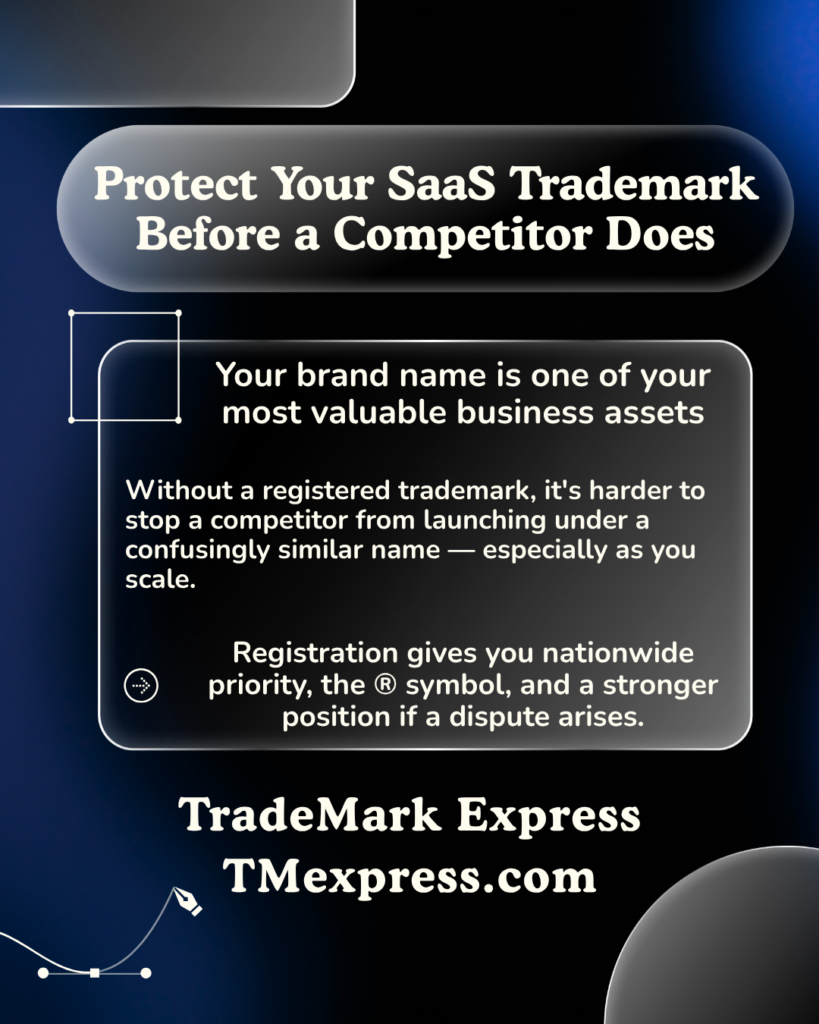
A registered trademark gives you nationwide priority, the right to use the ® symbol, and a presumption of ownership that can strengthen your position in a dispute. It also makes it significantly harder for another company to register a similar name and easier to enforce your rights if they try.
Run a Trademark Search Before You File
Before you invest time and money into a trademark application, you need to confirm that your brand name is actually available to register and use. A comprehensive trademark search looks beyond the USPTO database to include state trademark registrations, common law use, and similar names in adjacent markets.
This matters more for SaaS brands than many people expect. The software industry is crowded, and names that seem distinctive in one vertical may already be in use — or registered — in another.
A thorough trademark search can identify conflicts before you file, not after.
If your search comes back clear, you can move forward with confidence. If the search turns up a potential conflict, you can address it early — whether that means adjusting your name or consulting with a trademark attorney about your options.
What Trademark Class Covers a SaaS Brand
SaaS Belongs in Class 42
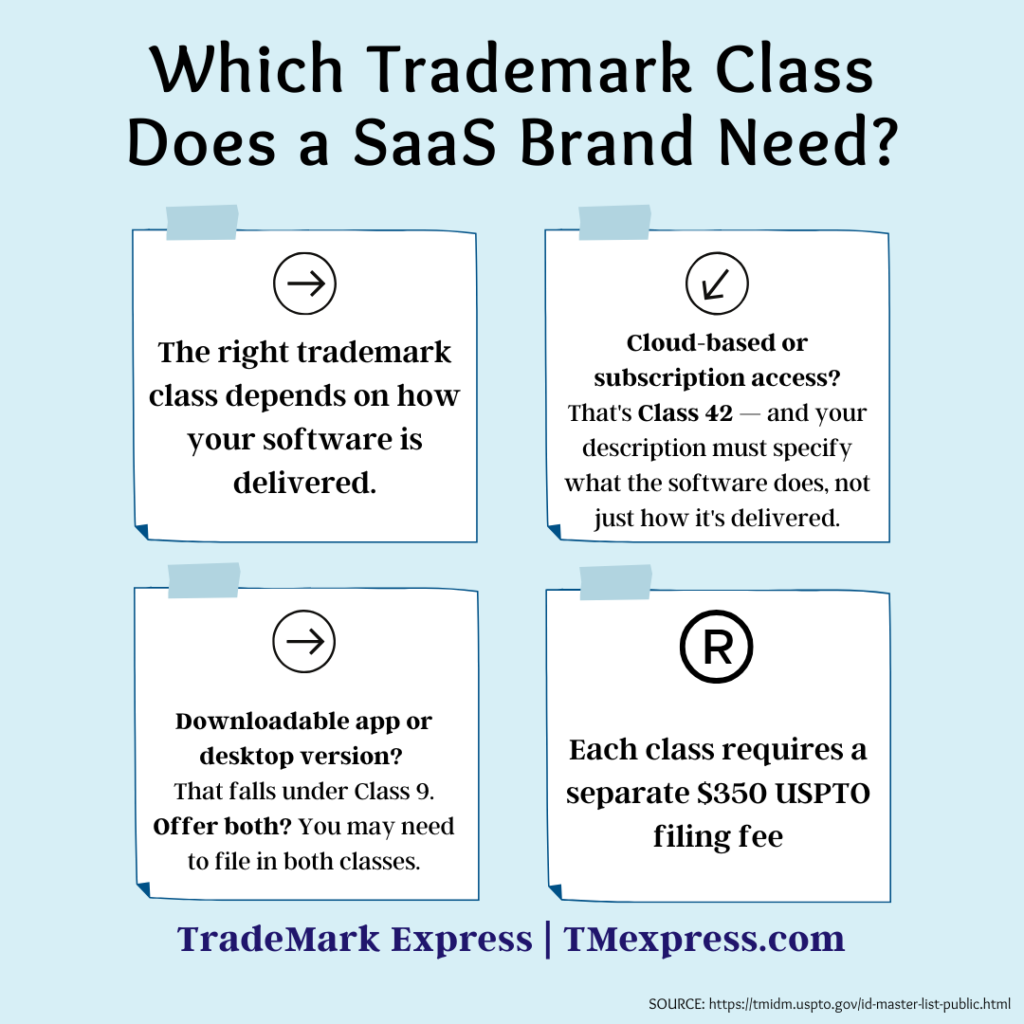
Trademark Class 42 covers software provided as a service — meaning software that users access online rather than download and install. If your product is browser-based, subscription-delivered, or accessed through a hosted platform, Class 42 is the right home for your application.
Your identification of services in Class 42 should describe what your software actually does. A vague description like “software as a service” alone is not sufficient. The USPTO expects specificity — for example, “Software as a service (SaaS) featuring software for project management” or “Software as a service (SAAS) services featuring software for computer-aided diagnostic testing services for the automotive industry” – in regards to specifying the function and the content/field of use.
When Class 9 May Also Apply
If you offer a downloadable version of your product — a desktop app, a mobile app, or an installable component — that falls under Class 9, which covers software in downloadable form. Many SaaS companies offer both a hosted web version and a downloadable app, which means they may need to file in both Class 9 and Class 42 to fully protect their brand.
Each class requires a separate $350 USPTO filing fee.
Use in Commerce for SaaS Brands
Use in commerce is a core concept in U.S. trademark law. It means you are actively using the mark in connection with the sale or delivery of your services in the normal course of business. For a SaaS brand, that generally means the software is accessible to paying customers — or at a minimum, to users actively receiving the service — and you are using the brand name in connection with that offering.
What Counts as Use in Commerce for SaaS
For services like SaaS, use in commerce is established when the service is rendered to customers in interstate commerce. This does not require a massive user base. It does require that the service is genuinely available and being used under your brand — not just described on a website or sitting behind a waitlist.
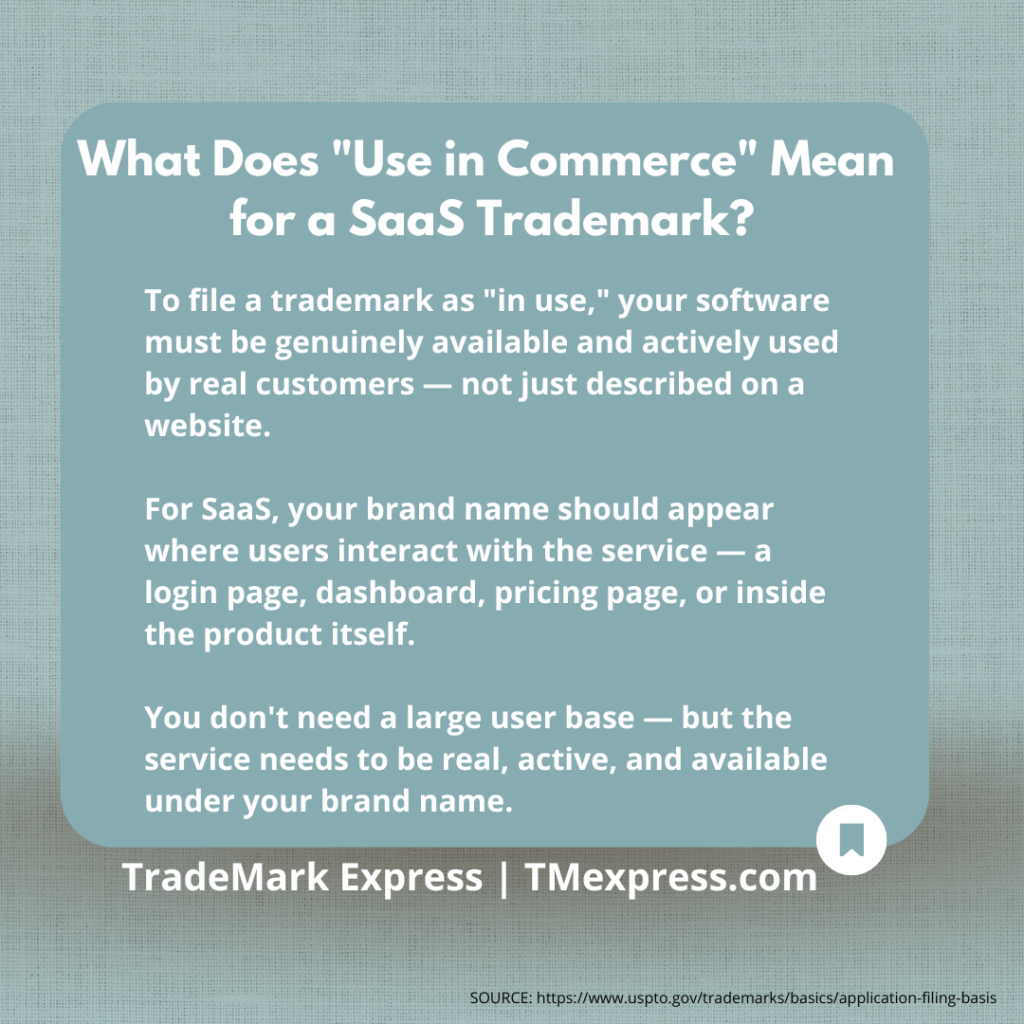
The mark also needs to appear in connection with the service itself. For SaaS, that typically means the brand name appears on your login page, dashboard, pricing page, or within the product interface in a way that associates the name with the service being delivered.
Is a SaaS Product in Beta "In Use" for Trademark Purposes?
This is one of the more nuanced questions for SaaS founders, and the answer depends on the nature of your beta.
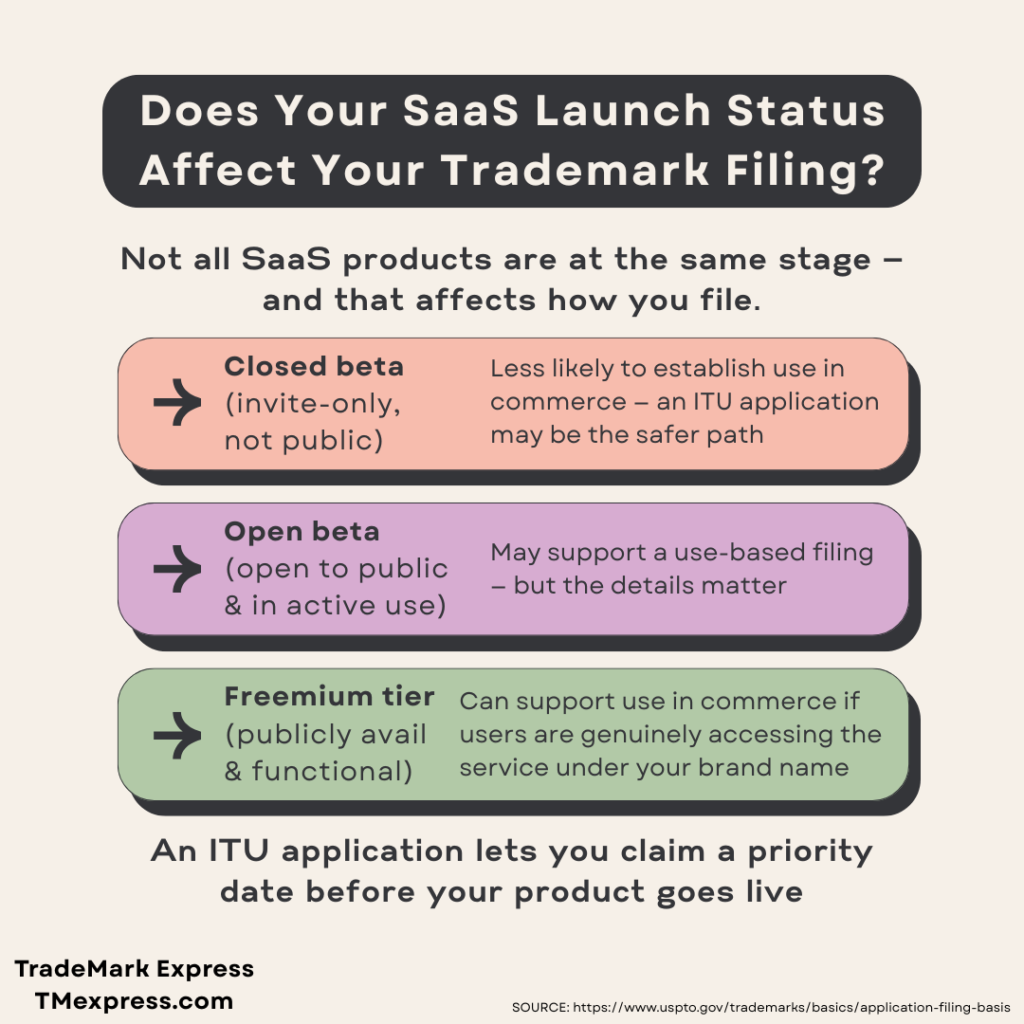
A closed beta that is free, invitation-only, and not open to the public generally does not establish use in commerce for trademark purposes. The service is not yet being rendered to customers in the normal course of business — it is being tested. An application filed as “in use” based solely on a closed beta may face challenges.
An open beta that is publicly accessible, where users are actively using the service — even if it is free or in a pre-launch pricing phase — is more likely to qualify, but the facts matter. The USPTO looks at whether the service is genuinely available to the public and whether the mark is being used in a way that associates it with that service.
If your product has not launched publicly yet, the safer path is to file an intent-to-use (ITU) application. An ITU application lets you claim a filing date — and establish priority — before your product goes live. You will need to show actual use before your registration is finalized, but your priority date runs from the day you file, not the day you launch.
Freemium Models and Use in Commerce
Offering a free tier does not automatically disqualify your SaaS brand from establishing use in commerce. What matters is whether the service is genuinely available to users and whether you are using the mark in connection with it. A freemium product that is publicly accessible and actively used can support a use-based application.
That said, the service needs to be real and functional — not just a sign-up page or a placeholder experience. If your free tier delivers actual value and users can access the software under your brand name, that generally supports use in commerce.
How to File a Trademark Application for a SaaS Brand
Choose Your Filing Basis
Before you file, determine whether your SaaS product is already live or still in development.
If the product is publicly available and you are already using the brand name in connection with delivering the service, you can file on a use-in-commerce basis. You will need to submit a specimen — proof that your mark is in use — at the time of filing.

If the product is not yet live, file an intent-to-use application. This secures your priority date early. Once your product launches and you establish use in commerce, you file a Statement of Use (SOU) to convert your application to a full registration.
What Makes a Good Specimen for a SaaS Application
A specimen for a Class 42 SaaS application must show the mark being used in connection with the actual delivery of the service. Screenshots of your website are commonly used, but they need to show more than just your brand name — they need to connect your mark to the service itself.
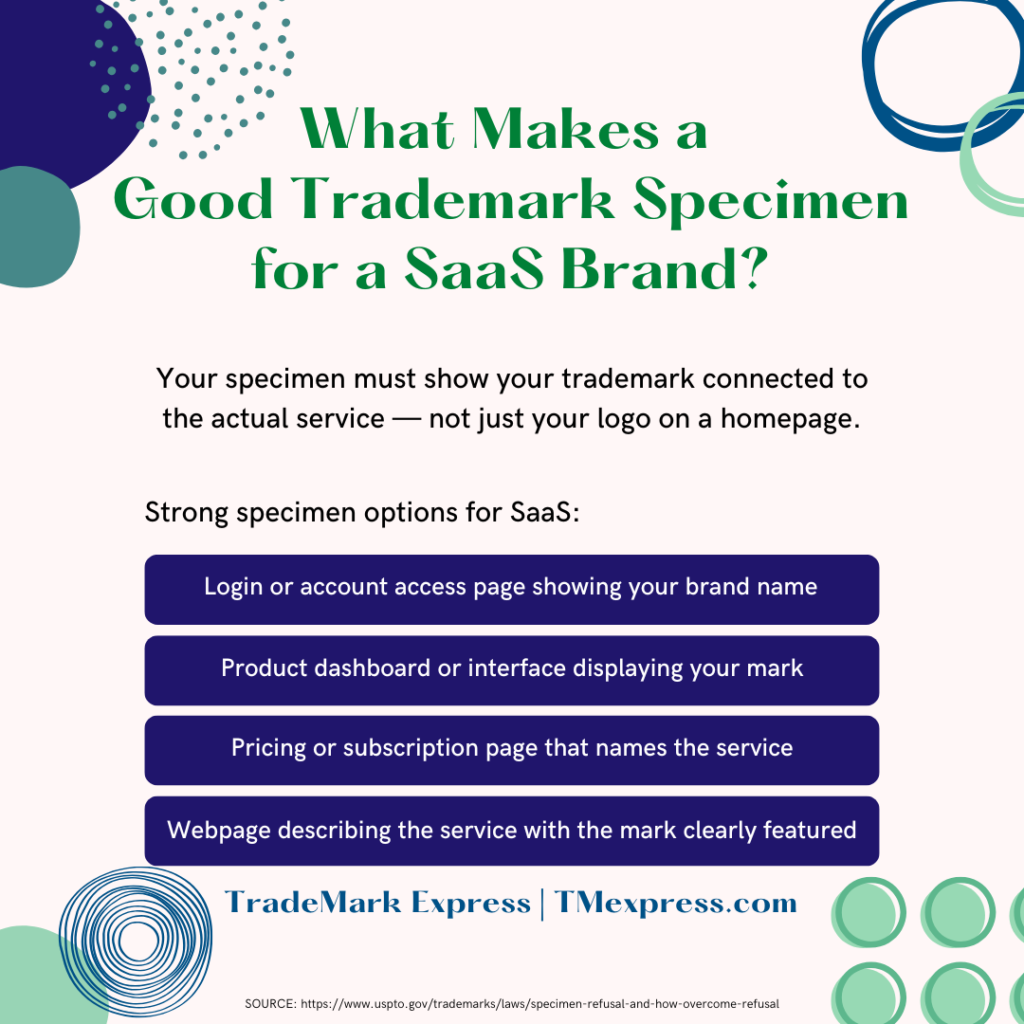
Acceptable specimens for SaaS typically include:
- A screenshot of your login or account access page showing your brand name
- A screenshot of the product dashboard or interface displaying your mark
- A pricing or subscription page that names the service and shows how it is offered
- A webpage that describes the service in detail and features the mark in connection with it
A homepage with just your logo and tagline may not be enough on its own. The specimen should make clear that the service is available and that users access it under your brand name.
The Application Itself
When you are ready to file, you will complete your application through the USPTO Trademark Center. You will need your mark, a description of your services in Class 42 (and Class 9 if applicable), your filing basis, and your specimen if filing based on use.
The USPTO filing fee is $350 per class. If you are filing in both Class 42 and Class 9, that is $700 in filing fees. Budget time as well — the examination process typically takes several months from filing to first action, and the full registration process often takes a year or more.
Industry-Specific Considerations for SaaS Trademark Applications
Brand Names That Describe What Your Software Does
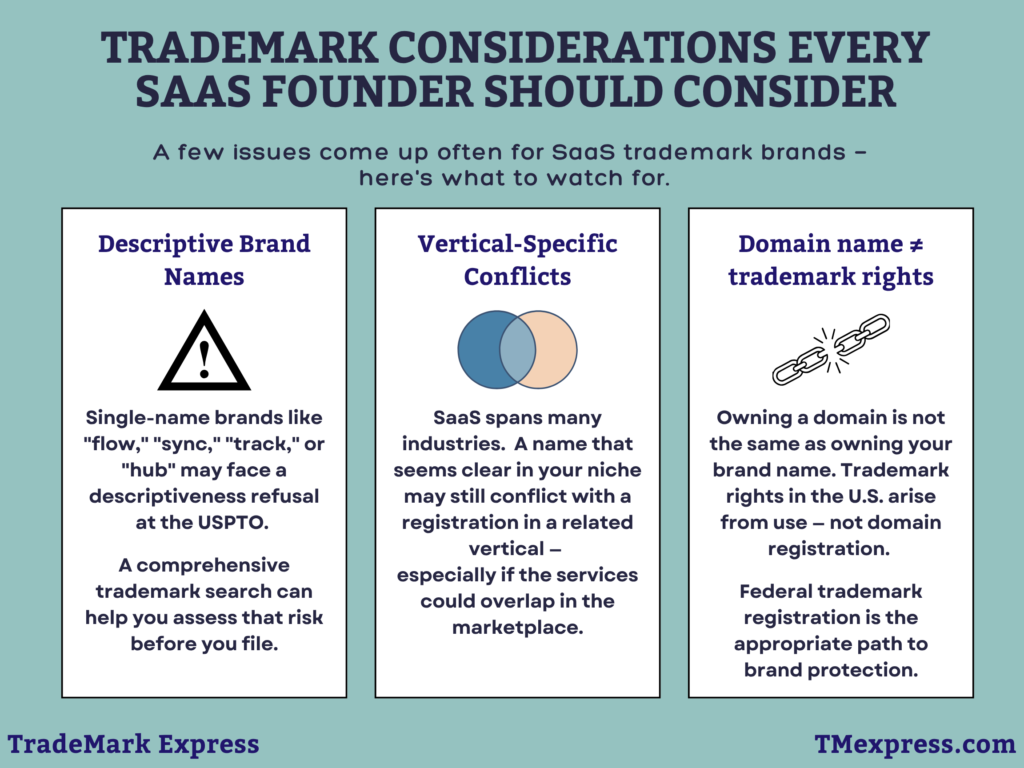
SaaS products often have names that describe their function — think of single-word names like “flow,” “sync,” “track,” “base,” or “hub.” Descriptive names face a higher bar at the USPTO. If your name directly describes a feature or function of your software, the examiner may issue a refusal on descriptiveness grounds.
This does not always mean the name cannot be registered, but it may mean the path to registration is more complex. A comprehensive trademark search can help you assess descriptiveness risk before you file.
Vertical-Specific Conflicts
The SaaS industry spans dozens of verticals — HR, finance, marketing, healthcare, logistics, and more. A name that is clear in one vertical may conflict with an existing registration in another. Because the USPTO evaluates likelihood of confusion across related goods and services, a SaaS brand competing in a different niche than an existing registrant may still face a refusal if the marks are similar and the services could overlap in the marketplace.
Domain Name vs. Trademark
Owning a domain name does not give you trademark rights. A registered domain is simply a web address. In the U.S., trademark rights generally arise from actual use in commerce, and federal registration significantly strengthens those rights. SaaS founders sometimes assume their domain ownership establishes total brand protection — it does not. If you want to protect your SaaS brand name, a trademark registration is the appropriate path.
Frequently Asked Questions
What trademark class does a SaaS product fall under? Most SaaS products fall under Trademark Class 42, which covers software provided online as a service. If you also offer a downloadable version of your software — such as a desktop app or mobile app — you may need to file in Class 9 as well, which covers software in downloadable form.
Can I trademark my SaaS brand name while still in beta? It depends on the nature of your beta. A closed, invitation-only beta that is not yet available to the public typically does not establish use in commerce for trademark purposes. If your product has not officially launched, an intent-to-use (ITU) application lets you secure your filing date before you go live, which you can convert to a full registration once the service is publicly available.
What is a trademark specimen for a SaaS application? A specimen is proof that you are using your brand name in connection with delivering the service. For SaaS, this typically means a screenshot of your login page, product dashboard, subscription page, or a webpage that connects your mark to the actual service users access.
How much does it cost to trademark a SaaS brand? The USPTO filing fee is $350 per class. If you file in Class 42 only, the government fee is $350. If you also file in Class 9 for downloadable software, that adds another $350, for a total of $700 in filing fees.
Protect Your SaaS Brand Before Someone Else Does
The SaaS market moves fast, and brand names get taken quickly. The sooner you start the trademark process, the sooner you establish priority — and the harder it becomes for a competitor to file under a confusingly similar name.
TradeMark Express provides comprehensive trademark research to help SaaS founders evaluate name availability before filing. We also assist with application preparation and connect clients with our trademark attorney referral network when expert guidance is needed.
Start with a comprehensive trademark search to see where your SaaS brand stands.
The information provided on this site is for general informational purposes only. All information on the Site is provided in good faith; however, we make no representation or warranty of any kind, express or implied, regarding the accuracy, validity, or completeness of any information on the Site. The Site cannot and does not contain legal advice. The legal information is provided for general informational and educational purposes only, and is not a substitute for legal advice. Consult a licensed attorney for legal advice.