Beware of Trademark Invoice Scams

You spent months choosing the perfect business name, completed your trademark application, and finally hit submit. Then, just a few days or weeks later, an official-looking letter arrives in the mail demanding payment. Or perhaps it’s an email congratulating you on your trademark approval and asking for one last fee to complete the process.

It looks legitimate. It includes your trademark application number, filing date, and even your company’s name. The letter may feature seals, reference numbers, and legal language that makes it appear to come from an official source.

But there’s one problem.

It’s a scam.

Unfortunately, trademark invoice scams have become increasingly common, targeting business owners at every stage of the trademark process. Some scams ask you to pay for services you don’t need. Others are designed to steal hundreds or even thousands of dollars. The worst part is that many of these invoices look convincing enough to fool even experienced business owners.

Here’s how these scams work, the warning signs to watch for, and what you should do if you receive one.

Why Trademark Owners Are Easy Targets

Unlike many business records, trademark applications are public.

Once a trademark application is filed with the United States Patent and Trademark Office (USPTO), much of the information becomes publicly available. This includes your business name, mailing address, application number, filing date, and the mark you’re trying to register.

Scammers monitor these public records and use the information to create convincing invoices that appear to be connected to your application.

To someone unfamiliar with the trademark process, these letters often seem like another required government fee.

That’s exactly what the scammers are counting on.

How Trademark Invoice Scams Work

Most trademark invoice scams follow the same playbook.

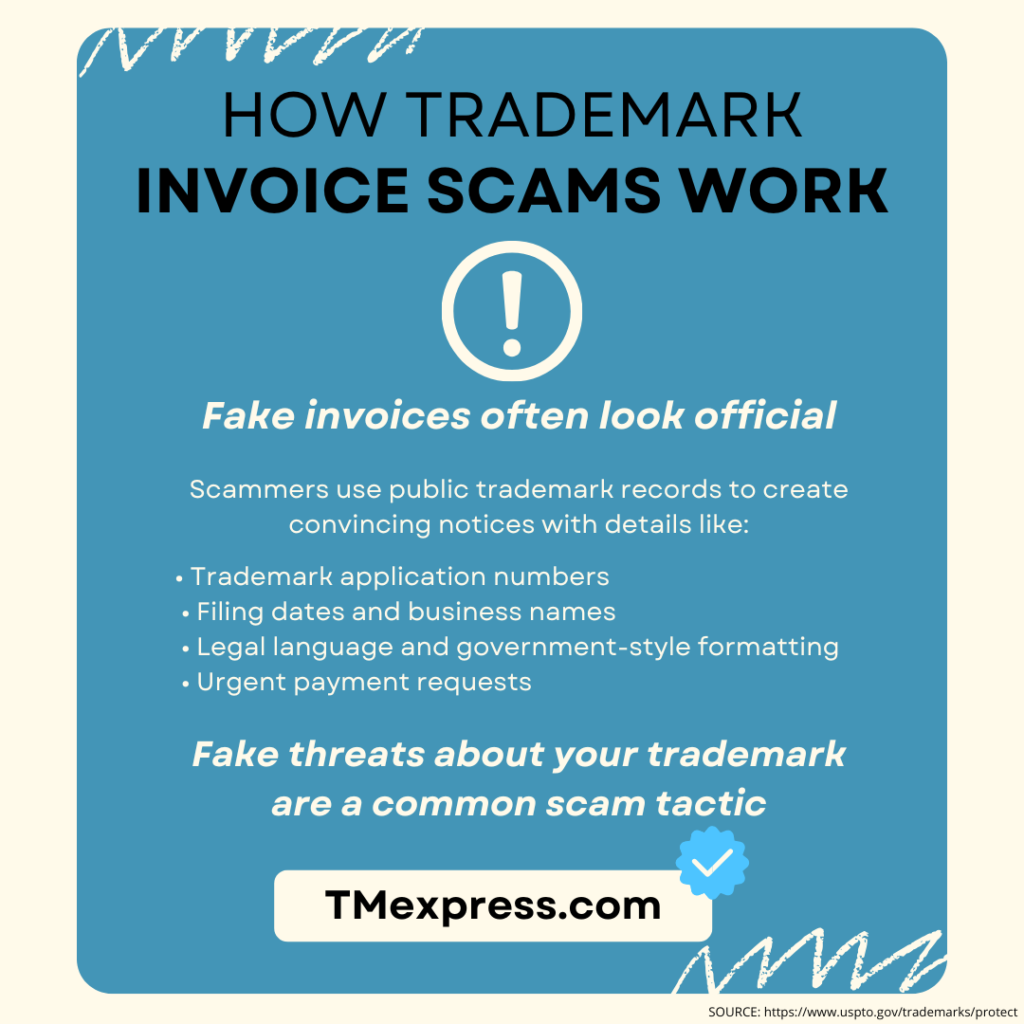
Graphic explaining how trademark invoice scams use official-looking details and urgent payment requests to trick trademark owners

A scammer gathers information from public trademark records and creates an invoice that looks official. The document often includes:

  • Your trademark application number
  • Your filing date
  • Your business name
  • Government-style formatting
  • Legal terminology
  • Reference numbers
  • Urgent payment instructions
  • A short payment deadline

Many invoices demand payment within days to create a sense of urgency. Others claim your trademark could be delayed, canceled, or lose protection if payment isn’t made immediately. Several reported scams requested payment by check, making it more difficult for victims to dispute the transaction later.

Seven Common Trademark Invoice Scams

1. Fake Trademark Publication Fees

One of the most common scams involves a letter demanding payment for a so-called “Trademark Publication Fee.”

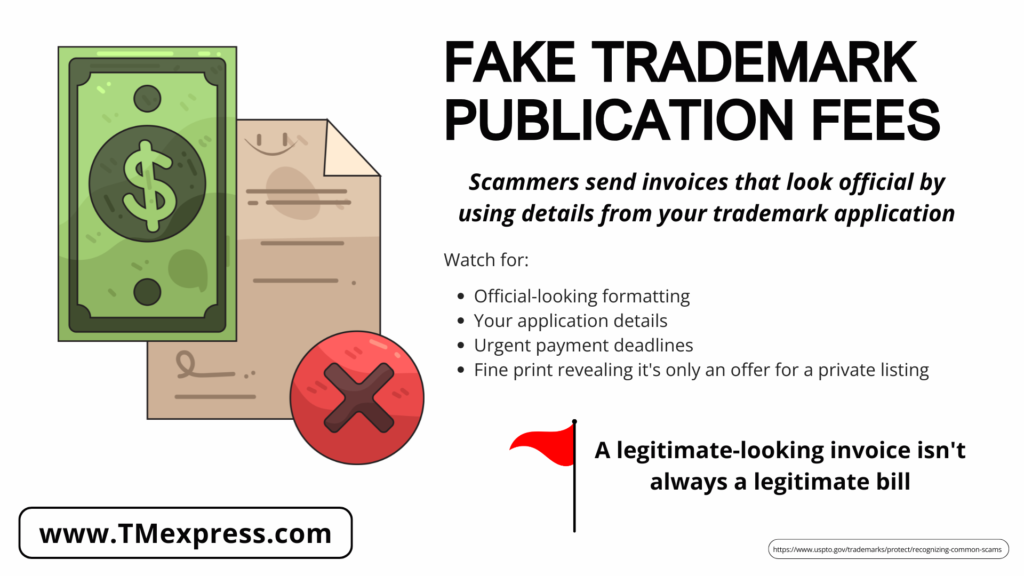
Graphic explaining that fake trademark publication fee invoices often use real application details, urgent deadlines, and hidden fine print to appear legitimate

These invoices often include nearly every detail from your actual trademark application, making them appear legitimate at first glance.

In one reported example, the letter instructed the recipient to pay $1,460 within 10 days. Hidden in tiny print near the bottom was a disclaimer stating that the payment was actually an offer to list the trademark in a private database, not a required government fee.

The average business owner isn’t expecting hidden fine print. They’re expecting a legitimate invoice.

That’s why these scams work.

2. Fake Trademark Renewal Notices

Another popular scam targets both pending applications and registered trademarks with fake renewal notices.

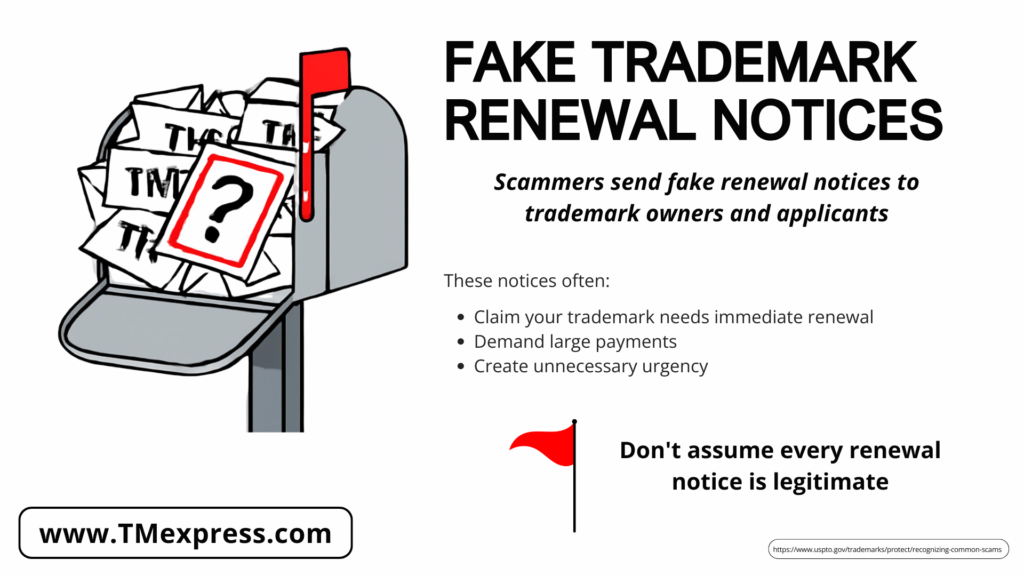
Graphic warning that fake trademark renewal notices often demand immediate payment and use urgency to trick trademark owners

These letters often claim your trademark is due for renewal and demand immediate payment. In one reported case, the recipient received a renewal request followed by another invoice seeking $1,950, payable only by check. After taking a closer look, they discovered the company was using a UPS Store as its listed address and operating a website flagged as unsafe.

Many small businesses simply assume someone is helping them stay compliant.

Instead, they’re paying a scammer.

3. Worthless Trademark Registry Listings

Some companies offer to list your trademark in a private database or registry.

While these businesses may include disclaimers somewhere in the document, the invoices are intentionally designed to resemble bills for required trademark services.

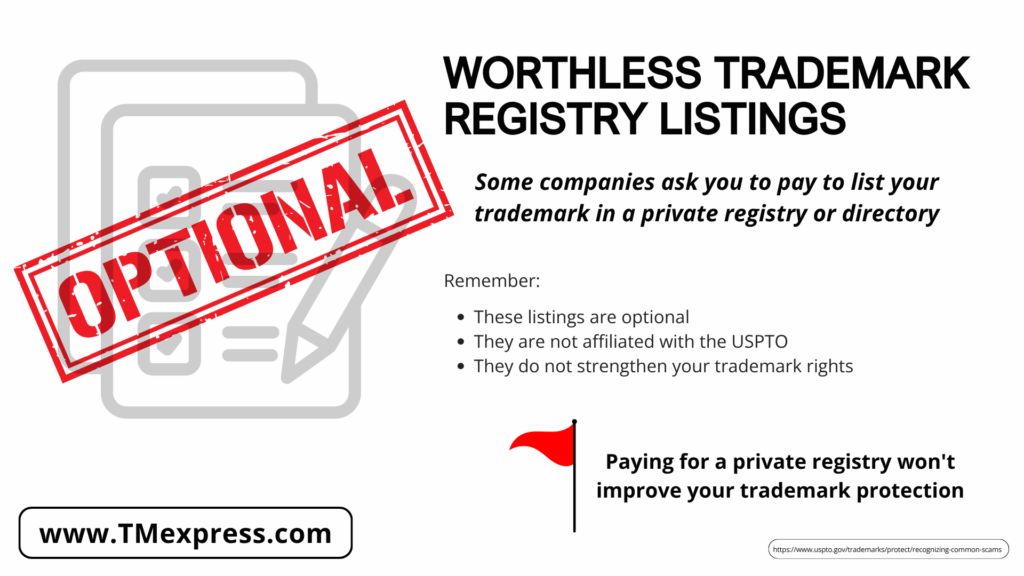
Your trademark rights are not enhanced by paying to have your mark listed in a private trademark directory or registry. These listings are generally optional and are not affiliated with the USPTO. Your federal trademark rights come from your registration with the USPTO, not from being listed in a private database.

Graphic explaining that private trademark registry listings are optional, not affiliated with the USPTO, and do not enhance trademark rights

If you receive an unexpected invoice asking you to pay for a private trademark registry or directory, treat it with caution. These services are not required to obtain or maintain a U.S. trademark registration.

If a company is asking you to pay hundreds or thousands of dollars simply to add your trademark to its registry, that’s a major red flag.

4. Fake Government Agencies

Some scammers don’t pretend to be private companies at all.

Instead, they impersonate government agencies.

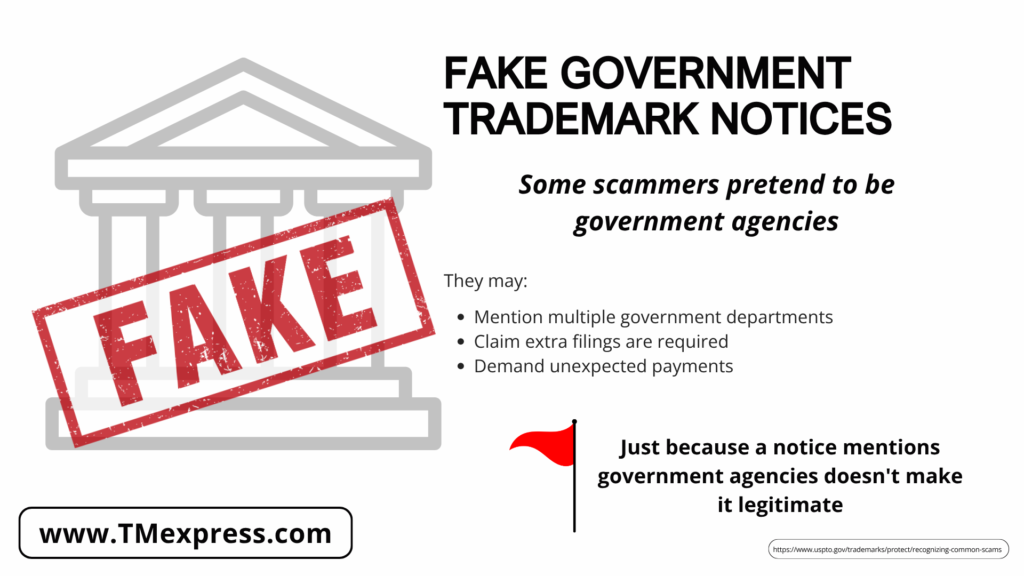
Graphic warning that scammers may impersonate government agencies and falsely claim additional trademark requirements

An email pasted to Reddit congratulated a trademark applicant on their application being accepted by the USPTO before claiming additional “mandatory” attestations were required through the Department of Commerce, Department of State, and Federal Trade Commission. The email demanded a total payment of $999 to complete the process.

The problem?

No such requirement exists.

Scammers know that combining several government agency names makes the request sound more believable.

5. Fake USPTO Emails

Email scams have become increasingly sophisticated.

Some include official-looking logos, professional formatting, and language copied from legitimate USPTO correspondence.

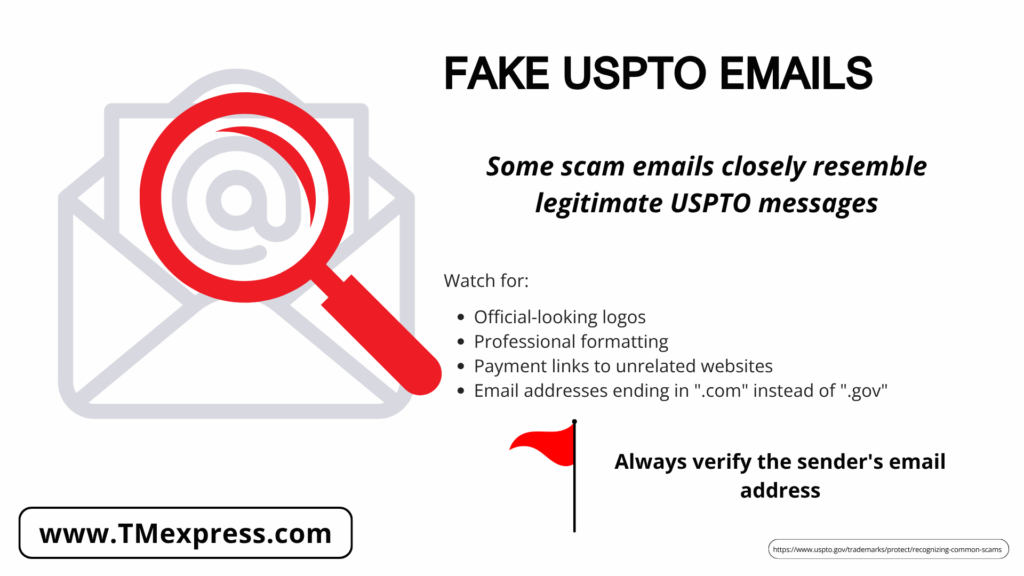
Graphic explaining that fake USPTO emails often use official-looking branding but come from non-government email addresses

In one example, the sender even signed the email as a “Trademark Assistant, USPTO.” However, the email originated from a “.com” domain instead of an official “.gov” address, and the payment link directed recipients to an unrelated website.

That small difference in the website address is often the easiest way to spot a fake.

6. Legal Jargon Designed to Intimidate

Scammers know that most business owners aren’t trademark experts.

That’s why many invoices are filled with legal terminology, references to intellectual property laws, and complicated language designed to make recipients feel they shouldn’t question the request.

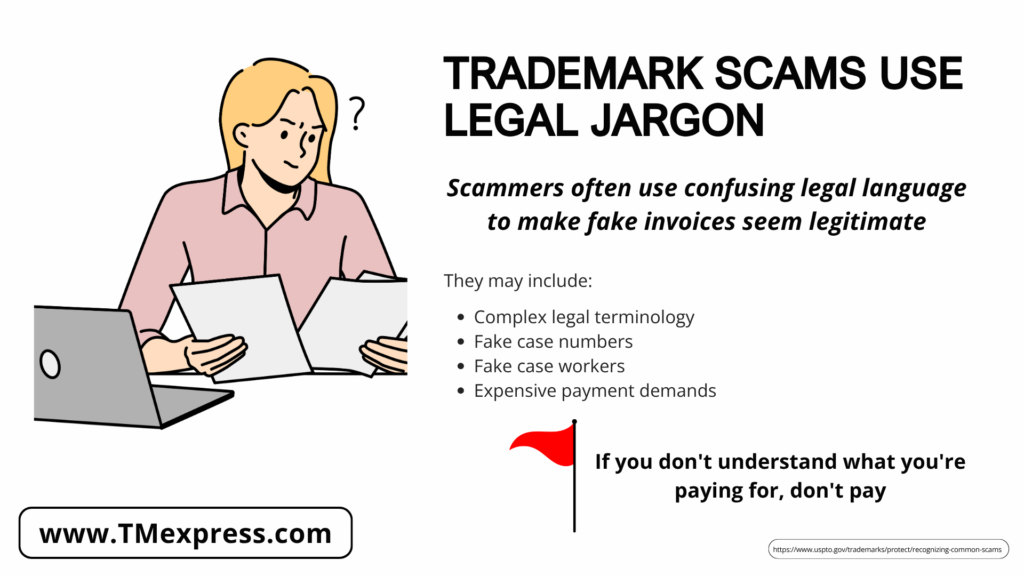
Graphic explaining that scammers use legal jargon, fake case numbers, and confusing language to pressure trademark owners into paying

Some victims reported being assigned fake case numbers and even fake case workers while being pressured to pay more than $1,000 for services that were never provided.

If you don’t fully understand what you’re paying for, stop before sending payment.

7. Fine Print That Changes Everything

One of the oldest tricks is also one of the most effective.

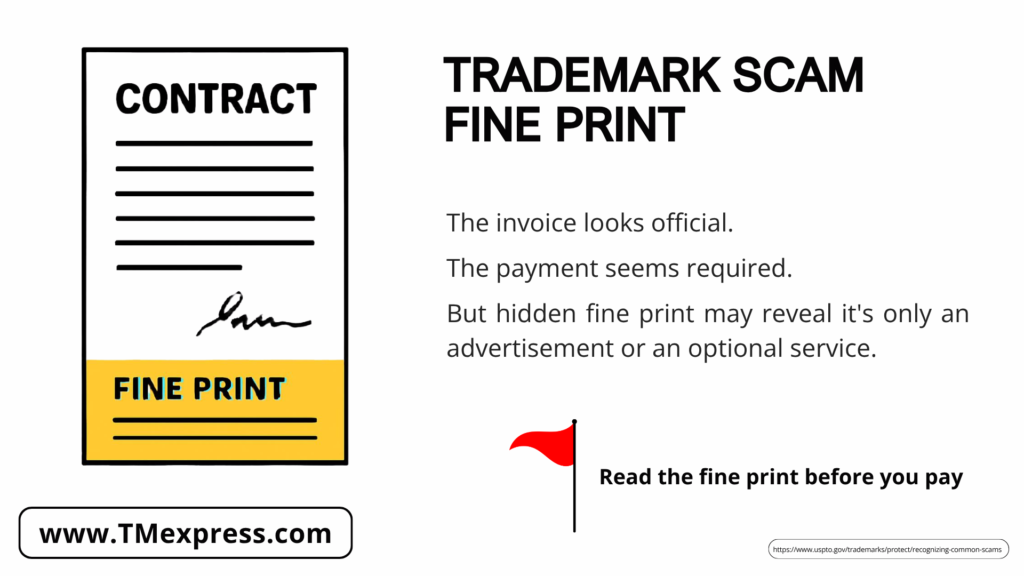
Graphic warning that fine print on trademark scam invoices may reveal the document is only an advertisement or offer for optional services

The invoice looks official.

The payment deadline looks urgent.

The amount appears mandatory.

But buried in tiny print is language stating that the document is actually an advertisement or an offer for optional services.

Most people never see it.

Scammers rely on recipients assuming the document is a bill rather than reading every line carefully.

Red Flags That Should Raise Concern

While every scam is different, most share several warning signs.

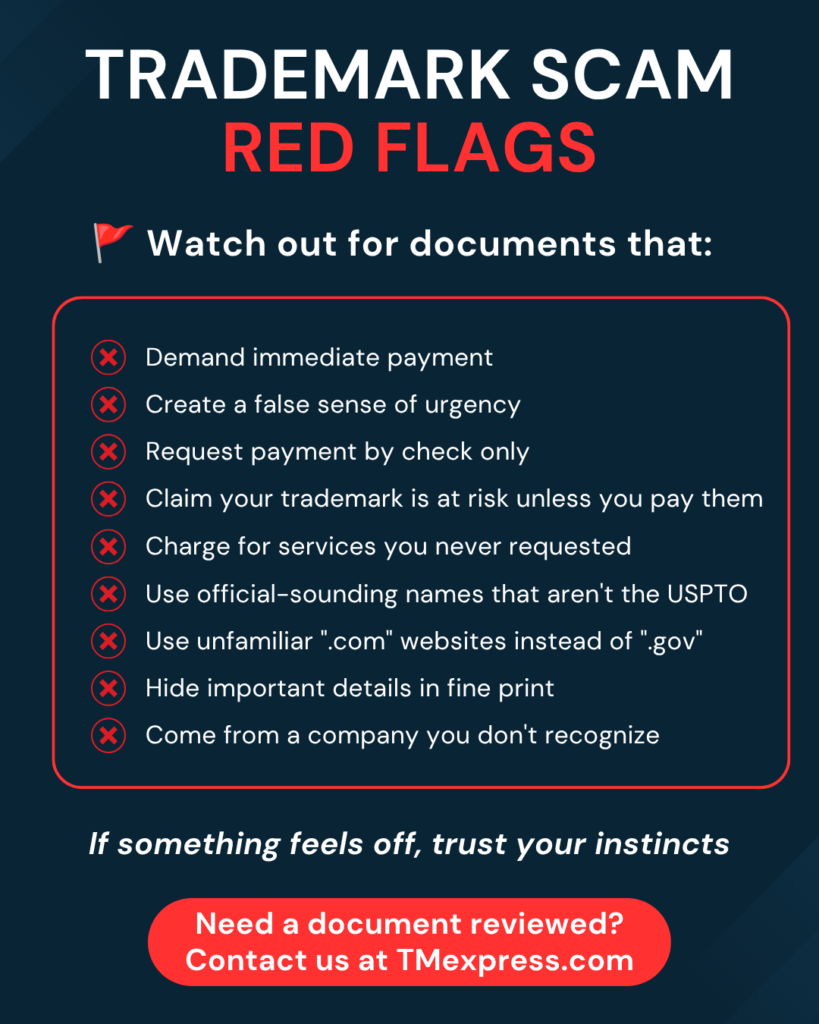
Watch for documents that:

  • Demand immediate payment.
  • Create a false sense of urgency by requiring payment within just a few days for an unexpected or unfamiliar fee.
  • Request payment by check only.
  • Claim your trademark will be canceled unless you pay them directly, especially if they aren’t the USPTO or the trademark professional handling your application.
  • Ask you to pay for publication, registration, or listing services you’ve never requested.
  • Use official-sounding names that aren’t the USPTO.
  • Include unfamiliar website addresses ending in “.com” instead of “.gov.”
  • Hide important information in very small print.
  • Arrive from a company you’ve never worked with.

If something feels off, trust your instincts.

Infographic listing common trademark scam red flags, including urgent payment demands, unfamiliar companies, fake government names, .com websites, fine print, and requests to pay for services that weren't requested

How to Verify Whether an Invoice Is Legitimate

Before paying any trademark-related invoice, take a few minutes to verify it.

Ask yourself:

  • Was I expecting this bill?
  • Does it come from the USPTO or from the trademark professional handling my application?
  • Does the sender use an official .gov email address if claiming to represent the government?
  • Can I verify this fee through my USPTO account or by contacting the attorney or trademark company that I hired?

If the answer to any of these questions is no, don’t send payment until you’ve confirmed the invoice is legitimate.

A five-minute phone call could save you thousands of dollars.

What to Do If You Receive a Suspicious Trademark Invoice

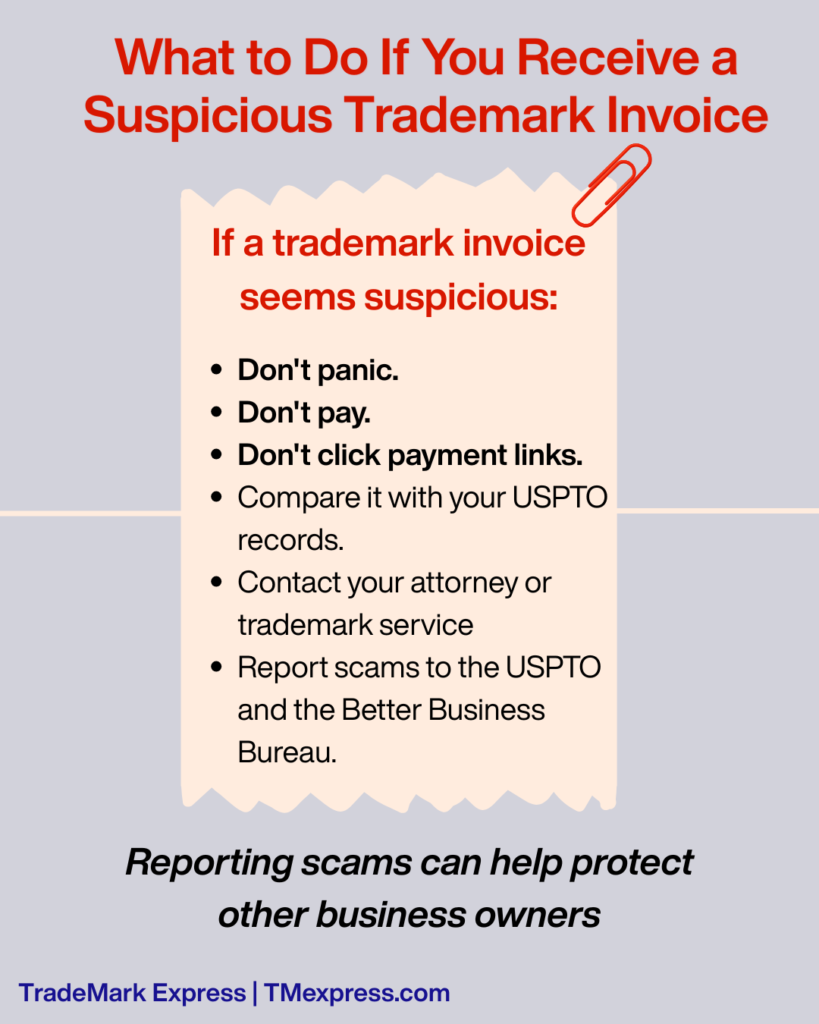
If you receive a questionable trademark invoice:

Infographic explaining what to do if you receive a suspicious trademark invoice, including avoiding payment, verifying the information, contacting your trademark professional, and reporting scams
  1. Don’t panic.
  2. Don’t send payment.
  3. Don’t click payment links. Actually, don’t click ANY links in suspicious emails.
  4. Compare the information with your official USPTO records.
  5. Contact the attorney or trademark service that helped you file your application.
  6. Report obvious scams to the appropriate authorities, including the USPTO and the Better Business Bureau.

The sooner these scams are reported, the more likely it is that other business owners will recognize them before becoming victims.

The Bottom Line

Trademark invoice scams aren’t random.

They’re carefully designed to catch business owners during an exciting but unfamiliar process. By using information from public trademark records, scammers can create convincing invoices that look almost identical to legitimate correspondence.

Fortunately, most scams have one thing in common: they fall apart when someone takes a moment to verify the request before paying.

If you’re ever unsure whether a trademark invoice is legitimate, don’t guess.

Ask.

It could save your business hundreds or even thousands of dollars.

Need Help Verifying a Trademark Invoice?

If you’ve received a trademark-related invoice and aren’t sure whether it’s legitimate, TradeMark Express can help point you in the right direction. Whether you’ve received a publication notice, renewal request, registry listing, or another unexpected trademark bill, it’s always better to verify it before sending payment.

If you’re filing a trademark for the first time, our comprehensive trademark search services and application preparation can also help you better understand the trademark process so you’re less likely to become the target of these scams. Contact TradeMark Express today to learn more.

The information provided on this site is for general informational purposes only. All information on the Site is provided in good faith; however, we make no representation or warranty of any kind, express or implied, regarding the accuracy, validity, or completeness of any information on the Site. The Site cannot and does not contain legal advice. The legal information is provided for general informational and educational purposes only, and is not a substitute for legal advice. Consult a licensed attorney for legal advice.
Leave a Comment

Your email address will not be published. Required fields are marked *