How to Trademark an AI Marketing Brand

How to Trademark an AI Marketing Brand

AI marketing brands are booming alongside the rapid explosion of AI in marketing strategies. New platforms and agencies appear constantly, often with similar names, creating both opportunity and brand risk.

Your brand is one of your most valuable assets—it’s how customers find, trust, and recommend you. A trademark helps establish ownership, protects your investment in ads, software, and content, and strengthens credibility with partners and investors. It also provides practical leverage if a competitor uses a confusingly similar name.

Without trademark protection, your brand could be copied, challenged, or blocked just as your business gains traction. Registering a trademark turns your brand from a marketing idea into a protected business asset, giving you confidence to grow and scale.

Step-by-Step Process to Trademark an AI Marketing Brand

Step 1: Choose a Strong Brand Name

Not all names are equal when it comes to trademarks.

The strongest names are distinctive. They do not directly describe what your AI marketing business does. Think of names like Google or HubSpot. They are memorable because they are not literal descriptions.

Understanding Trademark Strength

Trademark strength is often explained using the distinctiveness continuum.

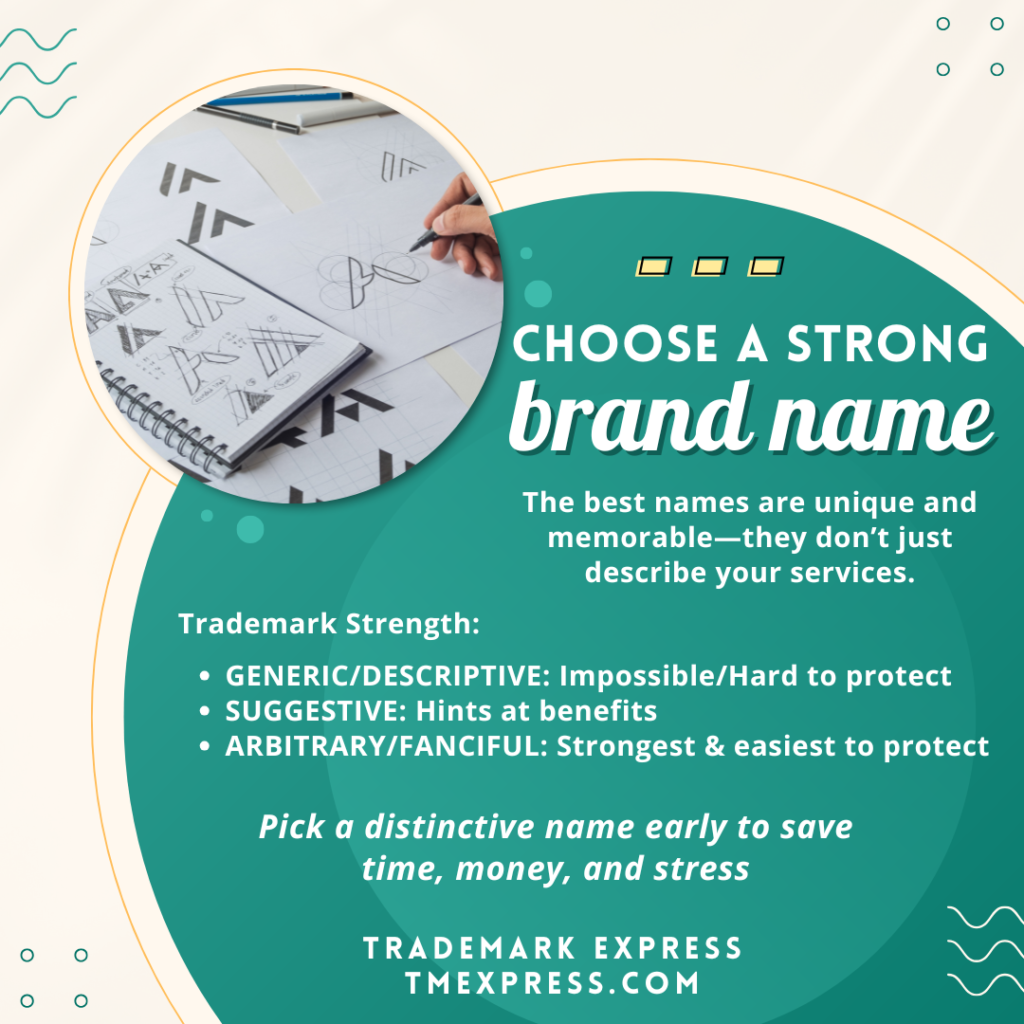
  • Generic or descriptive names explain the service directly and are difficult or impossible to protect.
  • Suggestive names hint at a benefit without spelling it out.
  • Arbitrary or fanciful names are usually the strongest and easiest to protect.
Illustration showing the importance of choosing a strong, distinctive name for a brand, with explanations of generic, suggestive, and fanciful names

For AI marketing brands, this distinction matters. Many founders choose descriptive names because they feel clear.

However, descriptive names are harder to trademark and easier for competitors to copy. Choosing a more unique name early often saves time, money, and frustration later.

Step 2: Conduct Comprehensive Trademark Clearance Research

Before filing, you need to confirm that your chosen name is available.

A proper trademark search looks beyond exact matches. It also reviews names that are similar in sound, appearance, or meaning. Different spellings can still create conflicts.

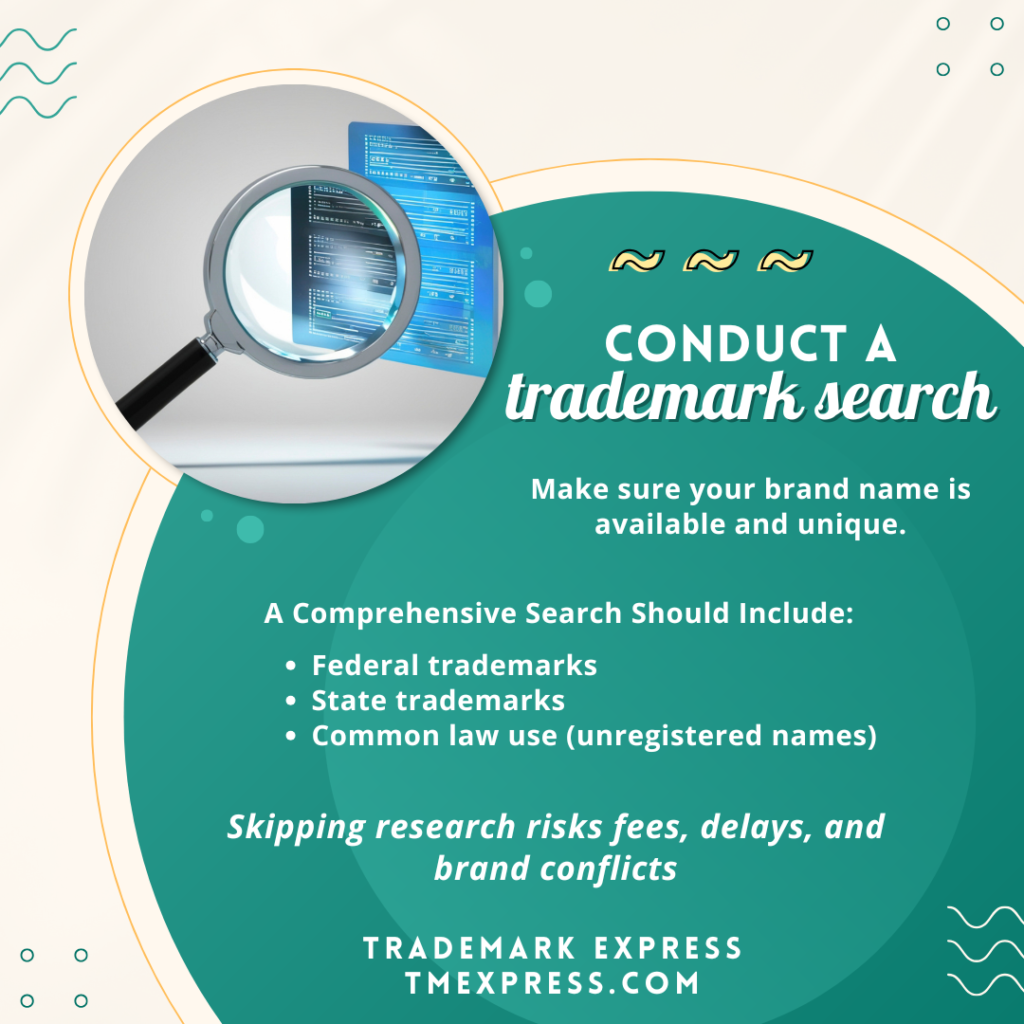
What a Comprehensive Search Covers

Effective clearance research includes:

Common law use is especially important. Many AI marketing brands operate online without registration, yet they can still pose a risk.

Skipping thorough research can be costly. You could lose filing fees, face objections, or discover conflicts after investing heavily in branding.

Graphic illustrating the importance of conducting a comprehensive trademark search for a brand, including federal, state, and common law checks

Why Goods and Services Matter

Trademarks are registered within NICE classes, which group related goods and services.

An AI marketing brand may fall under software goods and/or services, marketing services, or both. Selecting the right classes ensures your protection matches how you actually operate.

For example, an AI marketing brand might file under these NICE classes:

  • Class 009: Downloadable computer software using artificial intelligence (AI) for marketing
  • Class 035: Marketing services
  • Class 042: Software as a service (SAAS) services featuring software using artificial intelligence (AI) for marketing

These are just examples of possible goods and services descriptions. The specific classes and wording should reflect how your business actually operates.

Step 3: File the Trademark Application

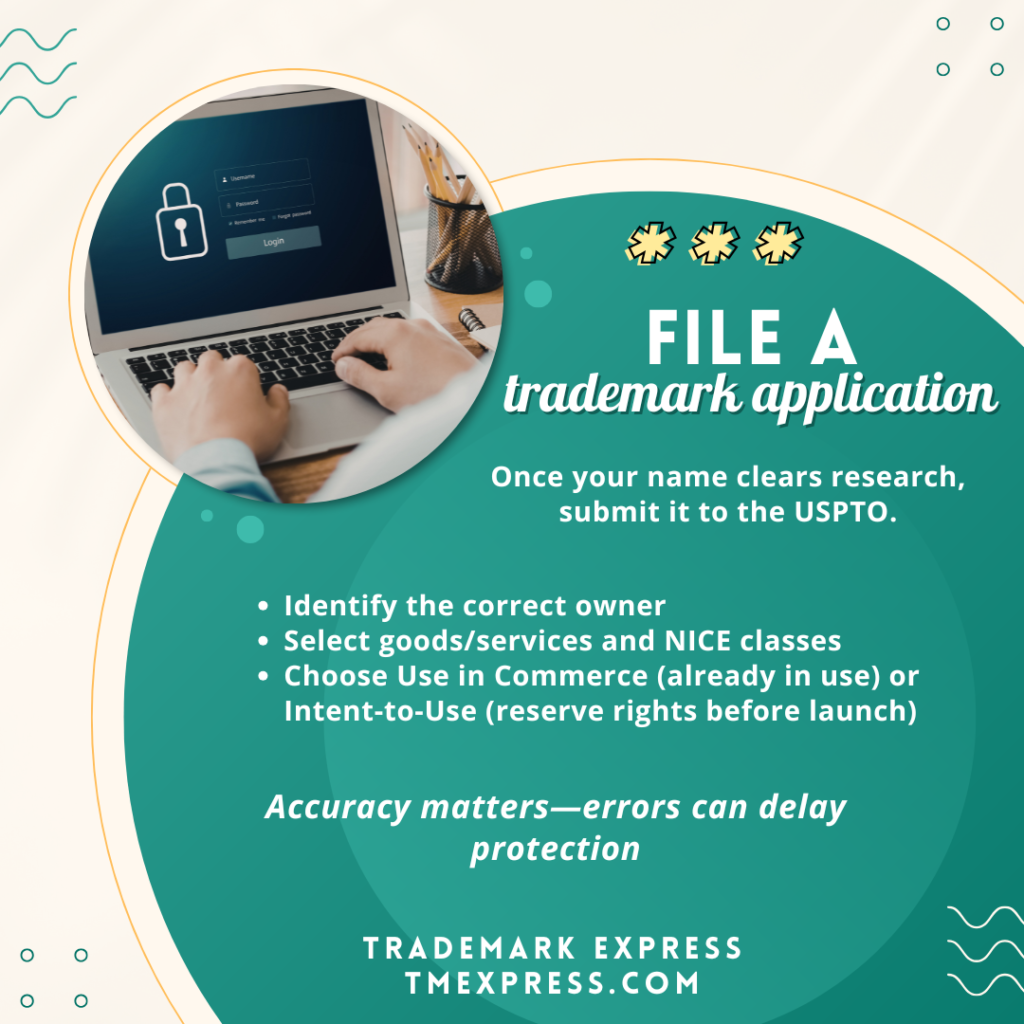
Once your name clears research, the next step is filing a trademark application with the USPTO.

This involves identifying the correct owner, selecting your goods and services, and choosing the appropriate NICE classes. Accuracy here matters, as errors can delay the process or weaken protection.

Use in Commerce vs. Intent-to-Use

When filing, you must also state whether your AI marketing brand is already in use or planned for future use.

Use in commerce means the name is actively used in connection with your services. For example, your AI marketing brand appears on a live website where customers can sign up or request services.

Intent-to-Use (ITU) allows you to reserve rights before launch. This option is common for startups still building their platform or finalizing their go-to-market strategy. ITU filings require additional steps later to show actual use.

Choosing the correct basis matters. Filing as in use without proper evidence can cause delays, while ITU filings require follow-through.

Graphic illustrating the steps to file a trademark application for a brand, including owner, goods/services, NICE classes, and use basis

After filing, a USPTO examiner reviews the application for conflicts and compliance. If issues arise, the examiner may issue an Office Action requesting clarification.

USPTO filing fees vary by application type and number of classes. Because fees change, it is best to reference the USPTO’s current fee schedule directly.

Step 4: Monitor the Trademark Application

Trademark filing is not a one-time task.

After submission, your application moves through examination and publication. Monitoring ensures you respond on time to USPTO notices or deadlines. You also want to watch out for potential infringers – the USPTO office won’t do this for you.

Illustration showing the importance of monitoring a trademark application, tracking deadlines, and responding to USPTO notices to protect your brand

Missing a deadline can result in abandonment and force you to start over. Ongoing monitoring protects your investment and keeps the process moving forward.

Step 5: Maintain Your Registered Trademark

Trademark protection continues only if you meet ongoing requirements.

Between years five and six, you must file a Section 8 Declaration confirming continued use. This keeps your registration active.

After five years of continuous use, you may optionally file a Section 15 Declaration, which can strengthen your registration.

Every ten years, a combined Section 8 and Section 9 renewal is required.

Graphic showing the timeline for maintaining a registered trademark, including Section 8, Section 15, and Section 8 & 9 renewal requirements

Ongoing Brand Care

Proper use and monitoring matter just as much as filing.

Using your mark consistently and watching for potential conflicts helps preserve long-term brand value.

In short, maintenance protects what you worked hard to register.

Industry-Specific Considerations for AI Marketing Brands

AI marketing businesses face trademark issues that do not always apply to traditional agencies.

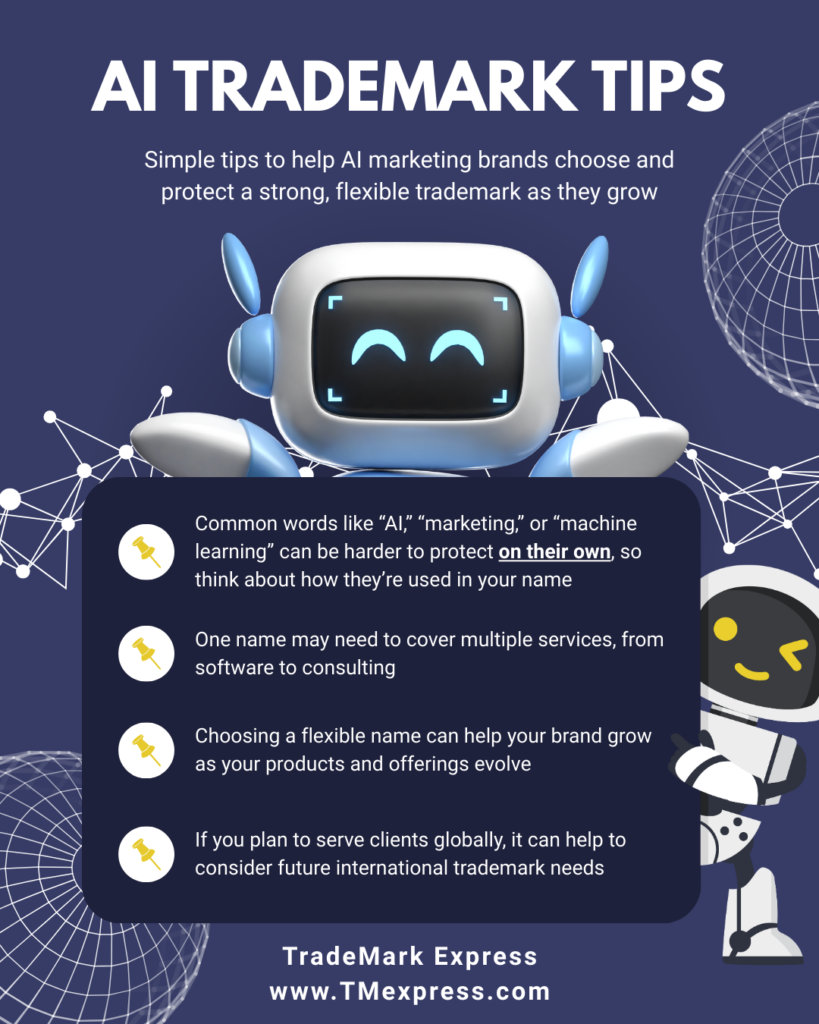
Graphic with trademark tips for AI marketing brands: using common words may be harder to protect, covering multiple services, flexible names, and planning for international trademarks

One common challenge is overusing industry buzzwords. Terms like “AI,” “machine learning,” and “automation” are often descriptive. When used alone, they can weaken trademark protection.

Another issue is overlapping services. Many AI marketing brands offer software tools, consulting, and agency-style services under one name.

Your trademark should reflect how customers experience your brand, not just how you describe it internally.

Technology changes fast, but trademarks are long-term assets. Choosing a flexible name allows your brand to grow beyond your current features or tools.

Many AI marketing businesses also serve global clients early. While a U.S. trademark is a strong starting point, future international expansion should be considered when choosing and clearing a name.

Quick takeaway: Avoid overly descriptive names, plan for service overlap, and think long-term.

Trademark Tips for an AI Marketing Brand

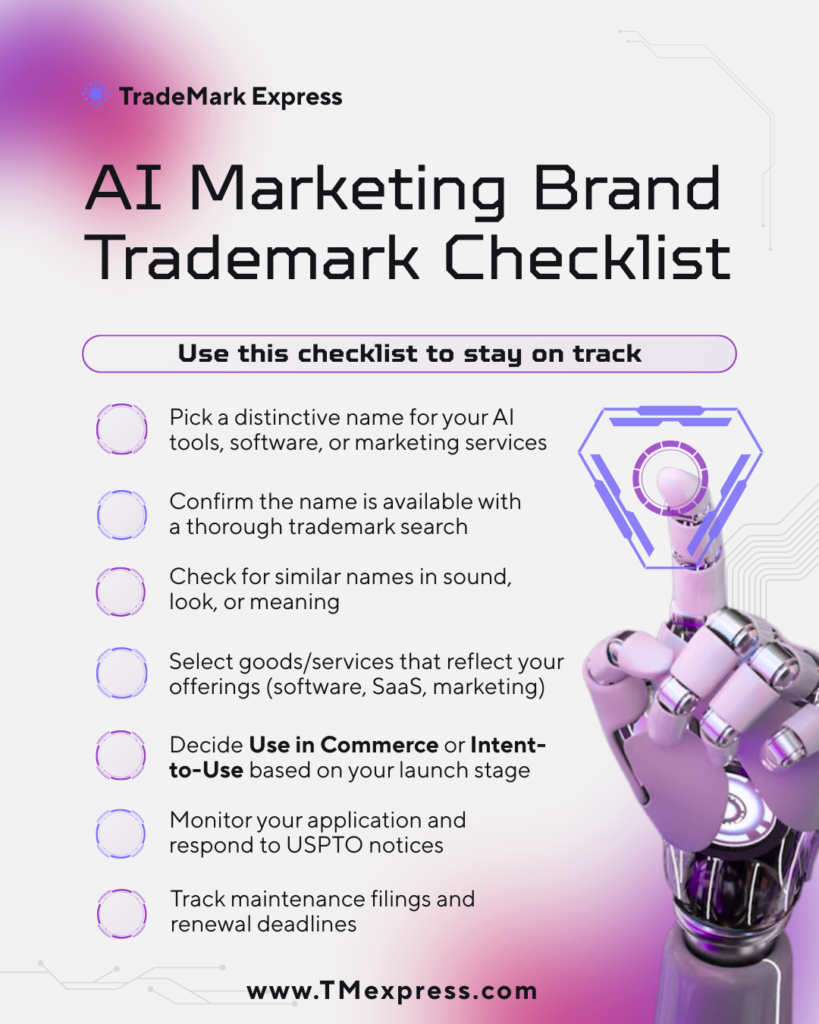
Use this checklist to stay on track when protecting your AI marketing brand:

Graphic showing a step-by-step trademark checklist for AI marketing brands, including choosing a distinctive name, checking availability, selecting services, filing, monitoring, and maintaining the trademark

Ready to Protect Your AI Marketing Brand?

TradeMark Express provides comprehensive trademark research and trademark application preparation. We also work with a trusted network of trademark attorneys when legal guidance is needed.

Order your AI marketing trademark today to secure your brand and start building protection immediately.

DISCLAIMER: References to particular trademarks, service marks, products, services, companies, or organizations appearing on this page are for illustrative and educational purposes only and do not constitute or imply endorsement.
The information provided on this site is for general informational purposes only. All information on the Site is provided in good faith; however, we make no representation or warranty of any kind, express or implied, regarding the accuracy, validity, or completeness of any information on the Site. The Site cannot and does not contain legal advice. The legal information is provided for general informational and educational purposes only, and is not a substitute for legal advice. Consult a licensed attorney for legal advice.
Leave a Comment

Your email address will not be published. Required fields are marked *