
How to Trademark Your Coaching Business and Protect Your Brand
You’ve built a coaching practice around your name, your methods, and your message. But without a registered trademark, another coach could start using a confusingly similar brand — and you’d have limited legal ground to stand on. Learning how to trademark a coaching business is one of the smartest moves you can make to protect what you’ve built. This post walks you through every step.
Why a Trademark Matters for Your Coaching Business
Building a successful coaching practice takes real expertise, dedicated clients, and a reputation you’ve worked hard to earn. But unlike licensed professions, there are no formal entry requirements — which means the market is open, and someone could launch a practice under a name that sounds a lot like yours. A federally registered trademark gives you exclusive rights to use your brand name, program titles, or taglines in connection with your services — nationwide.
Here’s why that matters specifically for coaches:

Brand recognition is everything. Coaches sell trust, expertise, and transformation. Your brand is your business. If someone else is operating under a similar name, you risk losing clients who can’t tell you apart.
Your content and programs have real value. If you’ve developed a signature framework, a group program, or a methodology with a distinct name, a trademark can help protect that identity in the marketplace.
Growth creates exposure. As your audience grows through podcasts, social media, and speaking engagements, your brand becomes more visible — and more vulnerable to infringement.
Investors and platforms take registered marks seriously. If you ever want to license your programs, expand into corporate training, or pitch a book deal, a registered trademark signals that you’re a legitimate, established brand.
According to the International Coaching Federation (ICF)’s most recent industry study, the global coaching market generated over $5 billion in revenue— a crowded space where brand differentiation matters.
How to Trademark a Coaching Business Step by Step
Step 1 — Choose a Strong Name
Not every name qualifies for trademark protection. The USPTO evaluates marks on a spectrum known as the Distinctiveness Continuum, which ranks names from strongest to weakest based on how unique they are.
Here’s how the five categories apply to a coaching business:
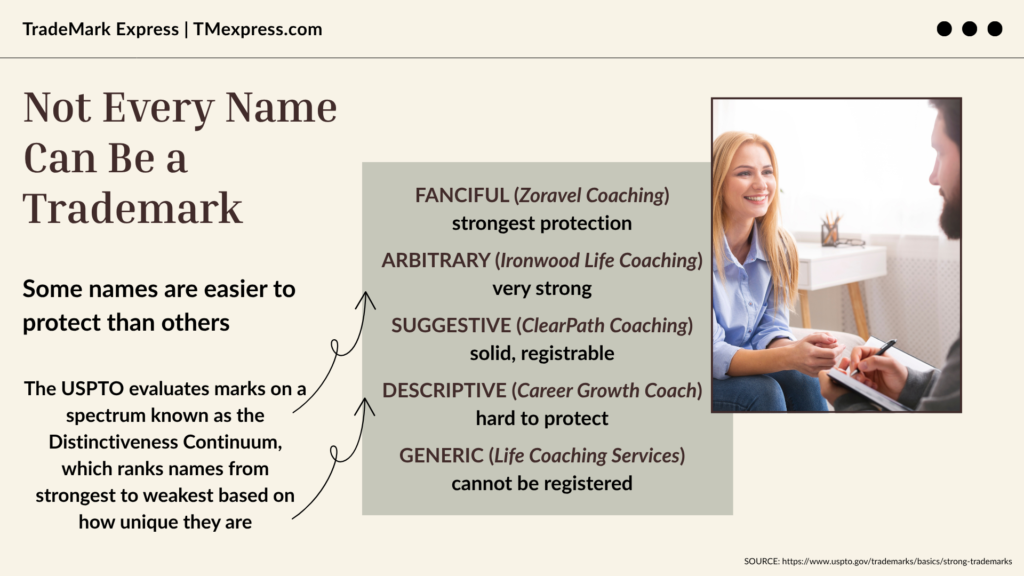
- Fanciful trademarks are invented words with no prior meaning. Example: Zoravel Coaching. These are the strongest and easiest to protect.
- Arbitrary trademarks use real words that have nothing to do with coaching. Example: Ironwood Life Coaching. Still very strong.
- Suggestive trademarks hint at what you do without describing it directly. Example: ClearPath Executive Coaching — it suggests direction and clarity without stating it outright.
- Descriptive trademarks simply describe your service. Example: Effective Business Coaching or Career Growth Coach. These are difficult — and sometimes impossible — to register without proof of long-term, exclusive use.
- Generic terms are the name of the thing itself. Example: Life Coaching Services. These cannot be registered at all.
For coaches, this matters because many practitioners naturally gravitate toward descriptive names — words like “clarity,” “growth,” “transform,” or “success.” These terms are used across hundreds of coaching brands, which, when used with descriptive language like coach or mentor can make them weak from a trademark standpoint.
The more distinctive and original your trademark, the stronger your protection.
Step 2 — Conduct Comprehensive Trademark Research
Before you file anything, you need to know whether your brand name is actually available. This is where comprehensive trademark research becomes essential — and where many business owners make a costly mistake by skipping it.
A thorough search goes well beyond a quick Google search or a scan of the USPTO database. It covers:
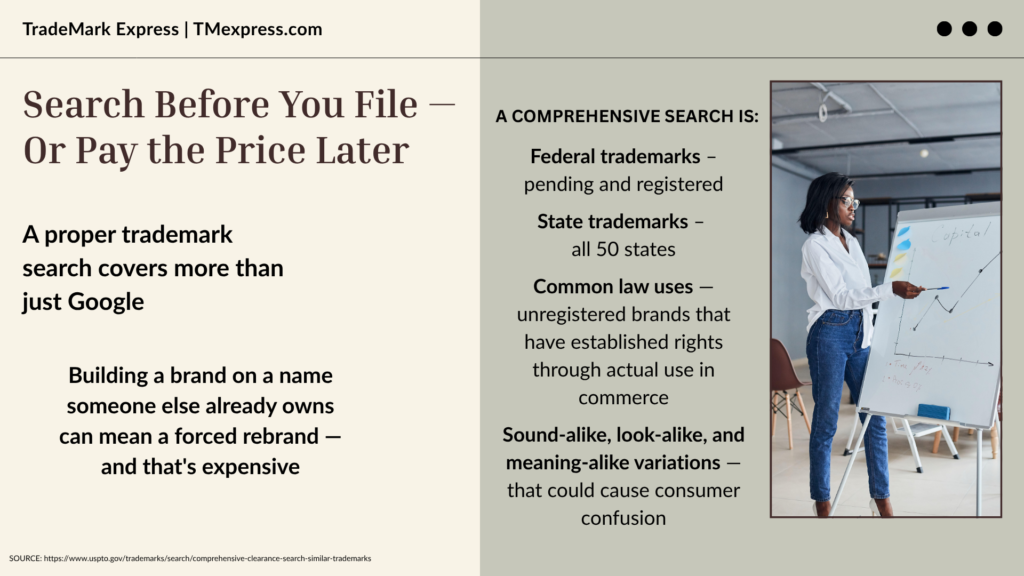
- Federal trademark filings from the USPTO – pending and registered
- State trademark registrations across all 50 states
- Common law uses — unregistered brands that have established rights through actual use in commerce
- For example, a life coach who has operated under the name Elevate Coaching in Los Angeles for several years may have common law rights to that name — even without a federal trademark or a California trademark. If you launch a coaching practice under the same or a similar name in Santa Monica, you could face a conflict.
- Sound-alike, look-alike, and meaning-alike variations that could cause consumer confusion
The USPTO won’t register your mark if it’s likely to be confused with an existing one — even if the names aren’t identical. Two coaching brands with phonetically similar names in the same space could be deemed confusingly similar.
In the coaching world, Class 41 covers education and training services, which is the primary class for most coaching practices. But depending on what you offer, other classes may apply. If you sell workbooks, online courses with physical materials, or coaching software, additional classes may need to be evaluated.
Skipping comprehensive research isn’t just a legal risk — it’s a financial one. If you build your brand, create a website, develop marketing materials, and launch programs under a name that someone else already owns, you could face a cease-and-desist letter or be forced to rebrand entirely. That’s an expensive problem that a proper search prevents.
TradeMark Express provides comprehensive trademark research that covers federal, state, and common law sources — giving you a clear picture of your risk before you invest further in your brand.
Step 3 — File the Trademark Application
Once your research confirms your name is likely available, you’re ready to file with the USPTO. Applications are submitted through the USPTO’s Trademark Center.
When preparing your application, you’ll need to:

- Identify your goods and services — the USPTO requires precise, specific language to describe your goods and services — vague or overly broad descriptions are likely to be rejected
- Select the right trademark class(es) — most coaching brands fall under Class 41, but if you offer digital products, books, or software tools, additional classes may apply
- Provide a specimen — real-world proof that you’re already using the mark in commerce, such as a screenshot of your website showing the mark alongside your services
- Pay the required fees — current USPTO filing fees are available at https://www.uspto.gov/trademarks/trademark-fee-information
Intent-to-Use vs. Use in Commerce
When filing, you’ll choose one of two bases:
Use in Commerce means you’re already using the mark to offer your coaching services to clients. You’ll submit a specimen with your application. This is the most straightforward path if your practice is already active.
Intent-to-Use means you haven’t launched yet but have a genuine plan to use the mark. This lets you stake your claim early — before your website, programs, or marketing materials are live. The trade-off is that you’ll need to file additional documentation (and pay additional fees) once you begin using the mark before the USPTO will issue your registration.
For coaches still in the naming or pre-launch phase, an intent-to-use application is a smart way to protect a name before you build your brand around it.
Step 4 — Monitor Your Trademark Application
Filing your application is not the finish line. Once submitted, your application goes through a review process that can take a year or more. An examining attorney at the USPTO will review your application and may issue an Office Action — a letter raising concerns or objections that you must respond to within the required timeframe.
During this period, you should:

- Check your application status regularly using the USPTO’s Trademark Status and Document Retrieval (TSDR) system
- Watch for USPTO correspondence and respond promptly — missed deadlines can result in abandonment
- Monitor new filings by other applicants who might be seeking a mark that conflicts with yours
Monitoring doesn’t end once your mark registers. Ongoing watch services alert you when new applications are filed that could conflict with your brand, giving you the opportunity to take action early.
Step 5 — Maintain Your Registered Trademark
Registration is not a one-time event. The USPTO requires you to keep demonstrating that you’re actively using your mark in commerce throughout the life of your registration. If you stop using your mark or miss required filings, you can lose your registration.
Here are the key deadlines to know:

- Section 8 Declaration (years 5–6 after registration): You must file proof that you’re still using the mark in commerce. This filing is required to keep your registration active.
- Section 15 Declaration (optional, after 5 years of continuous use): This filing makes your mark “incontestable,” which strengthens your rights and limits the grounds on which others can challenge it.
- Combined Section 8 & 15 (years 5–6): Many registrants file both at the same time during this window.
- Section 8 & 9 Renewal (every 10 years): You must renew your registration every decade and again show continued use.
In short, you need to keep using your mark and keep up with your filing deadlines if you want to hold onto your registration and all the benefits that come with it. Missing these windows can mean losing your registered status — even if you’ve used the mark for years.
Industry-Specific Considerations for Coaching Businesses
Coaching has some unique trademark dynamics worth understanding before you file.
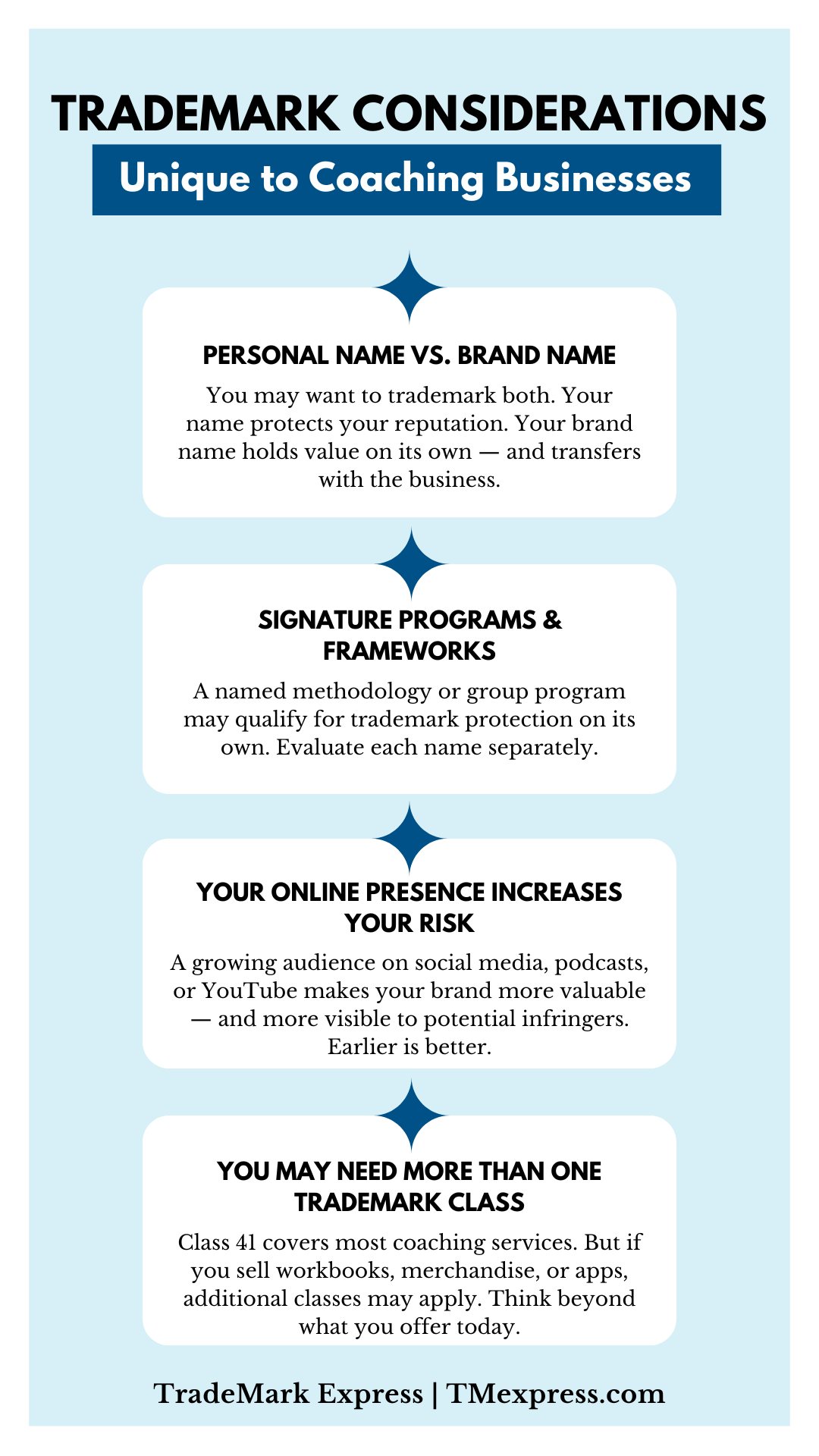
Your personal name and your brand name may be separate things. Some coaches build their business around their personal name — think ‘Jane Smith Coaching’ — while others develop a distinct brand name that stands apart from their identity. Depending on how your business is structured, you may want to trademark both. A registered trademark on your personal name protects your reputation and prevents others from trading on it. A distinct brand name, on the other hand, has value that exists independently of you — which matters if you ever want to license your programs, bring on partners, or sell the business down the road.
Program and methodology names are registrable. Coaches often develop signature frameworks, group programs, or proprietary methods with distinct names. If your methodology or program name has a unique identity — and you’re offering it as a service — it may qualify for trademark protection on its own. Evaluate each name separately.
Online presence amplifies both your brand and your exposure. Coaches build audiences on LinkedIn, Instagram, YouTube, and podcasts. A large following makes your brand more valuable and more visible to potential infringers. The sooner you establish trademark rights, the stronger your position if you ever need to enforce them.
Class 41 is your starting point, but it may not be your only class. If you sell physical workbooks, branded merchandise, or coaching software or apps, those goods and services fall under different trademark classes. A comprehensive evaluation of everything you offer — current and planned — helps ensure your application covers your full business model.
Get Started with a Coaching Business Trademark
Knowing how to trademark a coaching business is the first step — taking action is what protects your brand. A comprehensive trademark search gives you the information you need to move forward with confidence, whether you’re preparing to file or simply want to know where you stand.
Order your coaching business trademark search today with TradeMark Express to secure your brand and start building protection right away. Our research covers federal, state, and common law sources so you get a complete picture before you invest further in your name. When you’re ready to move forward, we can also assist with application preparation.
The information provided on this site is for general informational purposes only. All information on the Site is provided in good faith; however, we make no representation or warranty of any kind, express or implied, regarding the accuracy, validity, or completeness of any information on the Site. The Site cannot and does not contain legal advice. The legal information is provided for general informational and educational purposes only, and is not a substitute for legal advice. Consult a licensed attorney for legal advice.