
Filing in One Trademark Class or Several? Here's How to Decide
When you’re preparing to file a trademark application, one of the first decisions you’ll face is which class — or classes — your goods and services belong in. It sounds straightforward until you realize there are 45 international trademark classes, and your brand might touch more than one.
So how do you know whether you need to file in one class or several? And what’s actually at stake if you get it wrong?
What Is a Trademark Class?
The USPTO uses the Nice Classification system to organize trademarks into 45 categories — 34 for physical goods and 11 for services. Every trademark application must identify at least one class, and your registration covers the specific goods and services you list within that class — or classes — at the time of filing.

The class you file in is essentially how the USPTO categorizes what your brand covers. Getting that foundation right is the first step in building a filing strategy that actually protects your business.
When One Trademark Class Is Enough
For many small businesses, a single-class filing is the right move. If your brand is clearly tied to one category of goods or services — and you have no current or near-term plans to expand beyond it — filing in one class keeps costs down without sacrificing meaningful protection.
For example, a clothing brand that sells only apparel would generally file in Class 25. A software company offering a SaaS product would typically file in Class 42. One class, one clean application.
The key question is whether your business activities actually stay within one category. If they do, there’s likely no reason to overcomplicate the filing.
When Multiple Trademark Classes Make Sense
Here’s where things get more nuanced. Many brands — especially growing ones — operate across more than one class without realizing it.

Consider a few common scenarios:
- A food brand that sells packaged cookies and runs a catering service spans both Class 30 (food products) and Class 43 (food and beverage services).
- A wellness brand selling supplements and offering fitness training may need coverage in both Class 5 and Class 41.
- A tech company with a software platform and physical hardware products could require separate filings. Online software falls under Class 42 while downloadable software, like a mobile app, is in Class 9.
If your brand currently touches multiple categories — or you have a concrete plan to expand into them — filing across those classes from the start is generally the more strategic approach.
Trying to add classes after the fact means filing a new application — with its own filing fees — and potentially losing your priority date in that new category.
Why This Decision Matters More Than You Think
Trademark rights are tied directly to what you file for. A registration in one class doesn’t automatically protect you in another, even if your brand is well-known. Competitors can attempt to file in classes you’ve left unprotected — and there’s not always a clean remedy once that happens.
This is exactly why your class selection shouldn’t be an afterthought. You need it to be part of your deliberate filing strategy, informed by where your business actually operates and where it’s realistically headed.
The Role of Trademark Research in Class Strategy
Before you finalize which class or classes to file in, a comprehensive trademark search is essential. Why? Because conflicts aren’t limited to marks that sound or look identical — the USPTO evaluates whether marks are confusingly similar, and that analysis includes whether the goods or services involved are related.
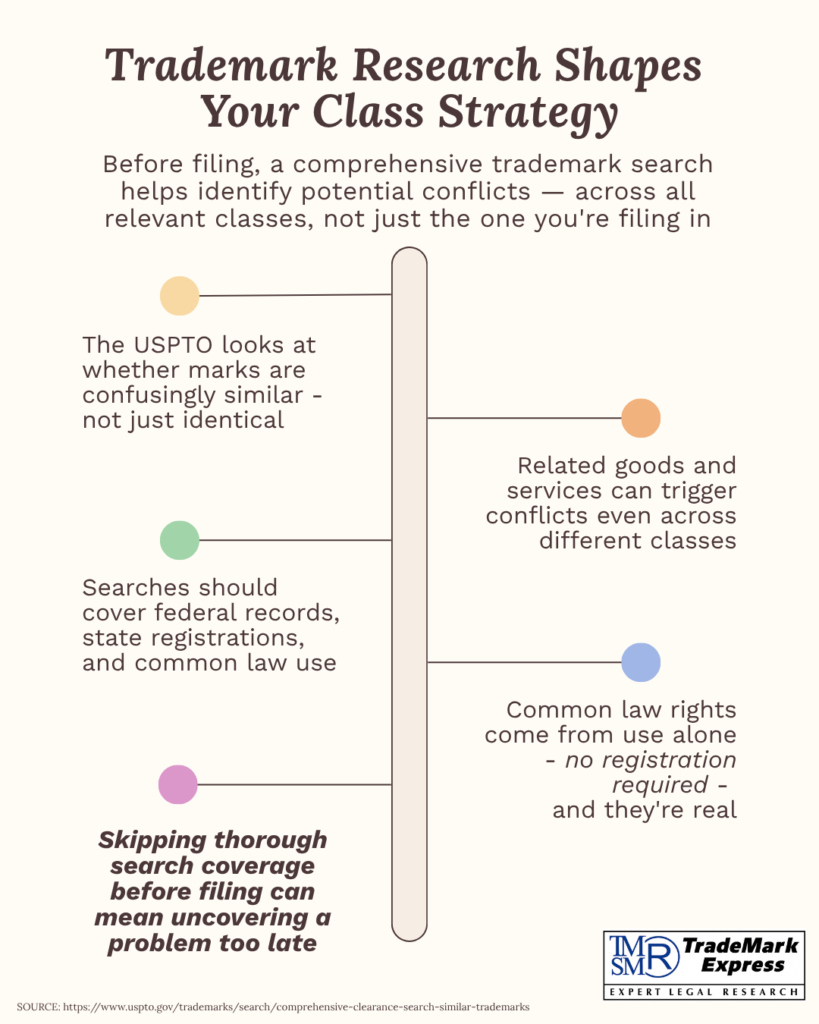
A thorough trademark clearance search should cover federal trademark records (both pending and registered marks), state trademark registrations, and common law usage — marks that are in active use but never formally registered. Businesses can acquire common law rights simply by using a mark in commerce, often within a specific geographic region, without any registration at all. Those rights are real and can affect your application.
It also needs to account for marks across related classes — not just the ones you’re filing in. A mark in a neighboring category could still create a conflict if consumers are likely to associate the two.
Cutting corners on search coverage before committing to a filing strategy can mean discovering a problem after you’ve already invested in the application.
Making the Right Call
There’s no universal answer to the one-class-vs.-multiple question. The right strategy depends on your specific goods and services, your growth plans, and what the trademark landscape in your space looks like.
What is universal: the decision deserves careful thought, solid research, and a clear picture of where your brand is going — not just where it is today.
Ready to figure out the right filing strategy for your brand? TradeMark Express provides comprehensive trademark research and application preparation assistance to help you move forward with clarity and confidence. Contact us to get started.