
Why Related Goods and Services Matter For Your Trademark Search
A comprehensive trademark search looks at related goods and services because a similar mark used in a different industry can still cause a conflict. If shoppers might reasonably assume two products or services come from the same source, the U.S. Patent and Trademark Office (USPTO) may treat them as related, even when the two businesses look very different on paper.
Most people picture a trademark conflict as two identical names competing for the same customers. In practice, the question is broader. A thorough trademark search checks the name itself and also what other businesses sell under similar names. This guide explains how the USPTO thinks about that second half and what it means when you choose someone to research your brand name.
What Exactly Are Related Goods & Services?
Related goods and services are products or services that consumers would reasonably expect to come from the same business, or from businesses that are connected. The USPTO considers this whenever it decides whether a new application could cause a likelihood of confusion, which simply means consumers may be unsure who stands behind a product or service.
That review has two parts.
First, are the marks similar enough in sound, appearance, or meaning to be confusing? (If you want more on that half of the equation, see confusingly similar trademarks.)
Second, are the goods or services related?
Both parts matter.
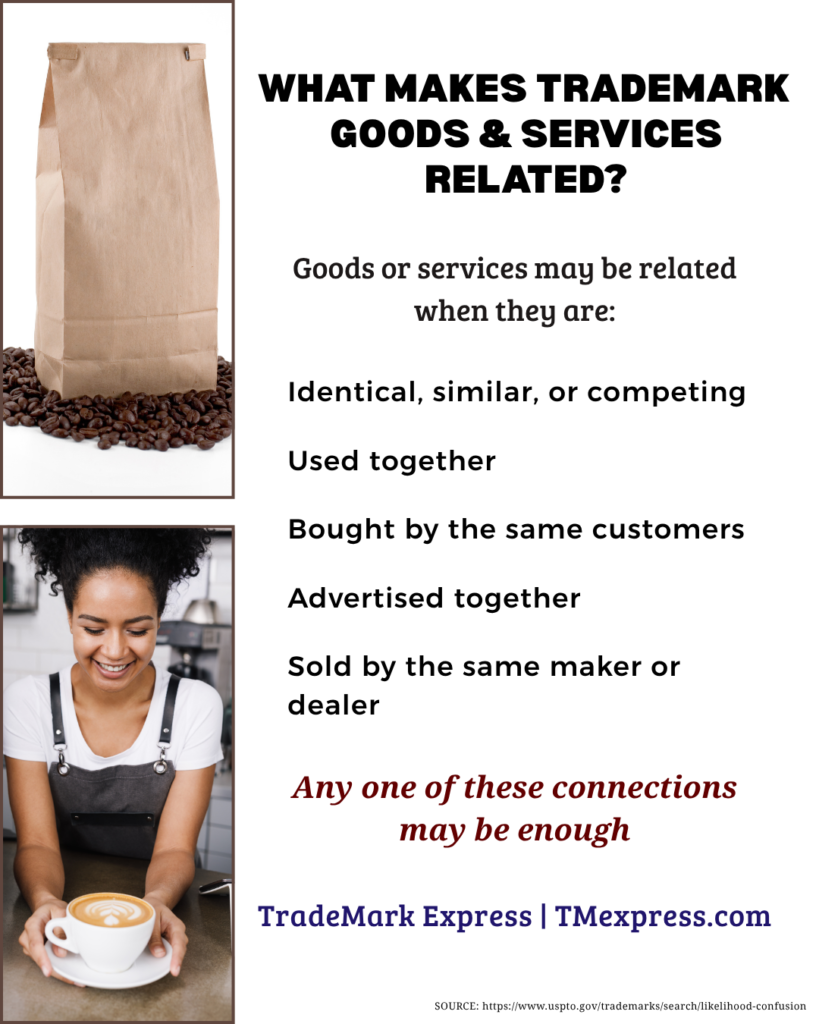
According to USPTO guidance, goods or services may be related when they are:
- Identical, similar, or competitive
- Used together
- Bought by the same customers
- Advertised together
- Sold by the same manufacturer or dealer
Any one of those connections could be enough to draw attention. Notice what is missing from the list: whether the two were filed in the same trademark class.
Why Identical Names Can Coexist on Different Products
Two identical trademarks can belong to different owners when the goods or services are far enough apart. The USPTO points to Dove, which appears on both soap and ice cream bars, and Delta, which appears on both faucets and air travel. Shoppers are unlikely to assume a bathroom faucet and an airline share an owner, so both marks can exist.
This is not a loophole, though. It works in the other direction too. As a general rule, the closer two marks are, the less related the goods need to be before the USPTO raises concerns. An identical or near-identical name on closely related products is where trouble tends to show up.
Very famous marks can also receive broader protection under trademark dilution principles, which is one more reason to look past your own industry before you commit to a name.
Five Questions That Help Identify Related Goods and Services
The easiest way to spot related goods and services is to think like a customer. The USPTO suggests a handful of questions to get started, and the examples below show how each one works.
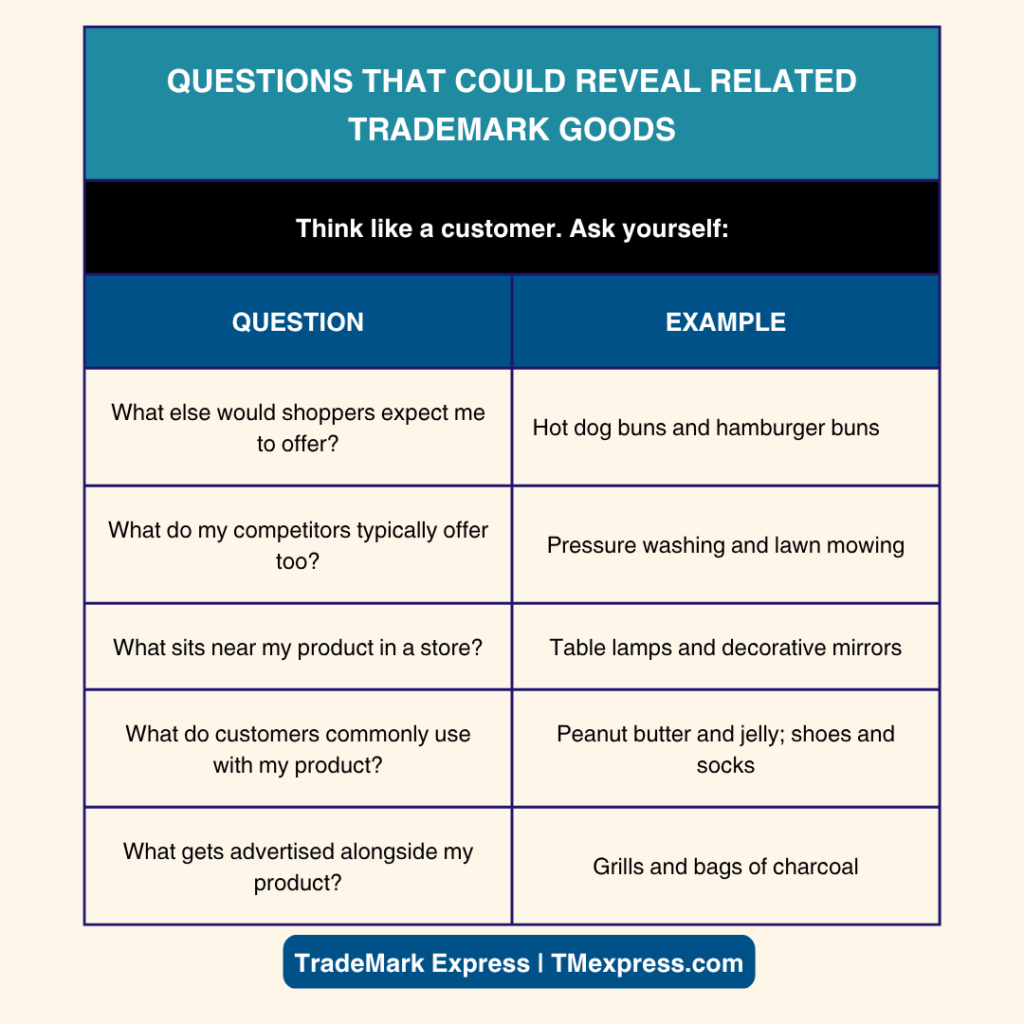
Question to Ask | Example |
What else would a shopper expect me to offer? | A hot dog bun seller may also be expected to sell hamburger buns and bread. |
What else do my competitors typically offer? | Many pressure washing companies also offer lawn mowing. |
What would sit next to my product in a store? | Table lamps are often displayed near decorative mirrors. |
What is commonly used with my product? | Peanut butter and jelly, or shoes and socks. |
What is typically advertised alongside my product? | Barbecue grills and bags of charcoal. |
The answers point to goods and services that travel in similar channels of trade, meaning they reach customers through the same kinds of stores, websites, or providers. When your list of answers overlaps with what another business sells under a similar name, that overlap is worth a closer look.
Hypothetical Naming Project: Juniper Flow
Imagine a founder launching a yoga studio called Juniper Flow. Before settling on the name, she works through each question.
What else would a shopper expect me to offer? Someone who loves the studio may assume it also sells branded mats, water bottles, and apparel, or offers online classes for days they can’t attend in person. Each is a plausible extension of the same name.
What else do my competitors typically offer? Looking at other studios, she finds that many also run teacher training programs, weekend workshops, and wellness retreats. Those services are ones a customer may expect from a business like hers.
What would sit next to my product in a store? If she sold mats, they would likely be displayed beside yoga blocks, straps, and bolsters. A similar name on any of those items could put her mat in the same aisle as someone else’s.
What is commonly used with my product? Mats are used with towels and blocks. Online classes are used with streaming platforms and apps. A similar name on a fitness app or a line of yoga accessories sits close to what she offers.
What is typically advertised alongside my product? Studios often promote class packages, retreats, and apparel drops together on social media and in email newsletters. A similar name on a retreat company or activewear brand may show up in front of the same audience.
Her list now covers yoga studio services, retail goods, digital classes, and travel experiences, all within a customer’s natural expectations of a yoga brand. A search that only looked for other yoga studios named Juniper Flow could miss a “Juniper Flow” activewear line or a “Juniper Flow” wellness retreat, both of which may be worth a closer look in a comprehensive trademark search.
Why Trademark Classes Alone Do Not Settle the Question
Trademark classes are an organizing system, not a test for whether goods are related. The USPTO groups goods and services into 45 classes so applications can be sorted and fees calculated. Goods in different classes can still be related, and goods in the same class may not be.
That is why a search limited to your own class can miss real risks. If you would like to see how classes fit into the research process, read why trademark classes matter in a trademark search. The short version is that classes are a starting point for the search, not its boundary.
What a Comprehensive Trademark Search Should Cover
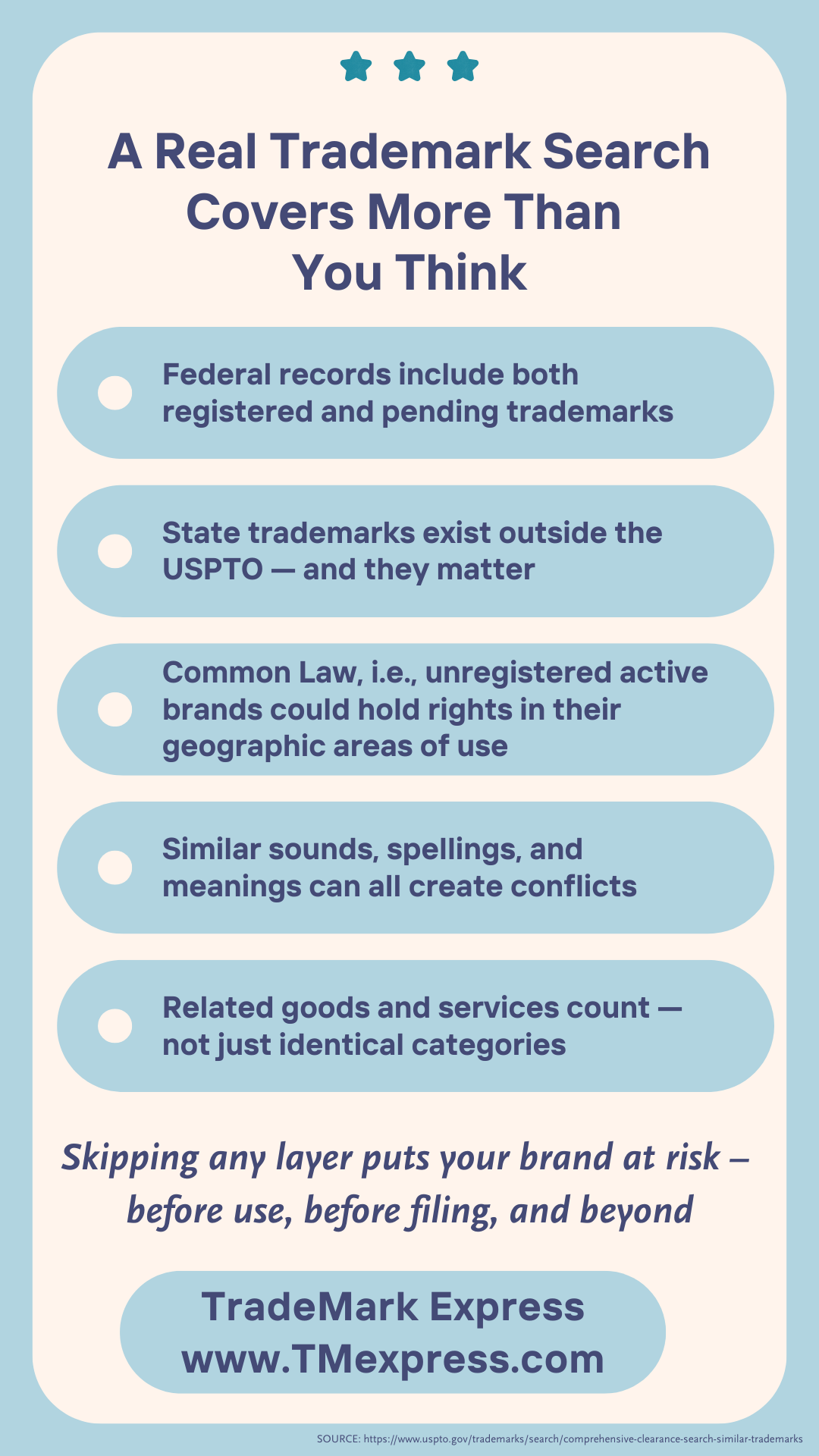
A comprehensive trademark search should cover federal records, state registrations, common law usage, similar marks, and related goods and services. If you are comparing providers, coverage is the most important thing to evaluate. A trademark clearance search that only checks for exact matches in your own class can leave meaningful risks unseen.
Federal Trademark Records
A full trademark search reviews federal trademarks – both registered and pending marks in the USPTO database. Pending applications matter because an earlier-filed application may be cited against a later one, even before that earlier mark is registered.
State Trademark Registrations
Each state keeps its own trademark records, and those registrations do not appear in the federal database. A trademark availability search that skips them can overlook a conflict close to home. You can learn more in our guide to state trademark registration.
Common Law Usage
Common law rights come from actually using a mark in commerce, even without any registration. These rights are geographic, so a business using a mark in a particular region may have protectable rights in that area. A common law search will look at business names, websites, social media, and marketplaces to find that kind of use. Our overview of common law trademark rights covers the basics.
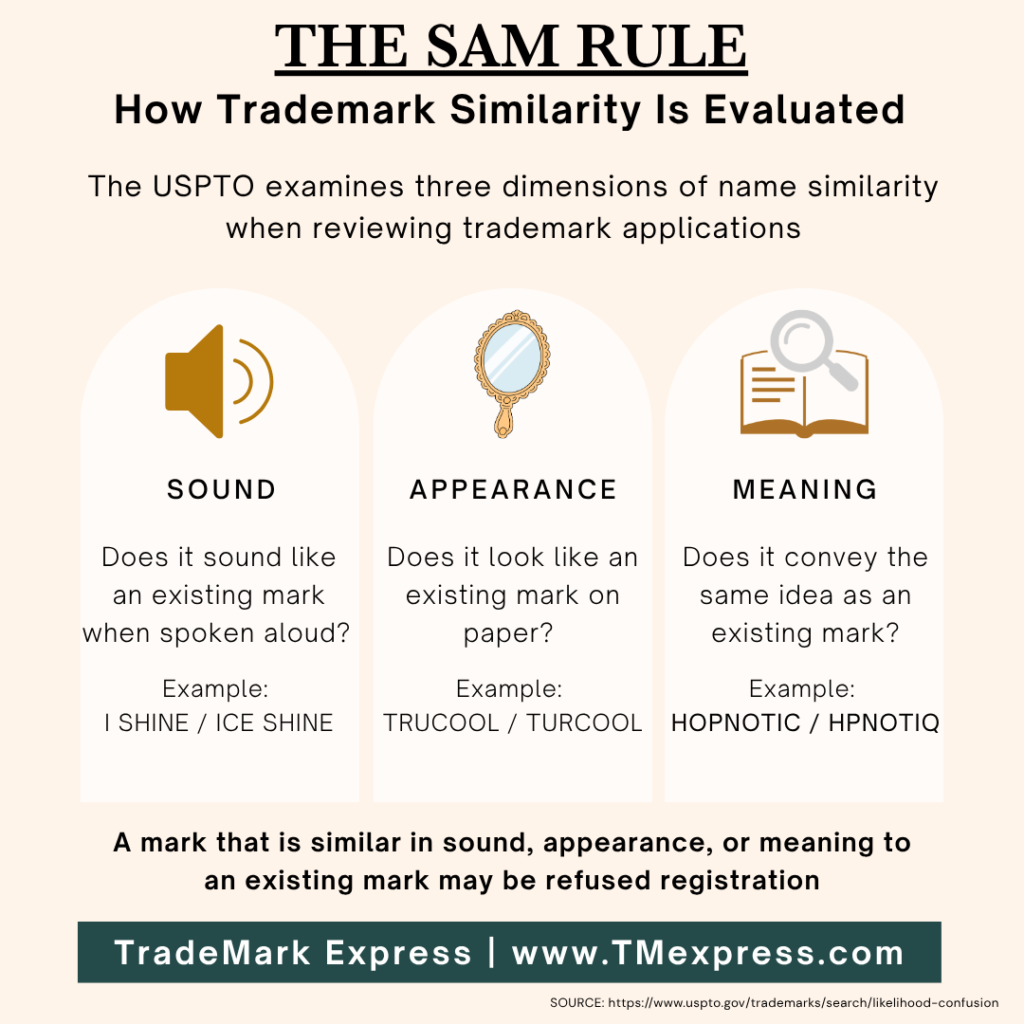
Similar Marks in Sound, Appearance, or Meaning
The USPTO’s standard is confusing similarity, not only identical wording. A search that only looks for identical matches will miss names that sound alike, look alike, or carry the same meaning in different words.
A good screening process catches those variations, including sound-alike trademarks, before they turn into problems.
Similar or Related Goods and Services
This is where everything above comes together. A conflict is not limited to the exact same industry. If a mark is used on goods or services that consumers would consider related to yours, a conflict may still exist. Trademark screening that stops at your own category may report that the path looks clear while a related business sits just outside the search.
Questions to Ask a Trademark Search Provider
Before hiring anyone for a trademark search, consider asking:
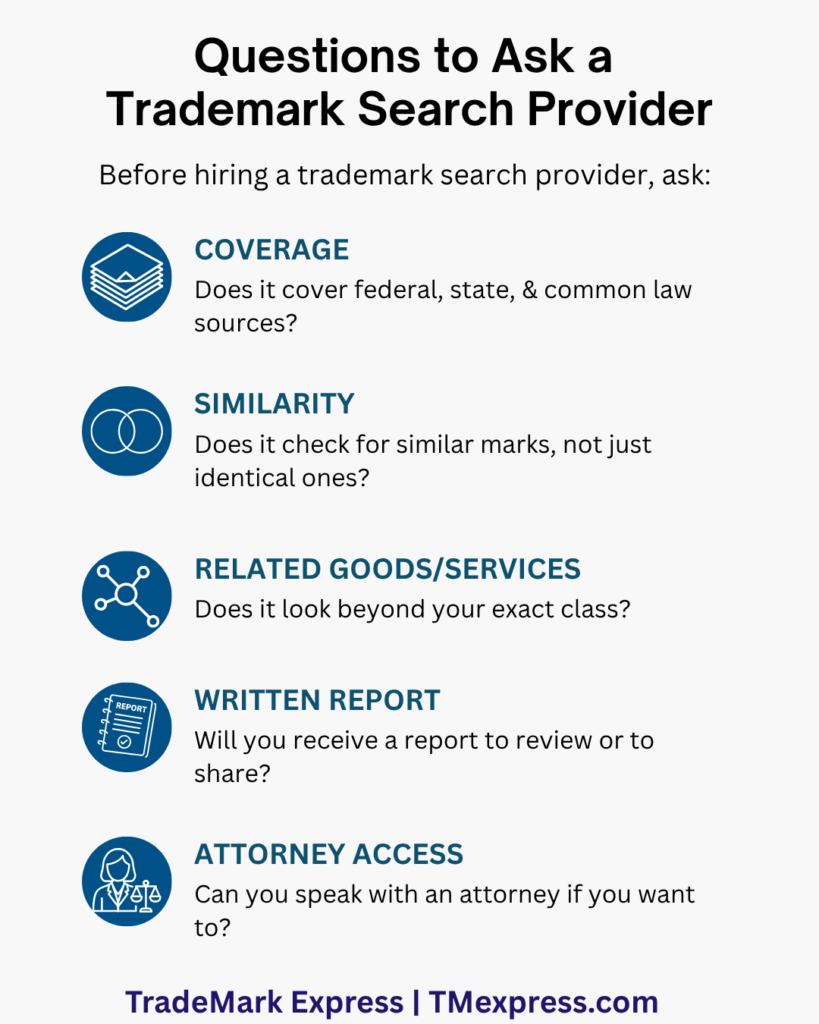
- Does the search cover pending and registered federal trademarks, state trademark registrations, and common law sources?
- Does it look for similar marks, or only identical ones?
- Does it examine related goods and services beyond my exact class?
- Will I receive a written report I can review myself or share with a trademark attorney?
- Is it clear who interprets the results, and can I speak with an attorney if I want to?
The last question matters because a research company and a law firm play different roles. Search results are information to review, and deciding what they mean for your brand is a conversation for a trademark attorney.
A Hypothetical Example of Related Goods in Action
Meet Dana, a founder who has spent a year perfecting a small-batch coffee blend. She has settled on the name Harbor Hill, ordered a logo, and priced out packaging. Before she prints anything, she checks the USPTO database for “Harbor Hill” coffee. Nothing comes up, and it looks like smooth sailing.
Now imagine she orders a full trademark search instead, one that looks beyond coffee. The report turns up several things a coffee-only search would never have flagged:
- A registered trademark for related services. A “Harbor Hill” is registered for café and restaurant services. Coffee and restaurants are often offered under one brand, and customers may assume a Harbor Hill coffee bag comes from the Harbor Hill café down the road.
- A similar mark in a neighboring category. A pending application for “Harbour Hill” covers loose-leaf tea. The spelling differs, the pronunciation is identical, and tea sits on the same shelf as coffee.
- Common law use. A small bakery in another state sells pastries and bagged coffee under “Harbor Hill Provisions.” It has no federal registration, but its use of the name in that region may give it protectable rights there.
Dana’s original search, limited to her own product and an exact match, would have reported a clear path. The wider view tells a different story, and she sees it before she has spent money on packaging, a website, or an application.
None of these findings automatically means Dana has to abandon the name. What they give her is information. She can review the report with a trademark attorney to understand what each result may mean for her plans, then decide whether to move forward, adjust the name, or choose a different one.
Any of those decisions is easier before launch than after.
Frequently Asked Questions
What are related goods and services in trademark law?
Related goods and services are products or services that consumers would reasonably expect to come from the same source. The USPTO looks at whether they are competitive, used together, bought by the same customers, advertised together, or sold by the same manufacturer or dealer. The closer the relationship, the more likely it is to matter in a conflict review.
Can two companies use the same trademark name?
Sometimes. Identical names have coexisted when the goods or services are unrelated, such as Dove soap and Dove ice cream bars. When goods or services are closely related, the same or a similar name may raise concerns with the USPTO.
Can goods in different trademark classes be related?
Yes. Classes are an organizational tool, not the deciding factor. Goods in different classes may still be related if consumers would expect them to come from the same source.
Does a trademark search check related goods and services?
A comprehensive trademark search should. A search that looks only at your exact goods or your own class can miss conflicts outside that category, so it helps to confirm the scope before you hire a provider.
How do I figure out which goods are related to mine?
Start by thinking like a customer. Ask what else people would expect you to sell, what your competitors offer, what sits near your product, and what is used or advertised with it. A professional search can then check those categories for similar marks.
Get a Trademark Search That Looks Beyond Your Own Industry
Choosing a name is easier when you know what is already out there, including in industries you might not have considered. TradeMark Express conducts comprehensive trademark searches covering federal and state records, common law usage, similar marks, and related goods and services. We also help you prepare your application using USPTO tools and guidelines, and you can review your search results with an attorney from our referral network.
Contact TradeMark Express to talk through your brand name and learn how our trademark research can support your next step.