How to Trademark a Baby Product Brand

Trademark Your Baby Product Brand the Right Way

The baby products market is one of the most competitive retail spaces in the country. The baby products market generates billions in revenue each year — and it keeps growing. Parents are loyal to brands they trust, and that loyalty starts with a name.

If you are launching or growing a baby product brand, securing a trademark for your brand name — and possibly your logo — is one of the most important steps you can take to protect what you are building.

This guide walks you through how to trademark a baby product brand, explains why this market requires extra attention to trademark coverage, and tells you what to expect along the way.

Why Baby Product Trademarks Are More Complex Than They Look

Baby products span a surprisingly wide range of goods. What starts as a single product idea can quickly grow into a full line covering multiple categories. The U.S. Patent and Trademark Office (USPTO) — the federal agency that registers trademarks — organizes goods into 34 international classes. Baby products fall across several of them, and that matters when you file.

Table showing USPTO trademark classes for common baby product categories, from clothing and feeding to gear and health items

Here is a quick look at the main baby product categories and where they typically land:

Category

Examples

USPTO Class(es)

Clothing & Apparel

Onesies, bodysuits, bibs, hats, socks

Class 25

Diapering & Hygiene

Disposable baby diapers, wipes, diaper bags

Class 5 / Class 3 / Class 18

Creams, Lotions & Washes

Baby lotion, diaper cream, baby wash, shampoo

Class 3 / Class 5

Feeding Supplies

Bottles, nipples, breast pumps, high chairs

Class 10 / Class 20

Nursery & Sleeping

Cribs, bassinets, baby monitors, bedding

Class 20 / Class 9 / Class 24

Bath & Grooming

Baby tubs, bath seats, nail clippers, brushes

Class 20 / Class 8 / Class 21

Transportation & Gear

Strollers, car seats, baby carriers, bouncers

Class 12 / Class 18 / Class 20

Playtime & Learning

Rattles, teething rings, infant toys

Class 28 / Class 10

Health & Safety

Baby thermometers, nasal aspirators, outlet covers

Class 10 / Class 9

If your brand covers products in more than one class, you will need to include each relevant class in your trademark application. Each class requires a separate filing fee, so knowing your product scope upfront saves you from surprises.

Start with a Comprehensive Trademark Search

Before you file anything, search. This step is the foundation of the entire process, and skipping it — or doing a surface-level search — is one of the most common and costly mistakes new brand owners make.

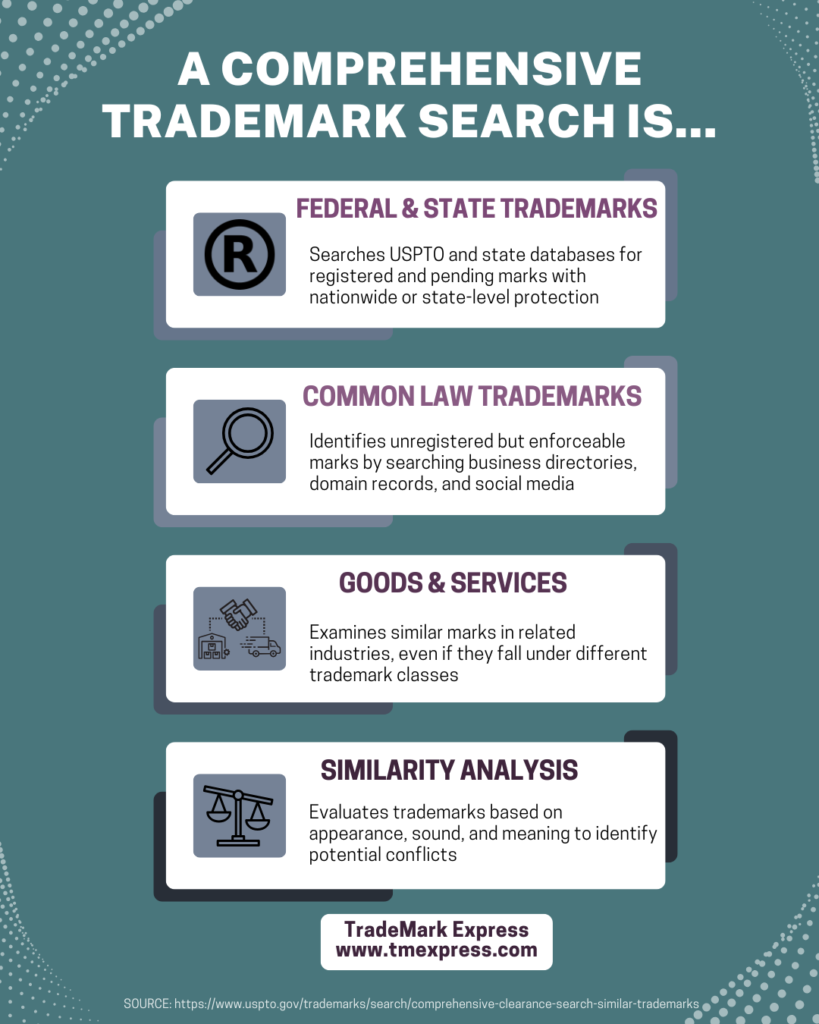
A comprehensive trademark search looks at existing Federal trademarks (registered and pending), state trademarks, and common law uses of similar names in your product space. In the baby market, this means searching across every category you plan to sell in, not just your initial product.

Here is why this matters: a name that is available for baby clothing might already be registered for baby skincare. If you expand into that category later without catching the conflict early, you could be forced to rebrand a product line mid-launch — or face opposition from an existing trademark owner.

What a Good Trademark Search Covers

A thorough search goes beyond a quick Google check. It should include:

Graphic titled “A Comprehensive Trademark Search is…” showing the key elements of a trademark search: checking federal and state trademarks, identifying common law uses, reviewing same or related goods/services, and evaluating similarity in sound, appearance, or meaning.
  • The USPTO’s Trademark Center for federal registrations and pending applications
  • State trademark databases, since some marks are registered at the state level rather than federally
  • Common law sources, including business name databases, domain registrations, and e-commerce platforms
  • Phonetic and spelling variations of your name
    • The USPTO evaluates trademark conflicts based on whether marks are likely to cause consumer confusion — and that test goes beyond identical matches. A mark can be refused or successfully opposed if it sounds similar to an existing mark, looks similar in appearance, or carries a similar meaning, even if the spelling is completely different.
  • Similar marks across all relevant international classes

The goal is to give you a clear picture of the trademark landscape before you invest in filing fees, packaging, and marketing.

Understanding the USPTO Application Process

Once your search clears, you are ready to prepare your application. The USPTO offers two main filing bases for U.S. applicants:

Use in Commerce — You are already selling products with the mark. You will need to provide a specimen showing the mark in actual use, such as a product label or website screenshot.

Intent to Use — You have not launched yet but have a bona fide intent to use the mark. This lets you secure a filing date while you finish getting your product ready to sell. Be aware that this filing basis requires additional forms and fees.

For baby product brands, the Intent to Use basis is common because founders often want to lock in their name before their product hits the market.

intent-to-use trademark vs use in commerce trademark, differences between

Identifying Your Goods Correctly

How you describe your goods in the application matters. The USPTO requires specific, accurate descriptions — not broad terms like “baby products.” Each item must be identified clearly and assigned to the correct international class.

For example, “disposable baby diapers” falls in Class 5, while “diaper bags” falls in Class 18. Getting these distinctions right the first time avoids office actions — official USPTO letters asking you to clarify or correct something in your application — which slow down the process.

Filing Your Trademark Application

USPTO trademark applications are filed online through the USPTO’s Trademark Center. When you file, you will select your filing basis, identify your goods with accurate descriptions, assign the correct international class or classes, and pay the required filing fee for each class included in your application.

What Trademark Protection Actually Covers

A federal trademark registration gives you the exclusive right to use your mark on the specific goods and services listed in your application — nationwide. It also gives you the legal presumption that you own the mark and the right to use the ® symbol once registration is complete.

Graphic illustrating six key benefits of federal trademark registration: public listing in the USPTO database, legal presumption of ownership, basis for international registration, right to sue in federal court, use of the ® symbol, and customs protection against infringing imports

What it does not cover is use outside those listed categories. This is why your comprehensive trademark search and application strategy need to account for where your brand might go — not just where it starts.

For a baby product brand, that means thinking ahead. If you are launching with a line of baby clothing today but plan to add nursery furniture, feeding accessories, or skincare within the next few years, your trademark protection should be built with that growth in mind.

How to Trademark a Baby Product Brand Step by Step

Here is the process from start to finish:

Step 1: Define your brand scope. List every product category you plan to sell in — now and within the next few years. Use this list to identify the relevant USPTO classes you will need to cover.

Graphic advising business owners to map out their full product range and USPTO trademark classes before filing

Step 2: Run a comprehensive trademark search and evaluate the results. Search federal registrations, pending applications, state trademark databases, and common law sources across all relevant classes. Look for identical matches, similar-sounding names, and phonetic variations. Then review what came up carefully — this is the step where professional guidance adds the most value, because a conflict you miss before filing can become a serious problem later.

Graphic explaining the importance of a comprehensive trademark search across multiple sources before filing an application

Step 3: Prepare and file your application. Choose your filing basis (use in commerce or intent to use), write accurate goods descriptions, and assign the correct international classes. File through the USPTO’s Trademark Center and pay the required filing fee for each class. Keep your serial number — you will use it to track your application’s progress. If the USPTO examiner has questions or concerns, you will receive an office action. Respond within the required timeframe to keep your application moving.

Graphic outlining key steps for preparing and filing a USPTO trademark application accurately

Step 4: Publication and registration. If the examiner approves your mark, it will be published in the Official Gazette for a 30-day opposition period. If no one opposes it, your registration moves forward and you will receive your certificate of registration.

Graphic explaining the USPTO publication and opposition period that follows trademark application approval

Step 5: File your post-registration maintenance documents. A trademark registration does not last forever on its own. The USPTO requires periodic maintenance filings to keep your registration active. Between the fifth and sixth year after registration, you must file a Declaration of Use (Section 8). At the ten-year mark, you file a combined Declaration of Use and Application for Renewal (Section 8 and Section 9). Missing these deadlines can result in your registration being cancelled, so mark them on your calendar early.

Graphic showing the post-registration maintenance filings required to keep a USPTO trademark registration active

Step 6: Monitor for potential infringers. Registration is not the finish line — it is the starting point for actively protecting your brand. Once your mark is registered, watch for new applications that conflict with yours, as well as unauthorized uses in the marketplace. This means checking the USPTO’s Trademark Center for similar filings, monitoring e-commerce platforms and retail channels, and keeping an eye on new brands entering the baby products space. You have tools available to challenge infringing marks, but only if you catch them.

Graphic reminding brand owners to actively monitor for trademark conflicts after registration is granted

Key Considerations Specific to Baby Product Brands

The baby market has a few characteristics that make trademark strategy a little different from other consumer goods categories.

Three reasons baby product brands benefit from trademark registration: trust, market competition, and product line growth

Trust is everything. Parents do extensive research before buying products for their children. A recognizable, protected brand name signals reliability. Trademark registration reinforces that credibility.

Private label and retail competition are intense. Major retailers and online marketplaces are filled with similar-sounding baby brands. A registered trademark helps you stand out and gives you tools to address infringement if a copycat appears.

The product lifecycle expands fast. A brand that starts with one type of product — say, a signature diaper rash cream — often grows into adjacent categories. Skincare can lead to bath products, which can lead to accessories. Building your trademark coverage to match your roadmap protects you as you grow.

Reminder that U.S. trademark registration does not extend to international markets — separate filings may be needed abroad

International markets matter. Baby products sell globally. If you plan to sell in Canada, the EU, or elsewhere, know that U.S. trademark registration does not automatically protect you in other countries. Separate filings may be needed.

Where TradeMark Express Can Help

Starting a baby product brand is exciting. Protecting it should not be overwhelming. TradeMark Express provides comprehensive trademark research and application preparation assistance across every product category your brand touches — so you know what you are stepping into before you commit to a name.

Ready to get started? Contact TradeMark Express today.

DISCLAIMER: References to particular trademarks, service marks, products, services, companies, or organizations appearing on this page are for illustrative and educational purposes only and do not constitute or imply endorsement.
The information provided on this site is for general informational purposes only. All information on the Site is provided in good faith; however, we make no representation or warranty of any kind, express or implied, regarding the accuracy, validity, or completeness of any information on the Site. The Site cannot and does not contain legal advice. The legal information is provided for general informational and educational purposes only, and is not a substitute for legal advice. Consult a licensed attorney for legal advice.

Leave a Comment

Your email address will not be published. Required fields are marked *