
Fake Trademark Attorney Texts and Emails Target Small Business Owners — Here's How to Spot Them
If you received an urgent text or email claiming that someone is about to trademark your business name or logo and demanding immediate payment to “stop” it, that message is likely a scam. This type of fraud targets small business owners who may not be familiar with how trademark law actually works, using fear and urgency to bypass careful judgment.
How This Scam Works
The message typically arrives by text or email from someone claiming to be a trademark attorney. The core pitch is alarming: a third party has supposedly filed — or is about to file — a trademark application for your business name or logo, and you need to act immediately or risk losing it.
From there, the scammer requests a small “initial filing fee” — often described as urgent and time-sensitive — followed by larger “federal filing fees” that materialize once the first payment clears. In many reported scams, nothing is ever filed. In others, payment card information is captured for additional unauthorized charges.
The fear is engineered. Legitimate trademark matters rarely require immediate, same-day payment through an unsolicited text message. Pressure to pay immediately is a common red flag.
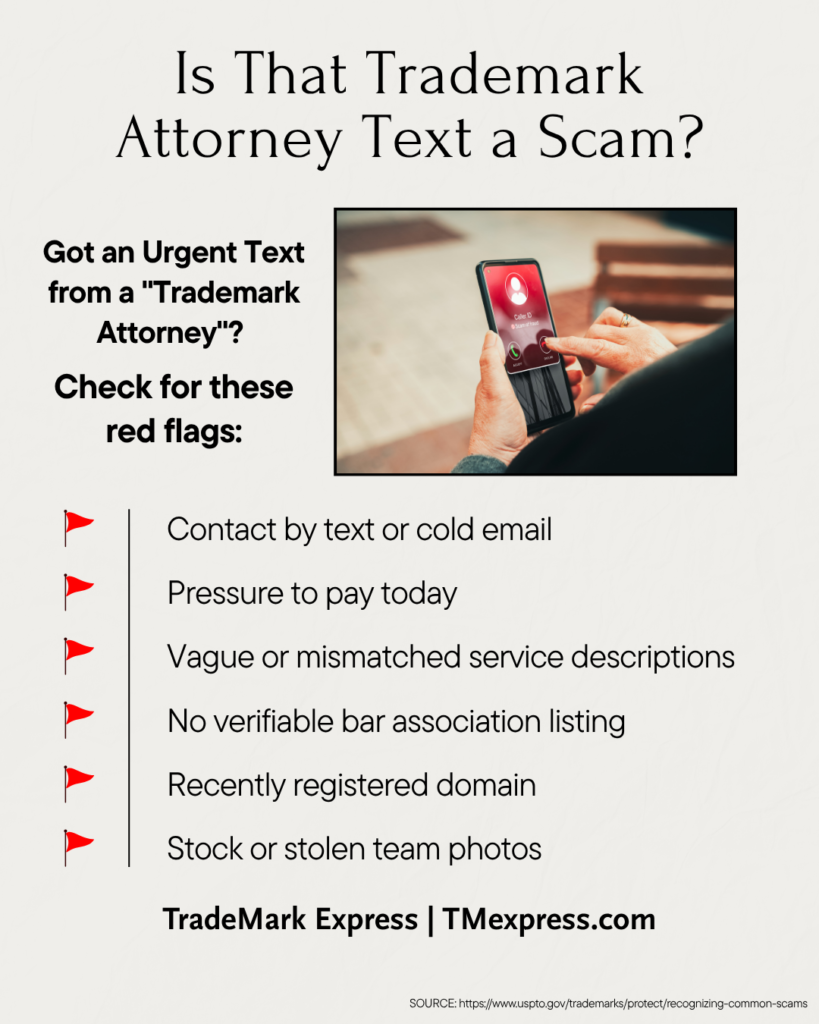
Red Flags That Signal a Fake Trademark Outreach
A few consistent warning signs appear across this type of scam:
Contact by text message. The USPTO does not send trademark communications by unsolicited text message. Legitimate trademark attorneys generally do not cold-text businesses demanding immediate action or payment.
Extreme urgency. Pressure to act “today” or “within hours” is a manipulation tactic designed to prevent you from researching the claim or consulting someone you trust.
Vague service descriptions. If the “classes” or goods and services referenced do not match your actual business, or the sender cannot explain what services are actually being provided, the message may be coming from a generic scam operation rather than someone familiar with your brand.
Unusually low fees for comprehensive research. Thorough trademark clearance research requires significant time, professional databases, and experienced analysis. Extremely low prices for “worldwide” or “comprehensive” searches may indicate that the service being offered is not what it claims to be.
Inconsistent business details. Missing suite numbers at listed office addresses, recently registered domains, and inconsistent contact information across communications are all red flags. These types of inconsistencies are common warning signs in trademark-related scams.
Stock or recycled photography. A quick reverse image search of a “team photo” can reveal whether it was lifted from an unrelated news story or website.
No verifiable bar association presence. If someone claims to be a trademark attorney, they should be listed through the appropriate state bar association. If someone claims to be an attorney but cannot be verified, that is a major warning sign.
What to Do Instead
If you receive a suspicious trademark-related text or email:
- Do not click any links or call back numbers provided in the message.
- Check any claimed trademark filing directly through the USPTO’s TSDR system at tsdr.uspto.gov using your Serial Number from your trademark records — not information supplied by the sender.
- Consult a trademark professional or licensed attorney through a verifiable referral source before making any payment.
- Report suspicious messages to the USPTO, the FTC at reportfraud.ftc.gov, and the BBB’s Scam Tracker.
FAQ
Can someone really trademark my business name without my knowledge? Yes, it is possible for someone to file a trademark application without you knowing about it immediately. Trademark applications are public records, but there is no requirement that someone notify existing businesses before filing. However, a legitimate concern about a conflicting application can be verified through the USPTO’s public database. A scammer demanding immediate payment by text is not a reliable source of information.
How do I find out if someone actually filed a trademark on my name? You can search the USPTO’s trademark database to see whether a federal application exists, but that is only one part of understanding your trademark risk. A comprehensive trademark search reviews federal, state, and common-law records to identify potential conflicts with similar names, logos, and brands that may not appear in the USPTO database. If someone is pressuring you to pay an unexpected “filing fee” to protect your name, do not rely on their claims. Verify the situation independently through a trusted trademark professional.
Do real trademark attorneys contact business owners by text? A legitimate attorney may communicate by text with an existing client or permitted contact, but unsolicited messages demanding same-day payment are a major warning sign.
What if I already paid? Contact your bank or credit card company immediately to dispute the charge. Report the incident to the USPTO, the FTC at reportfraud.ftc.gov, and the BBB Scam Tracker.
How can I verify whether a trademark firm is legitimate? If they claim to be a trademark attorney, search the firm name/person’s name through your state bar association’s online attorney directory. Check whether the domain has been registered recently (free tools like whois.domaintools.com can show this). Look for consistent, verifiable business information across their website, email, and any correspondence.
The best protection against trademark scams is knowing what the real process looks like.
A professional trademark search from a trusted provider helps you understand potential conflicts and make informed decisions about your brand. TradeMark Express has been helping small business owners navigate the trademark process since 1992.
The information provided on this site is for general informational purposes only. All information on the Site is provided in good faith; however, we make no representation or warranty of any kind, express or implied, regarding the accuracy, validity, or completeness of any information on the Site. The Site cannot and does not contain legal advice. The legal information is provided for general informational and educational purposes only, and is not a substitute for legal advice. Consult a licensed attorney for legal advice.