
Comprehensive Trademark Search: What It Covers and Why It Matters Before You File
A comprehensive trademark search is the most thorough investigation available before filing a trademark application. It examines the federal trademark register, state trademark databases, and common law sources to determine whether your desired mark is available — and whether filing it carries significant risk.
It is not a simple database lookup. It is a multi-layered research process that requires professional tools, experienced analysis, and judgment about how the USPTO evaluates conflicts. Done correctly, it gives you the clearest possible picture of your trademark’s viability before you invest in a filing.
This post explains exactly what a comprehensive trademark search covers, how each component works, and why each one matters.
Why a Comprehensive Trademark Search Goes Beyond a Basic USPTO Lookup
The USPTO’s Trademark Search tool is publicly available and free to use. Many applicants start there — and for identifying obvious, identical conflicts quickly, it is a reasonable first step.
It only covers the federal register. It returns results for federally registered trademarks and pending applications, nothing more. State trademark registrations — which carry enforceable rights within their state — do not appear. Unregistered marks that have been used in commerce for years — which can carry common law rights — do not appear. And the results themselves require careful interpretation that goes beyond reading a list.
A comprehensive trademark search addresses all of these gaps. It covers every relevant source of prior rights, and the results are analyzed by an experienced trademark professional who understands how the USPTO evaluates likelihood of confusion.
For more on how the types of searches compare, see our Trademark Search guide.
The Three Pillars of a Comprehensive Trademark Search
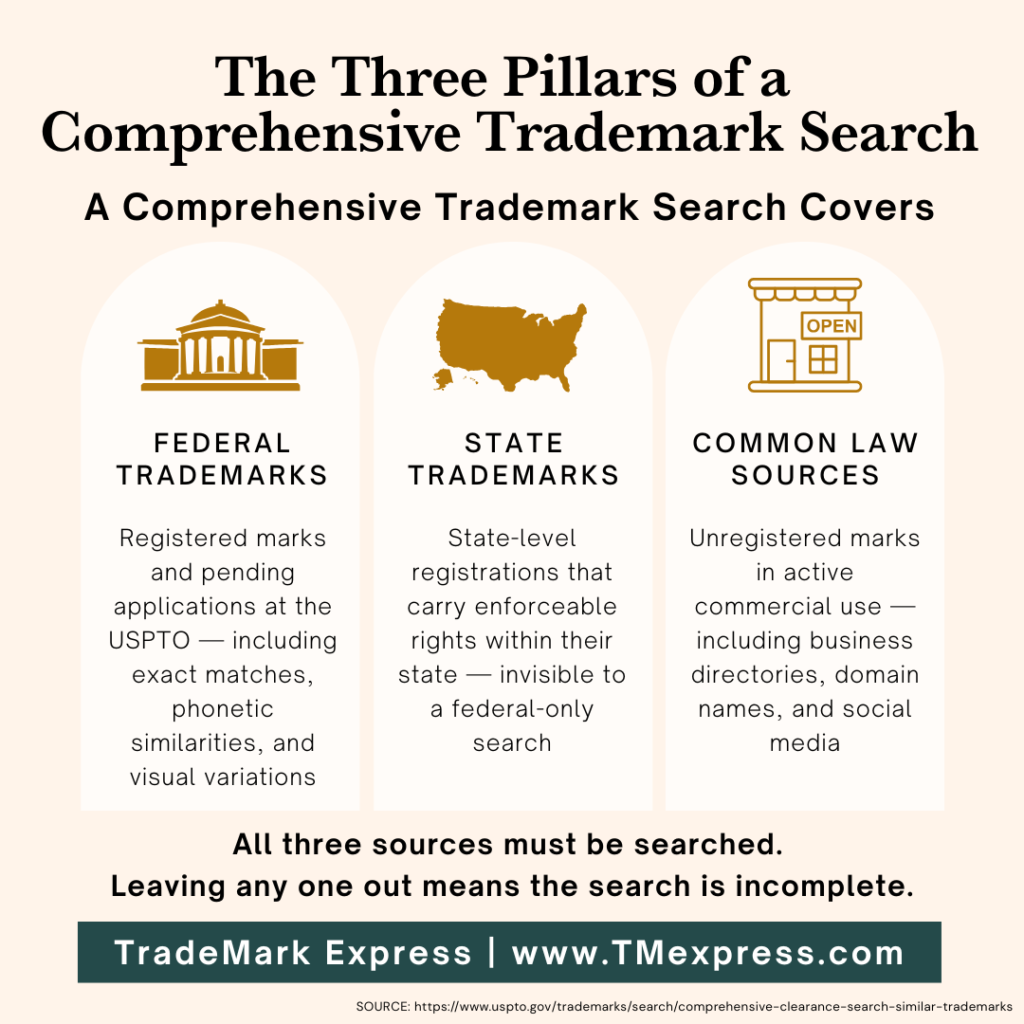
A truly comprehensive trademark search has three distinct components. Each one covers a different source of prior rights. Leaving any one out means the search is incomplete.
Federal Trademark Search
The federal search examines the USPTO’s database of registered marks and pending applications. This is the foundation of any trademark search — it covers marks that have been formally filed and either approved, pending examination, or recently expired.
A professional federal search goes well beyond typing a name into the search bar. It searches for:
Exact matches — any mark identical to yours in the same or related class of goods or services.
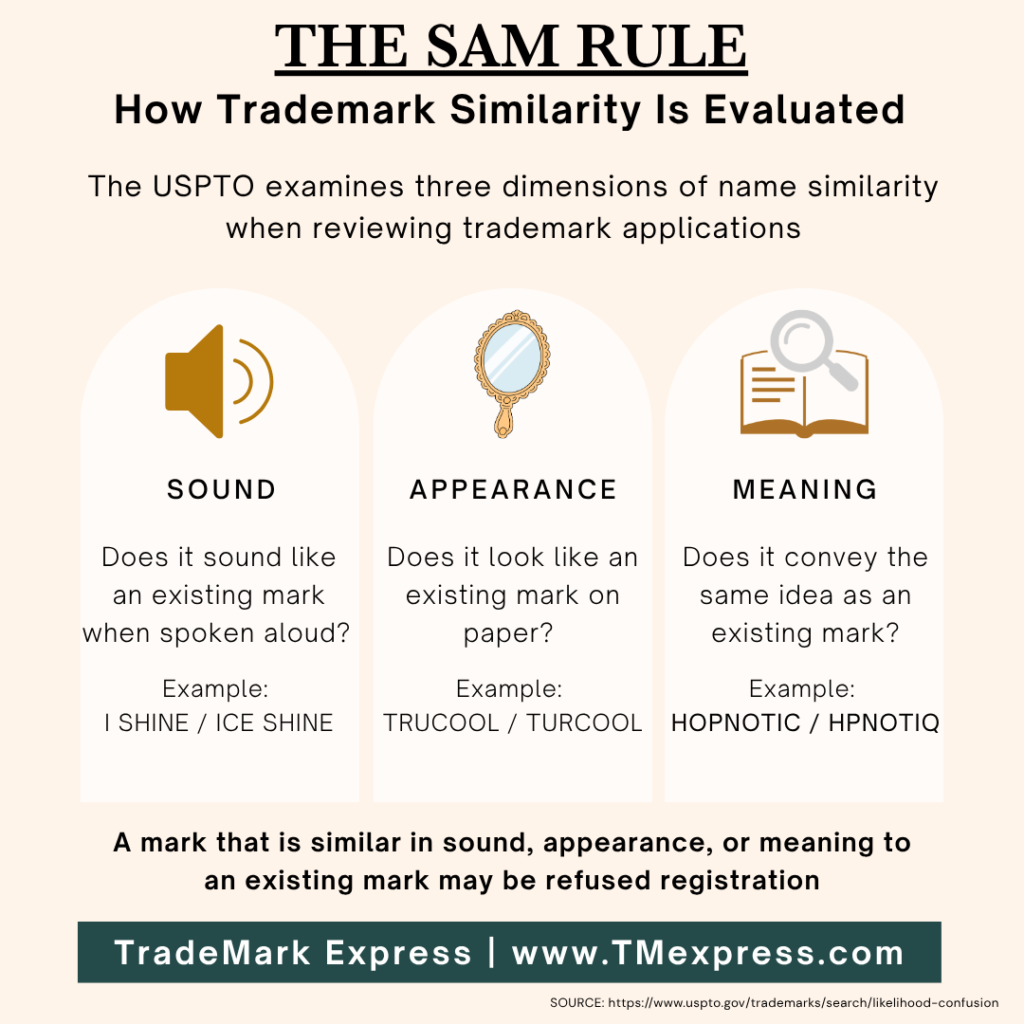
Phonetic similarities — marks that sound like yours even if spelled differently. The USPTO evaluates marks as they are spoken, not just as they appear in writing. A mark that sounds confusingly similar to yours is treated the same as one that looks identical. For example, “I SHINE” and “ICE SHINE” could be considered confusingly similar in sound.
Visual similarities — marks that look like yours even if they are not spelled the same. Even minor visual differences may not be enough to avoid a likelihood of confusion finding. “TRUCOOL” and “TURCOOL” could be considered confusingly similar in appearance.
Meaning similarities — marks that convey the same idea or concept as yours. “HOPNOTIC” and “HPNOTIQ,” for example, could be considered confusingly similar in meaning even though neither is spelled the same as the other.
This three-part analysis — Sound, Appearance, and Meaning — is the framework the USPTO uses when examining applications for likelihood of confusion. A comprehensive search applies the same framework so you can identify risk before the examiner does.
State Trademark Search
Federal trademark registration is not the only form of trademark protection in the United States. Many businesses hold state trademark registrations, which provide enforceable rights within the state where they are registered. These registrations do not appear in the USPTO’s database — they exist in separate state-level systems and require separate research.
This matters for two reasons. First, a state registration in a key market for your business represents a real conflict even if it does not block your federal application outright. Second, a business with a state registration may also have common law rights that extend beyond their registered territory. Overlooking state registrations is one of the most common gaps in DIY trademark searches.
For more on how state and federal trademark protection differ, see State Trademark vs. Federal Trademark.
Common Law Search
Common law trademark rights arise from actual use of a mark in commerce — not from registration. A business that has been operating under a name for years has rights to that name in its geographic area of use, even if it has never filed a trademark application of any kind.
Those rights will not appear in any government trademark database. They are invisible to anyone who only searches the USPTO or state trademark systems. And they can still be used against you — either to oppose your federal application or to assert prior use in a specific geographic market that matters to your business.
This is why common law research is not an optional add-on to a comprehensive search. It is a core component of it.
A thorough common law search examines:
- Business name directories and company databases
- Domain name registrations
- Social media handles and profiles
- Online marketplaces
- Industry trade publications and journals
- Major newspaper and wire service archives
- Websites operating under similar names in your industry
The goal is to surface any use of a similar mark in commerce that could represent prior rights — regardless of whether that use has ever been formally registered anywhere.
For more on how common law rights work, see Common Law Trademark Rights: What Are They?
How Relatedness of Goods and Services Affects the Search
Finding a similar mark in a search does not automatically mean you have a conflict. Trademark law considers two marks confusingly similar only when both the marks themselves and the goods or services they cover are related closely enough that consumers might assume they come from the same source.
This means a comprehensive search cannot evaluate results in isolation. Every potential conflict needs to be assessed in the context of what goods or services it covers and how those relate to yours.
The goods and services do not need to be identical to create a conflict — they only need to be related in a way that could cause consumer confusion about the source.
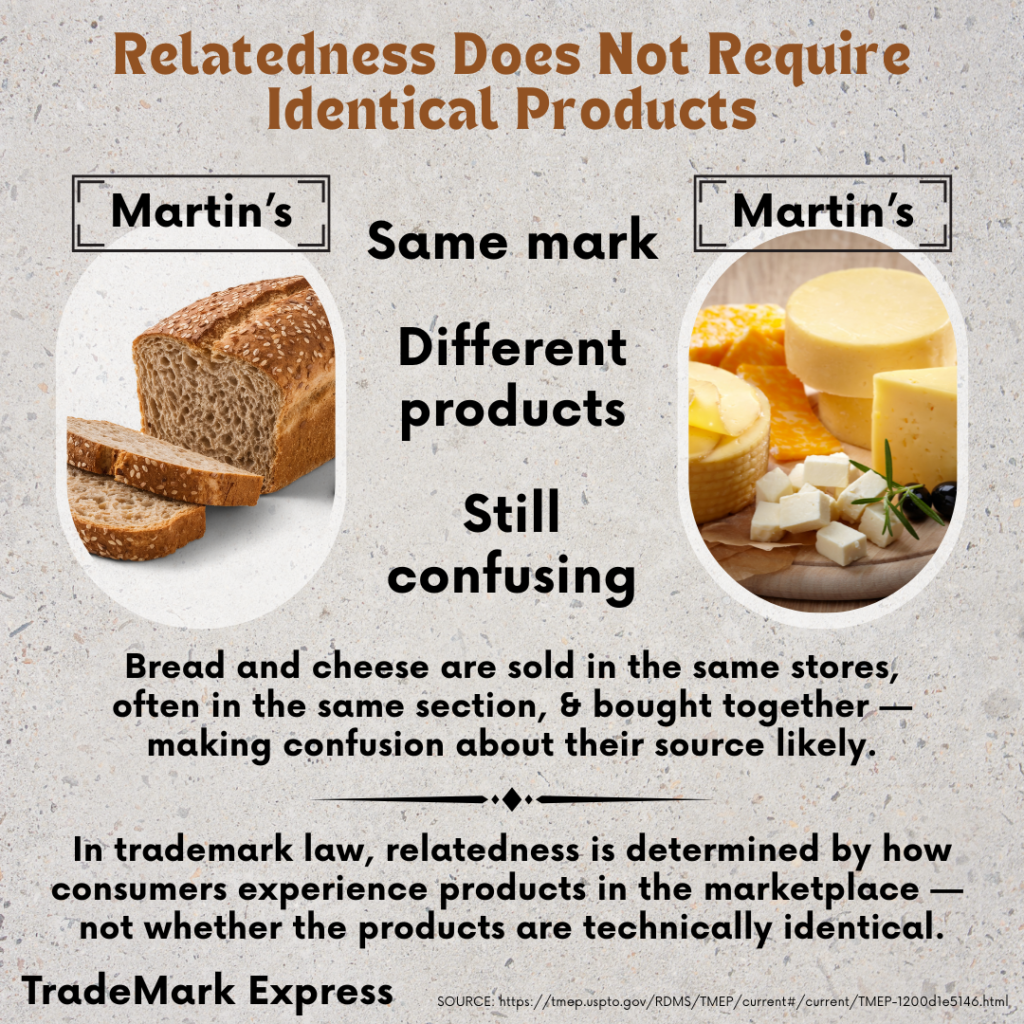
A well-known example illustrates this clearly. Two companies were both using the name MARTIN’S — one for wheat bran and honey bread, the other for cheese. A court found likelihood of confusion between the marks even though bread and cheese are different products. The reasoning: bread and cheese are complementary foods, sold in the same stores, often in the same section, and commonly purchased together. Consumers could reasonably assume both products came from the same company.
The takeaway for trademark applicants is that relatedness is determined by how consumers actually experience goods and services in the marketplace — not just by whether they are technically the same product. A professional comprehensive search accounts for this in evaluating every result.
For a deeper look at how trademark conflicts are assessed, see Trademark Conflicts: It’s Not Just Exact Matches and Trademark Confusion Explained.
What Happens After a Comprehensive Search
A comprehensive trademark search produces a detailed report — not just a list of results, but an organized analysis of what was found and what it means for your filing.
The report identifies potential conflicts, explains the basis for concern in each case, and gives you a clear picture of the risk landscape for your mark. From there, you have the information you need to make an informed decision.
If the search comes back clear, you can move forward toward filing with substantially greater confidence than you would have had without searching. A clear search is not a guarantee of registration — the USPTO examiner may identify issues a search did not surface — but it significantly reduces the likelihood of a surprise refusal.
If the search turns up conflicts, you have options. Depending on the nature and strength of each conflicting mark, those options may include modifying your mark to reduce similarity, narrowing your goods and services description, choosing a different name, or consulting a trademark attorney to evaluate the level of risk and discuss strategy. Finding a conflict before filing is far preferable to finding out during examination — or after your brand is already built.
For guidance on what to do when a search surfaces a conflict, see Using Trademark Search Results to Perfect Your Brand Name.
What a Comprehensive Search Is Not
A few clarifications worth stating directly.
A comprehensive search is not a legal opinion. A search report identifies potential conflicts and presents findings. It does not constitute legal advice and is not a guarantee of registration. If your search turns up significant conflicts, consulting a trademark attorney is the appropriate next step.
A comprehensive search is not the same as an automated scan. Software-generated reports that scan only the federal database and return unanalyzed results are not comprehensive searches. The depth of research and the quality of analysis are what distinguish a comprehensive search from a basic one.
A comprehensive search is not required by the USPTO. You can file a trademark application without conducting any search at all. However, doing so means filing blind — with no knowledge of what conflicts exist and no ability to assess the risk you are taking on. Given that application fees are non-refundable, filing without searching is a significant financial and strategic risk.
Frequently Asked Questions
What is a comprehensive trademark search? A comprehensive trademark search is a professional investigation covering the federal trademark register, state trademark databases, and common law sources — including business directories, domain names, and social media — to identify potential conflicts before filing a trademark application. It includes expert analysis of the results and a detailed report of findings.
How is a comprehensive search different from a free USPTO search? The USPTO’s free Trademark Search tool covers the federal register only. It does not cover state trademark registrations or common law uses. A comprehensive search covers all three sources and includes professional analysis of the results. See How to Do a Free Trademark Search for a full breakdown of what a DIY search covers and where it falls short.
Is a comprehensive trademark search required before filing? The USPTO does not require a search before filing. However, filing without one means submitting your application without knowing what conflicts exist. Application fees are non-refundable, and a conflicting mark you could have found in a search can result in refusal — or an infringement claim after your brand is already established.
What does a comprehensive trademark search report include? A comprehensive search report identifies potential conflicts across federal, state, and common law sources, explains the basis for concern in each case, and presents findings in a format you can understand and act on. It is an analysis, not just a list of results.
How long does a comprehensive trademark search take? A professional comprehensive trademark search typically takes a few business days, depending on the provider and the complexity of the search.
What happens if a comprehensive search finds a conflict? A conflict found during a search is not necessarily a dead end. Depending on the nature and strength of the conflicting mark, your options may include modifying your mark, narrowing your goods and services, choosing a different name, or consulting a trademark attorney to assess the level of risk. Finding a conflict before filing gives you the most options.
How much does a comprehensive trademark search cost? Professional comprehensive searches typically range from $600 to $1000 or more depending on the provider and scope of research. See our trademark search pricing guide for a full breakdown of what different search levels include and what each costs.
Ready to Search Before You File?
A comprehensive trademark search is the most important step you can take before submitting a trademark application. It tells you what you are working with, where the risks are, and whether your mark is viable — before you spend money on a filing.
TradeMark Express specializes in comprehensive trademark research. Our searches cover the federal register, state trademark databases, and common law sources. Our reports are prepared by experienced trademark analysts and give you a clear picture of what was found and what it means for your filing.
Learn about our trademark search services or contact us to get started.
Pingback: File a Trademark Application: The How-To - TME
Pingback: Understanding Trademark Classes in the US: A Comprehensive Guide - TME
Pingback: Trademark a Logo: Decoding Your Brand's Visual Identity
Pingback: How to Trademark a Name
Pingback: Unlocking the Supplemental Register Trademark
Pingback: Trademark Refusals: 7 Common Reasons
Pingback: Trademark a Slogan: Protecting Your Brand's Catchy Phrases
Pingback: What Are Fanciful Trademarks, and Why Are They So Powerful?
Pingback: Deciphering Trademark Likelihood of Confusion Refusal
Pingback: Arbitrary Trademarks: The Essentials
Pingback: Maple Leaf to Market: A Guide to Canada Trademark Registration
Pingback: How to Trademark Your Food Brand
Pingback: How to Trademark an App
Pingback: 7 Common Trademark Mistakes
Pingback: Trademark Class 20: Furniture
Pingback: Trademark Services for Branding Agencies
Pingback: Can You Trademark a Name Without a Trademark Search?
Pingback: When to Search for Trademarks
Pingback: Using Trademark Search Results to Perfect Your Brand Name
Pingback: Trademark Search Pricing: What’s Worth the Cost
Pingback: Bill Belichick's Trademark Rejections
Pingback: How to Spot Red Flags When Choosing a Trademark Company
Pingback: Trademark Lessons from the LAS VEGAS ATHLETICS
Pingback: Trademark Search