
What Is the Difference Between the USPTO Trademark Search and a Professional Trademark Search?
If you are getting ready to file a trademark application, you have probably come across two options for searching existing marks: the USPTO’s free Trademark Search tool and professional trademark search services. They are not the same thing — and understanding the difference matters before you decide how to proceed.
The short version: the USPTO’s Trademark Search tool is a useful starting point, but it covers only one database and returns results that require significant expertise to interpret correctly. A professional trademark search covers more ground, involves trained human analysis, and gives you a clearer picture of your risk before you file.
This post walks through exactly what each option covers, where each one falls short, and how to decide which is appropriate for your situation.
What Is the USPTO Trademark Search Tool?
The USPTO’s Trademark Search is a free, publicly available database search tool that allows anyone to search federally registered trademarks and pending applications. It is maintained by the USPTO and updated regularly as new applications are filed and processed.
It is a legitimate and important resource. Every trademark professional uses it as part of the search process. For a quick check of whether an identical mark already exists in your class, it is fast and accessible.
What it is not is a complete trademark search. Its coverage is limited to the federal register — one database among several that matter when evaluating trademark availability.
What the USPTO Trademark Search Covers
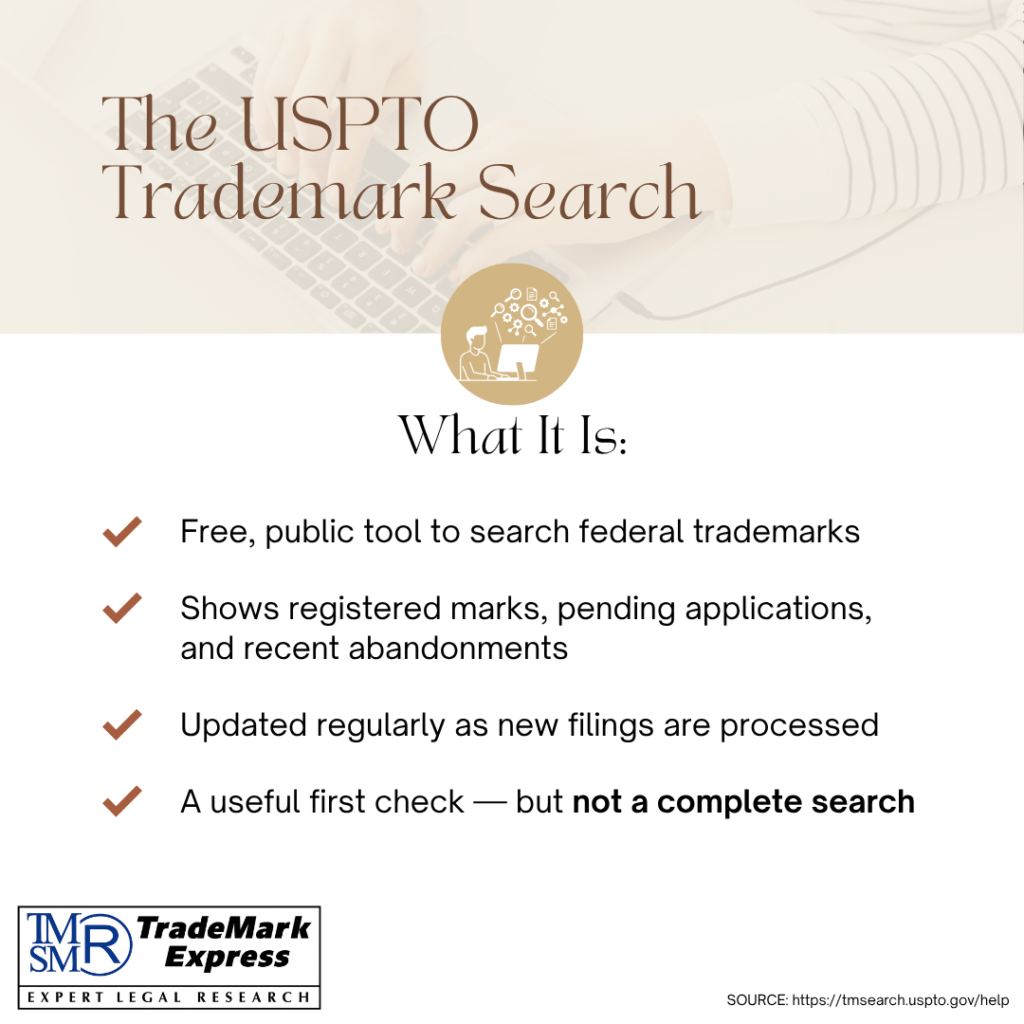
- Federally registered trademarks
- Pending trademark applications
- Marks in various stages of examination
- Recently expired, cancelled, or abandoned federal marks
What the USPTO Trademark Search Does Not Cover
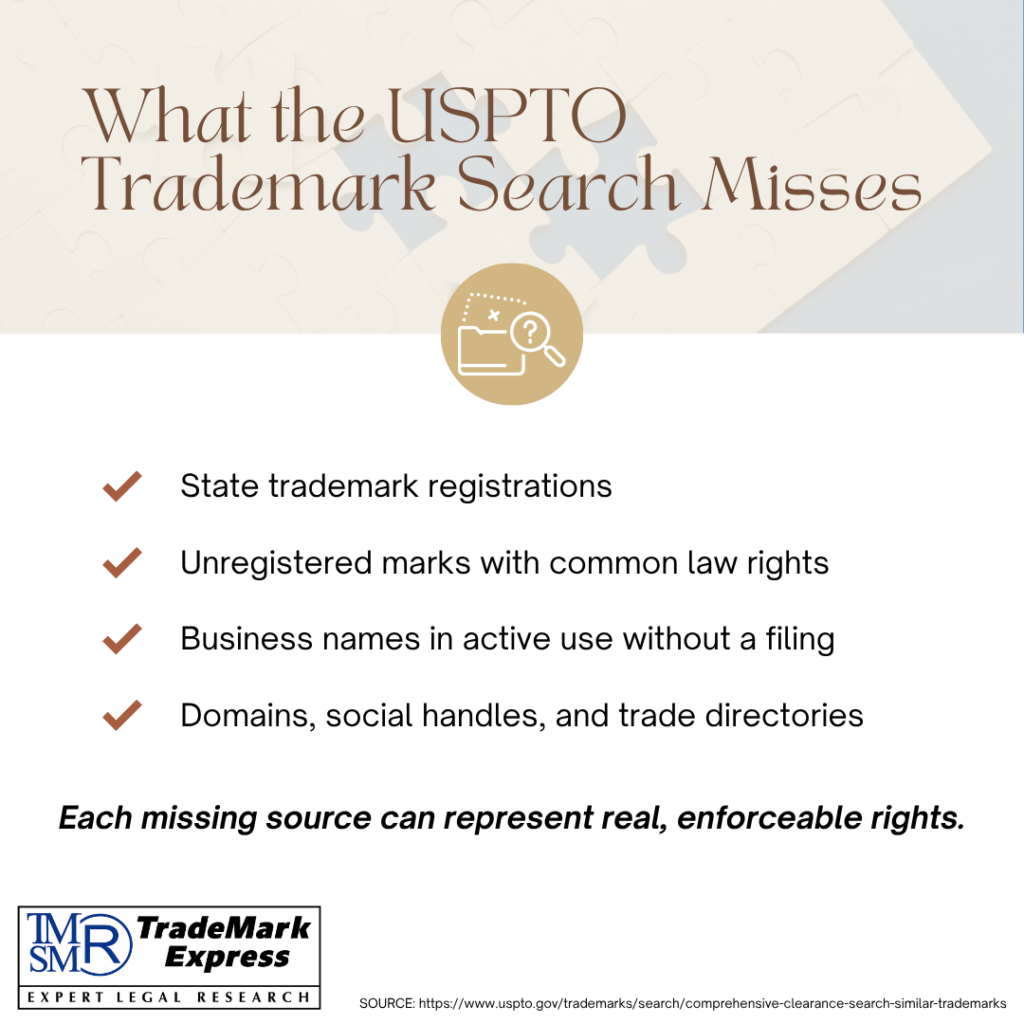
- State trademark registrations
- Unregistered marks with common law rights
- Business names in active commercial use without any registration
- Domain names, social media handles, or online marketplace listings
- Industry directories or trade publications
Each of the sources missing from the USPTO’s tool can represent real prior rights.
For example…
- A business that has been using a name in commerce for years without ever filing a trademark application may have enforceable common law rights in their geographic market.
- A company with a state trademark registration has legally protected rights within their state.
Neither will appear in a USPTO search.
What Is a Professional Trademark Search?
A professional trademark search is a comprehensive investigation conducted by an experienced trademark analyst using professional-grade research tools and databases. It covers the federal register, state trademark databases, and common law sources — and the results are analyzed and presented in a structured report.
The key distinction is not just what databases are searched. It is what happens to the results afterward.
Raw search results are not a clearance decision.
They are a starting point that requires interpretation — evaluating each potential conflict based on similarity of the marks, relatedness of the goods and services, channels of trade, and other likelihood-of-confusion factors.
That evaluation requires knowledge of how the USPTO examines applications and experience with how conflicts play out in practice.
What a Professional Trademark Search Covers
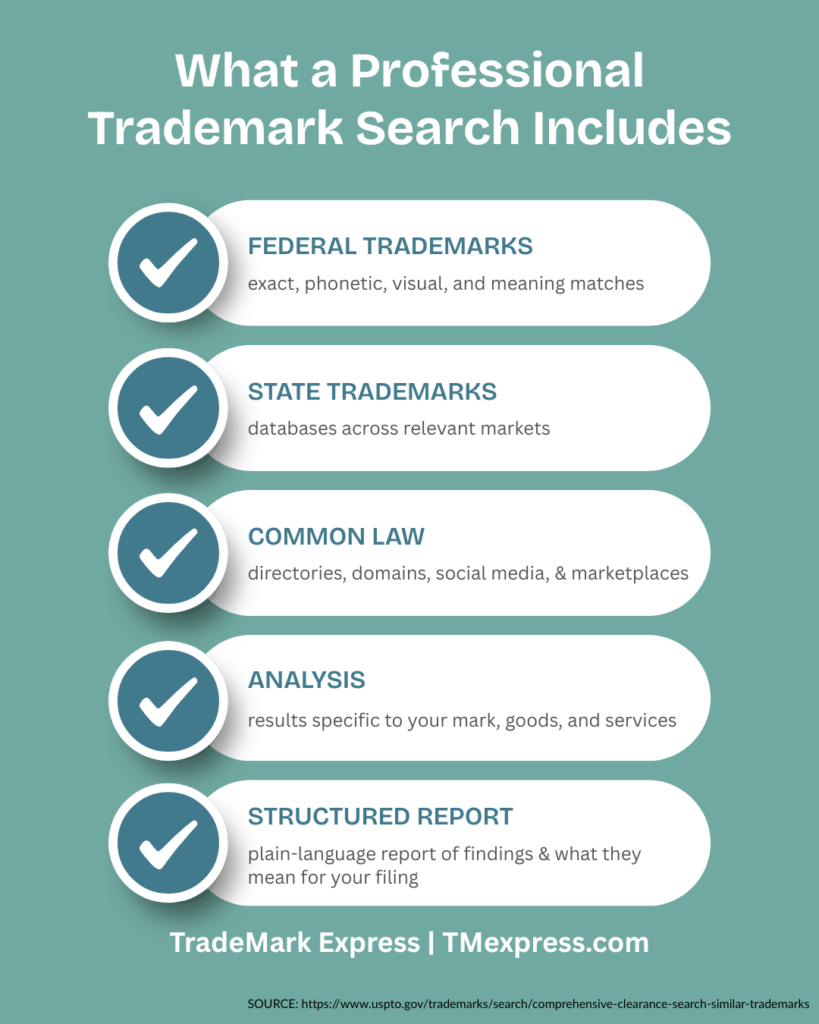
- The full federal register, searched for exact matches, phonetic similarities, visual variations, and meaning similarities
- State trademark databases across relevant geographic markets
- Common law sources including business directories, domain registrations, social media, online marketplaces, and news sources
- Analysis of each result in the context of your specific mark, goods, and services
- A plain-language report explaining findings and their implications for your filing
For a full breakdown of what a comprehensive professional search involves, see What Is a Comprehensive Trademark Search.
Side-by-Side Comparison
USPTO Trademark Search | Professional Trademark Search | |
Cost | Free | $600-$1000 for a comprehensive search |
Federal register | Yes | Yes |
State trademark databases | No | Yes |
Common law sources | No | Yes |
Domain names / social media | No | Yes |
Human expert analysis | No | Yes |
Plain-language report | No | Yes |
Appropriate before filing | As a starting point only | Yes |
Where the USPTO Trademark Search Falls Short
Understanding the specific limitations of the USPTO tool helps clarify why it is not sufficient on its own before filing.
It Requires You to Know How to Search It
Running a basic search in the USPTO Trademark Search tool is straightforward. Type in your mark, hit search, and results come back. The problem is that a basic search is rarely sufficient.
A thorough federal search requires searching far beyond your exact mark. Phonetic variations, alternative spellings, root words, foreign equivalents, plural forms, and design code searches for logo marks all need to be run separately — and knowing which variations to search, and how to construct those searches correctly, takes experience with the tool and with trademark law.
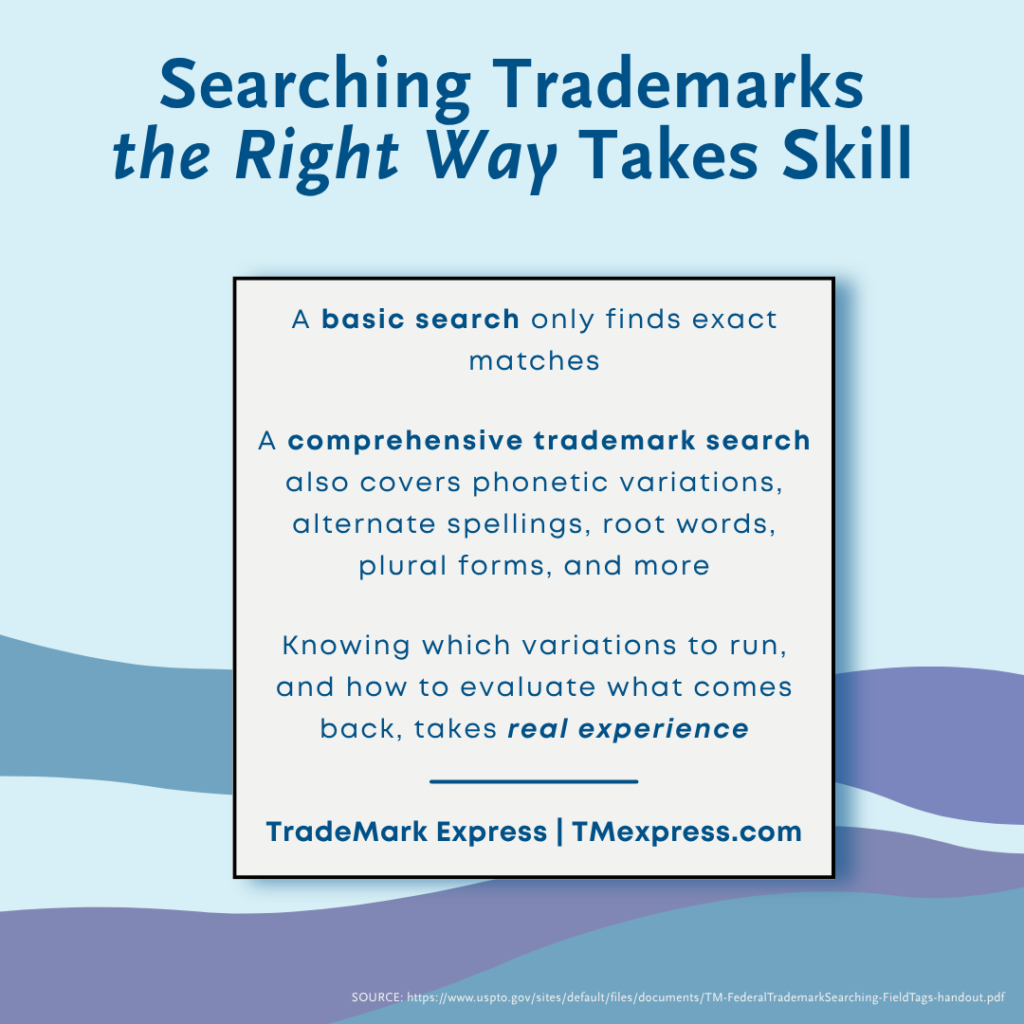
Searching for “BLUEBIRD” as an exact term is easy.
Knowing to also search “BLUE BIRD,” “BLU BIRD,” “BLOOBYRD,” “BRD BLEU,” and related terms — and then knowing how to filter and evaluate what comes back across multiple classes — is a different skill entirely.
It Does Not Surface Common Law Rights
Common law trademark rights arise from use in commerce — not from registration. A business that has been operating under a name for years has rights in their geographic market regardless of whether they have ever filed a trademark application. Those rights can be asserted against your federal application or used to challenge your mark after registration.
The USPTO tool will never show you these marks. That gap is one of the most significant risks in relying on a DIY search before filing. For more on how common law rights work, see Common Law Trademark Rights: What Are They?
It Misses State Trademark Registrations
Many businesses hold state trademark registrations that provide enforceable rights within their state. These registrations do not appear in the USPTO database. If you plan to operate in a specific state or region, a state trademark registration in that market is a real conflict worth knowing about before you file. See State Trademark vs. Federal Trademark for more on how state registrations work.
Results Require Expert Interpretation
Returning a list of results is not the same as analyzing them. When you search the USPTO database, you get back every mark that matches your search parameters — but knowing which results represent real conflicts and which do not requires familiarity with trademark law and USPTO examination practices.
Two marks can look similar in a search result and pose no real conflict if the goods and services are entirely unrelated. Two marks can look different and still be considered confusingly similar if they sound alike or convey the same meaning.
Sorting through this accurately takes experience. For more on how trademark similarity is evaluated, see Trademark Confusion Explained.
When a USPTO Search Alone Is and Is Not Enough
There are situations where a quick USPTO search serves a legitimate purpose — and situations where relying on it alone creates real risk.
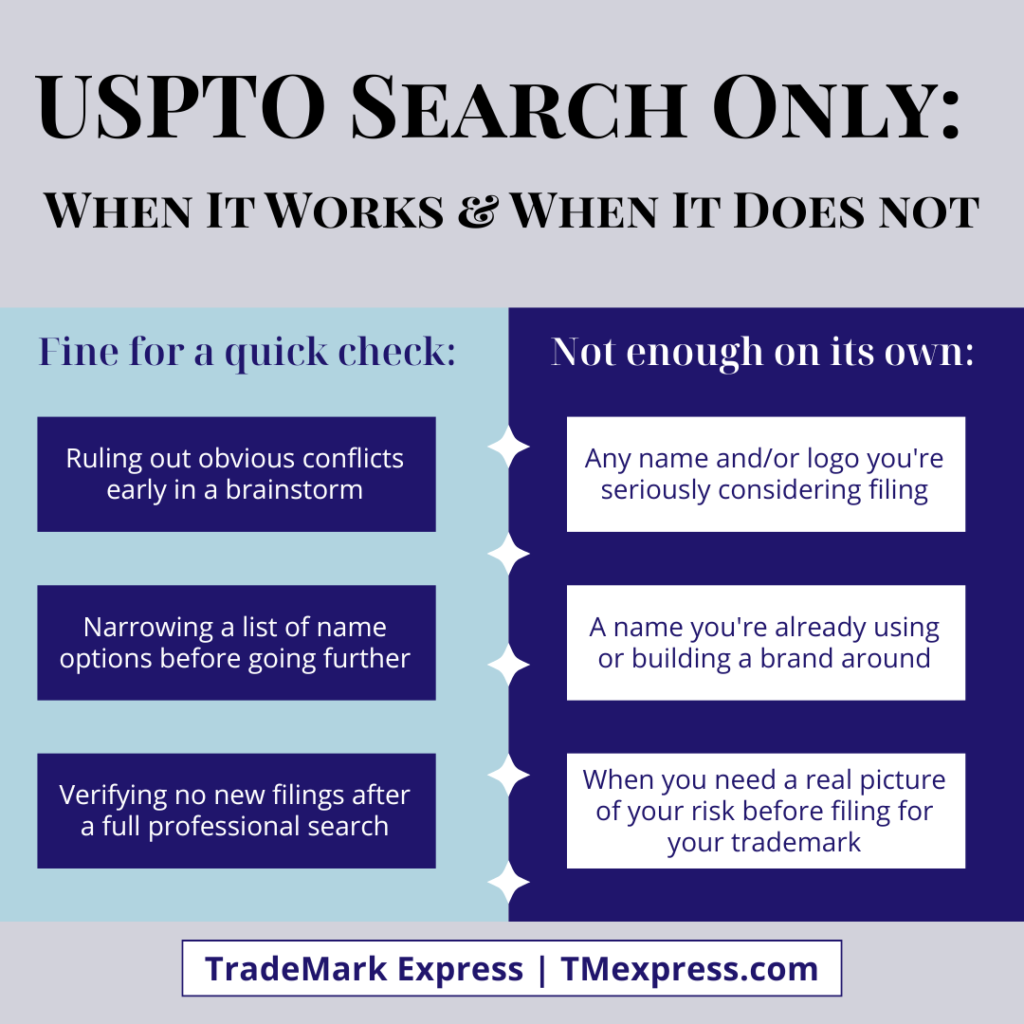
A USPTO search alone may be appropriate for:
- A fast preliminary knockout check to rule out obvious identical conflicts before investing more time
- An early-stage brainstorm when you are evaluating multiple name options and want to eliminate clear blockers quickly
- A supplemental check after a professional search to verify nothing new has been filed in the interim
A USPTO search alone is not appropriate for:
- Any name and/or logo you are seriously considering filing
- A mark you are already using or planning to build a brand around
- Any situation where you need to assess your actual risk before committing to an application
If you are at the point of deciding whether to file, a professional comprehensive search is the appropriate standard. The cost of a professional search is modest compared to the non-refundable USPTO filing fees you will pay when you submit your application — and far less than the cost of a refusal, a rebranding, or an infringement dispute.
See Trademark Search Pricing for a full breakdown of what professional search services typically cost.
Can You Use Both?
Yes — and in practice, a professional search always includes a thorough search of the USPTO database as its federal component. A professional search does not replace the USPTO tool; it incorporates it alongside the additional sources and analysis that make the search complete.
If you want to do a quick self-check first before ordering a professional search, that is a reasonable approach.
Run a basic USPTO search to identify any obvious identical conflicts. If nothing jumps out, proceed to a professional comprehensive search before filing.
Do not treat a clean USPTO result as a green light to file — it does not that the full landscape is clear.
Frequently Asked Questions
Is the USPTO Trademark Search free? Yes. The USPTO’s Trademark Search tool at tmsearch.uspto.gov is publicly available and free to use. It searches federally registered trademarks and pending applications.
Does the USPTO trademark search show common law marks? No. The USPTO tool only covers the federal register. Unregistered marks with common law rights do not appear in any government trademark database. A professional comprehensive search covers common law sources separately.
Can I rely on the USPTO search before filing? As a standalone search, no. The USPTO tool covers one database and returns results that require expert interpretation. It does not cover state registrations or common law uses. For any mark you are seriously considering filing, a professional comprehensive search is the appropriate standard.
What does a professional trademark search cost? Professional comprehensive searches typically range from $600 to $1000 or more depending on the provider and scope. See our trademark search pricing guide for a full breakdown.
How long does a professional trademark search take? A professional comprehensive search typically takes a few business days depending on the provider and complexity of the search.
What happens if I file without doing a professional search? You file without knowing what conflicts exist. USPTO application fees are non-refundable, and a conflicting mark discovered during examination can result in refusal. A conflict discovered after filing — or after your brand is established — can be significantly more disruptive and costly to resolve.
The Bottom Line
The USPTO Trademark Search is a valuable tool and a legitimate part of the search process. It is not a substitute for a comprehensive professional search before filing.
A professional search covers more sources, involves trained analysis, and gives you a complete picture of your trademark’s viability before you commit to an application. For any mark you are serious about protecting, that complete picture is worth having.
For a full overview of the trademark search process, visit our Trademark Search guide.
Ready to Go Beyond the Basics?
TradeMark Express conducts comprehensive trademark searches covering the federal register, state trademark databases, and common law sources. Our reports are prepared by experienced trademark analysts and give you a clear, thorough picture of your trademark landscape before you file.
Learn about our trademark search services or contact us to get started.
The information provided on this site is for general informational purposes only. All information on the Site is provided in good faith; however, we make no representation or warranty of any kind, express or implied, regarding the accuracy, validity, or completeness of any information on the Site. The Site cannot and does not contain legal advice. The legal information is provided for general informational and educational purposes only, and is not a substitute for legal advice. Consult a licensed attorney for legal advice.