
What You Need to Know to Trademark Your Wine Brand
You’ve built a wine brand — a name, a label, maybe a story that runs through every bottle you produce. Protecting that brand with a federal trademark registration is one of the smartest moves you can make. It gives you nationwide rights to your brand name, puts the public on notice that the name is yours, and gives you powerful tools if someone tries to copy it.
But trademarking a wine brand comes with a layer of complexity you won’t find in most other industries. Geographic names — and how they’re used on wine labels — are subject to special rules at the USPTO. Before you file, you need to understand how to trademark a wine brand the right way.
This guide walks you through the full process, from conducting a comprehensive trademark search to choosing the right NICE classes and avoiding the geographic pitfalls specific to wine.
Start with a Comprehensive Trademark Search
Before you take any other step, run a comprehensive trademark search. This isn’t optional — it’s the foundation of the entire process.
A comprehensive search goes well beyond the USPTO’s free Trademark Search database. It covers federally registered and pending trademark applications, state trademark registrations, and common law uses across the internet, social media, domain registrations, and industry directories. Wine brands are often built around evocative names, place references, and founder names, all of which require careful clearance work.
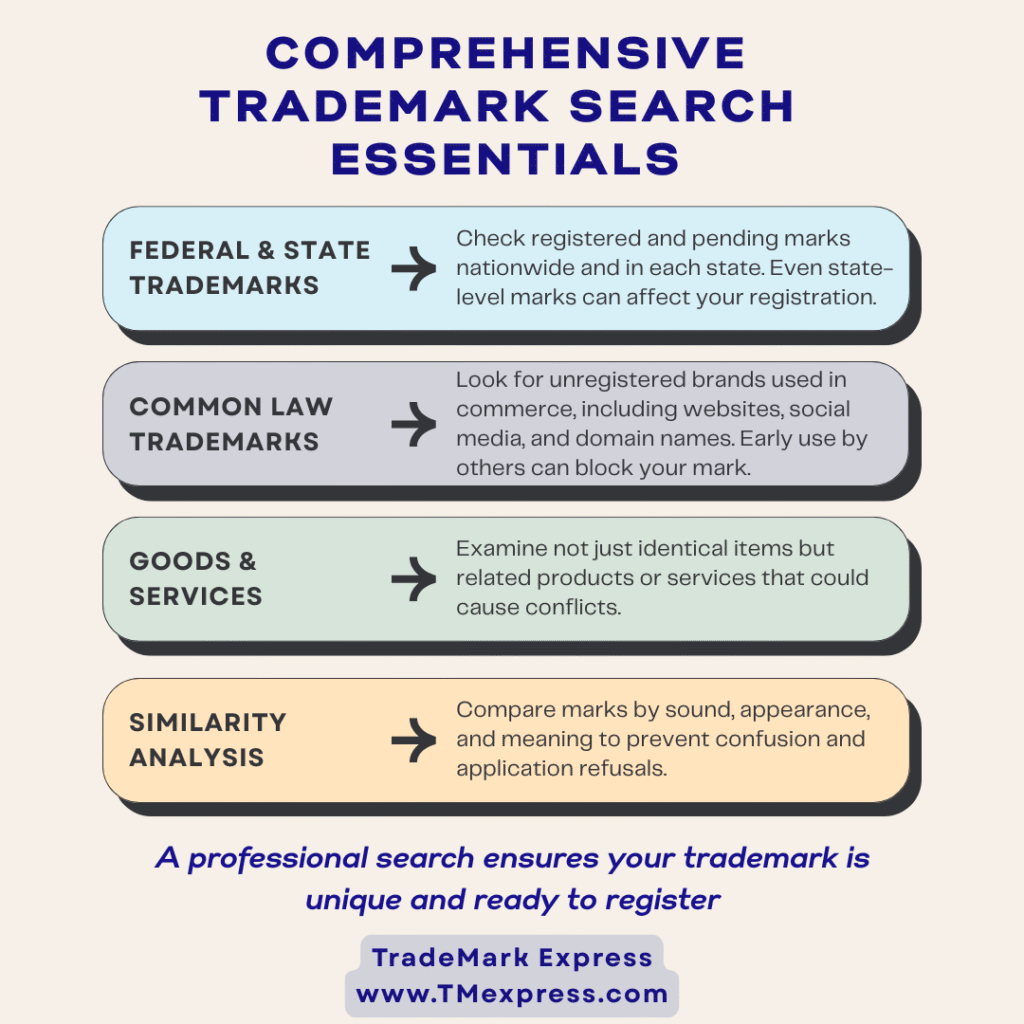
Why does this matter so much? If you file an application for a mark that conflicts with an existing registration, the USPTO may refuse it — and you may have already invested time and money building brand recognition around that name. A thorough search before you file helps you understand the risk landscape before you commit.
At TradeMark Express, comprehensive trademark research is the core of what we do. Our searches give you a clear picture of what’s already out there so you can make an informed decision about moving forward.
What Can You Trademark for Your Wine Brand?
A trademark can protect a wide range of brand elements. For wine producers, the most common registrations cover brand names, label designs, and logos. You can also register a distinctive tagline if it functions as a source identifier, though this is less common in the wine industry.
The USPTO evaluates every mark for distinctiveness. On the spectrum from generic to fanciful, the stronger your mark, the easier it is to register and the broader the protection it receives.
Strong Marks vs. Weak Marks in Wine Branding
Fanciful or arbitrary names — invented words or common words applied in an unexpected context — are the strongest. A made-up word used as a winery name, or a word with no connection to wine at all, is much easier to register than a name that describes the wine, the region, or the winemaking process.
Suggestive marks fall in the middle. These are names that hint at a quality, characteristic, or experience associated with the wine without directly describing it. The consumer has to use some imagination to make the connection.
Descriptive marks are harder to register. If your brand name directly describes a feature of your wine — its taste, its style, its grape variety — the USPTO may refuse registration unless you can show the mark has acquired distinctiveness through long and exclusive use in commerce. This is a high bar to clear, especially for newer brands.
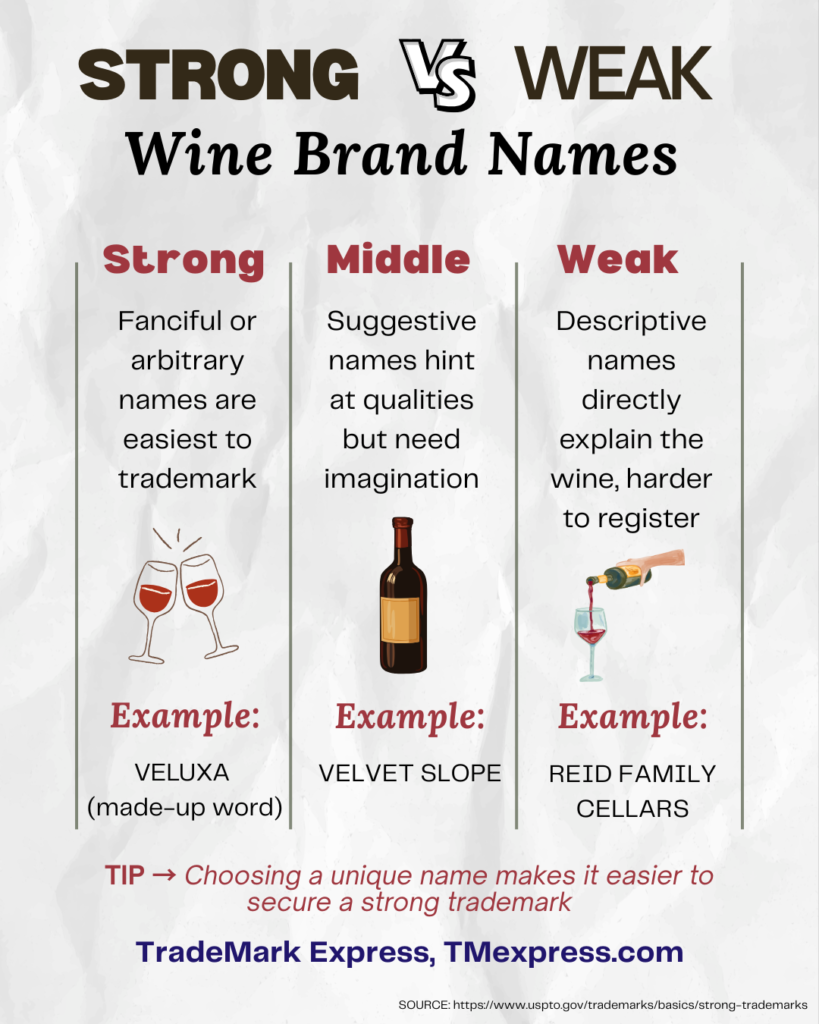
To see how this plays out in practice, consider four hypothetical wine brands.
- VELUXA is fanciful — an invented word with no prior meaning, and one of the strongest marks you can own.
- ANVIL is arbitrary — a real word that has nothing to do with wine, which makes it distinctive by default.
- VELVET SLOPE is suggestive — it hints at a smooth, refined wine from rolling vineyard terrain, but the consumer has to make that leap.
- REID FAMILY CELLARS is descriptive — it identifies the wine by the family name behind it rather than by any distinctive brand element, which is exactly why it would face the steepest path to registration.
Geographic Names on Wine Labels — What You Need to Know
This is where wine trademark registration diverges sharply from most other industries. The USPTO applies special rules to geographic names used on wine labels, and those rules have real consequences for your brand.
The Trademark Act (Section 2(a)) contains a specific provision for wines and spirits that doesn’t apply to other goods. Understanding it is essential before you name your brand.
Your Wine Does NOT Come From the Named Place (TMEP § 1210.08(a))
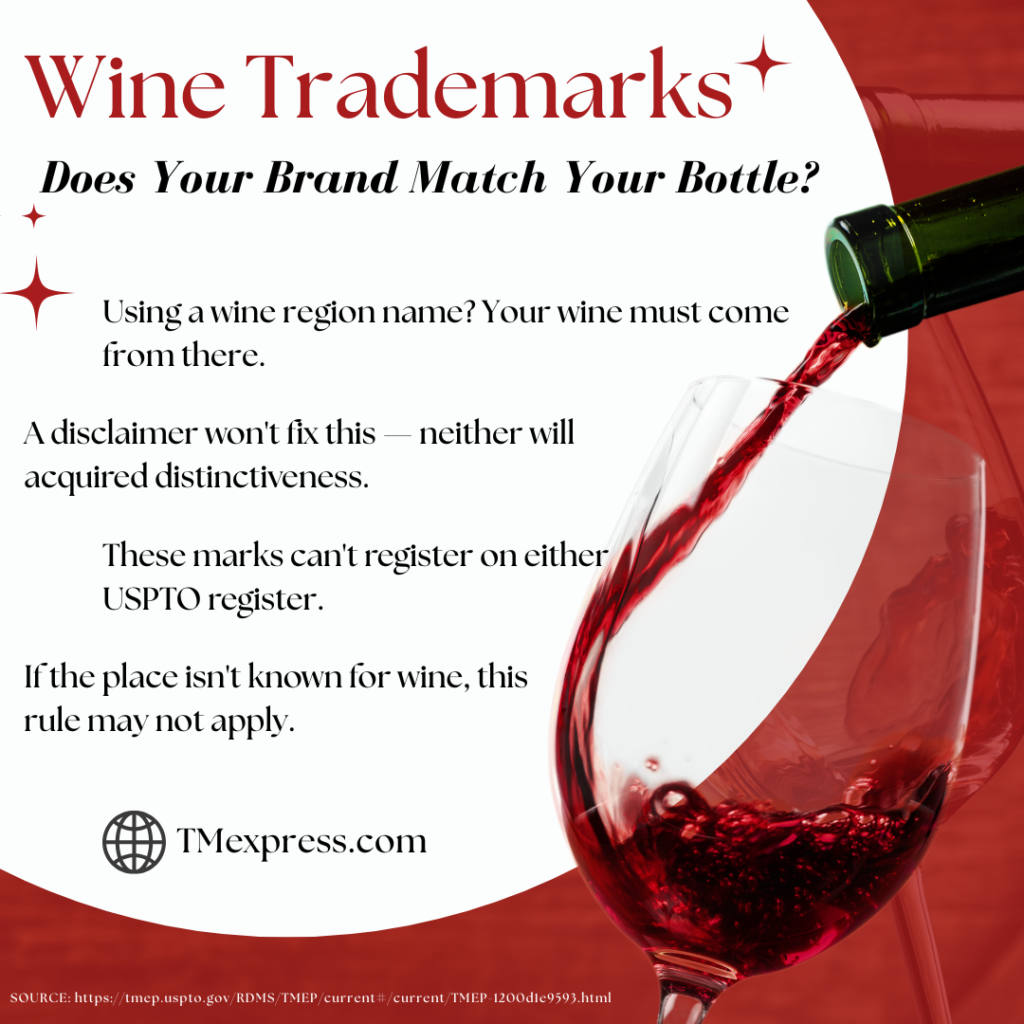
If your brand name includes — or is — a geographic term that consumers associate with a wine-producing region, and your wine does not actually come from that place, the USPTO will refuse registration under Section 2(a) of the Trademark Act.
This applies when four conditions are met: (1) the term’s primary significance is geographic; (2) consumers would likely associate the term with wine from that location; (3) your wine doesn’t actually originate there; (4) and that geographic association would influence a buyer’s decision. The first use of the mark in commerce must also have occurred on or after January 1, 1996, which is when this stricter standard for wine-related geographic terms took effect.
This type of refusal is effectively absolute. You can’t overcome it with a disclaimer, and acquired distinctiveness won’t help. These marks are not eligible for either the Principal or Supplemental Register. If your wine brand name evokes a well-known wine region — and your wine doesn’t come from there — you face a significant registration barrier.
A key nuance: the geographic location must be known to consumers for wine. If the place is obscure, or not recognized as a wine-producing region, the USPTO may find that no meaningful goods/place association exists.
Your Wine Does Come From the Named Place (TMEP § 1210.08(b))
If your wine originates in the region you’ve named in your mark, you face a different but related issue. When the primary significance of your mark is a well-known geographic location and the wine genuinely comes from there, the USPTO will generally refuse registration under Section 2(e)(2) as primarily geographically descriptive.
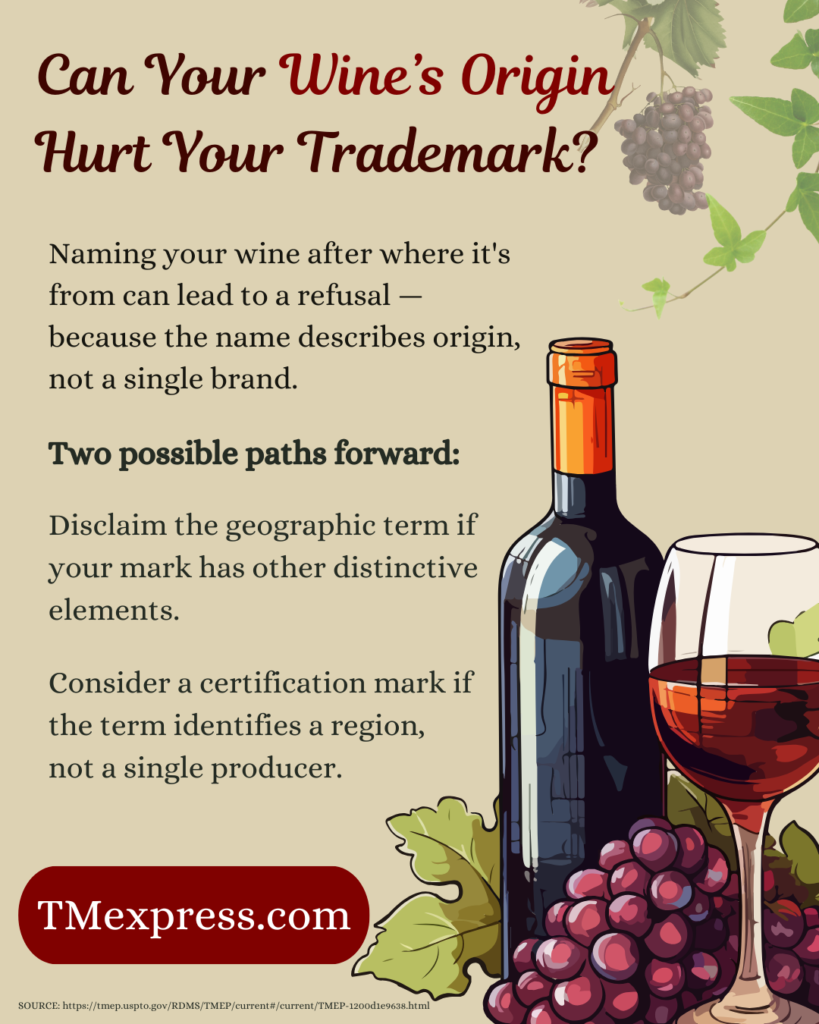
In plain terms: naming your wine after where it comes from can be an issue, because the name describes geographic origin instead of identifying a single brand source.
Unlike deceptively misdescriptive marks, this type of refusal may be overcome in certain circumstances.
In some cases, a geographic term can be disclaimed — meaning you acknowledge it isn’t exclusively yours — but only if the overall mark includes additional distinctive elements.
In other situations, if the term is used to certify that the wine originates from a specific region (rather than identify a single producer), it may be more appropriate for registration as a certification mark.
When a Geographic Term Has Become Generic for Wine (TMEP § 1210.08(c))
Some geographic terms have moved beyond mere description and are used in the United States as the generic name for a type or style of wine. Terms like “Champagne,” “Burgundy,” and “Chablis” are often cited as examples, though their treatment can vary depending on how U.S. consumers perceive them.
When a geographic term is generic in this sense — meaning consumers see it as designating a kind of wine rather than a place of origin — it cannot function as a trademark on its own. However, if the term is part of a composite mark (i.e., a mark made up of multiple elements, such as unique words, logos, or design features, where the generic term is just one part), the mark may still be registrable, typically with a disclaimer of the generic term.
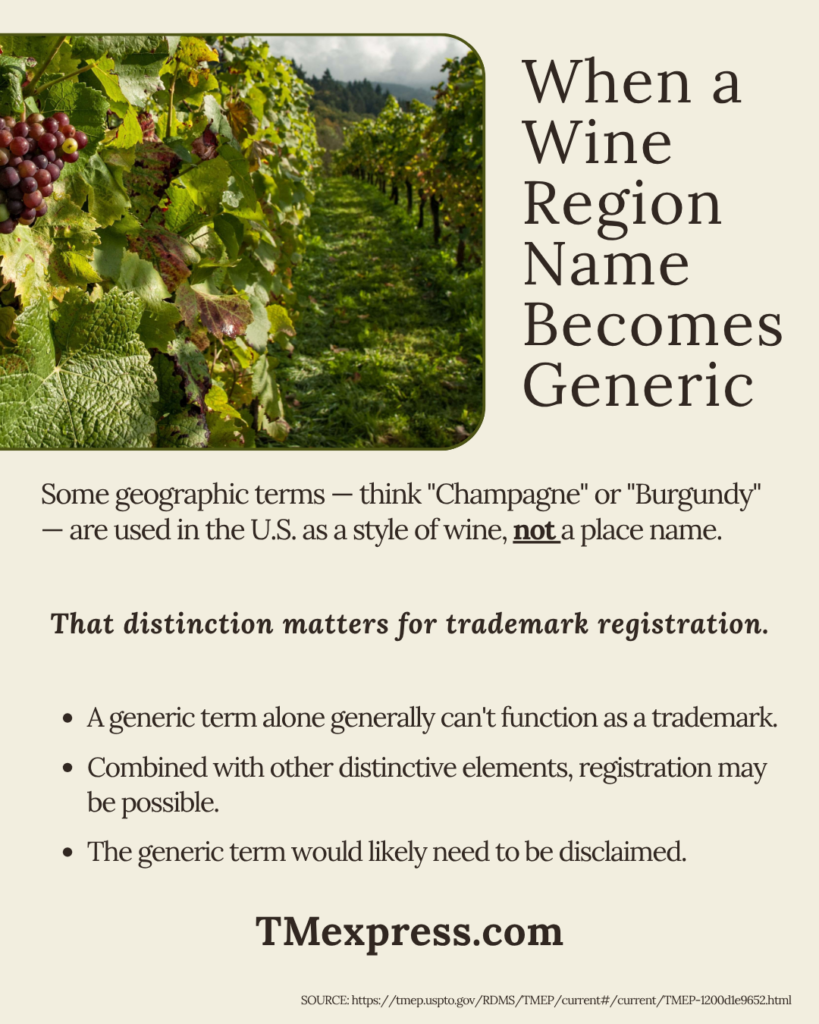
This is a separate analysis from geographic deceptiveness. In some cases, a term could raise both issues, depending on how consumers perceive it. The practical takeaway: widely recognized wine-region names can be especially difficult to register, if filed on their own.
Industry-Specific Considerations for Wine Brands
The wine industry sits at the intersection of several regulatory systems, and trademark registration doesn’t exist in isolation. A few additional considerations are worth understanding as you build your brand protection strategy.
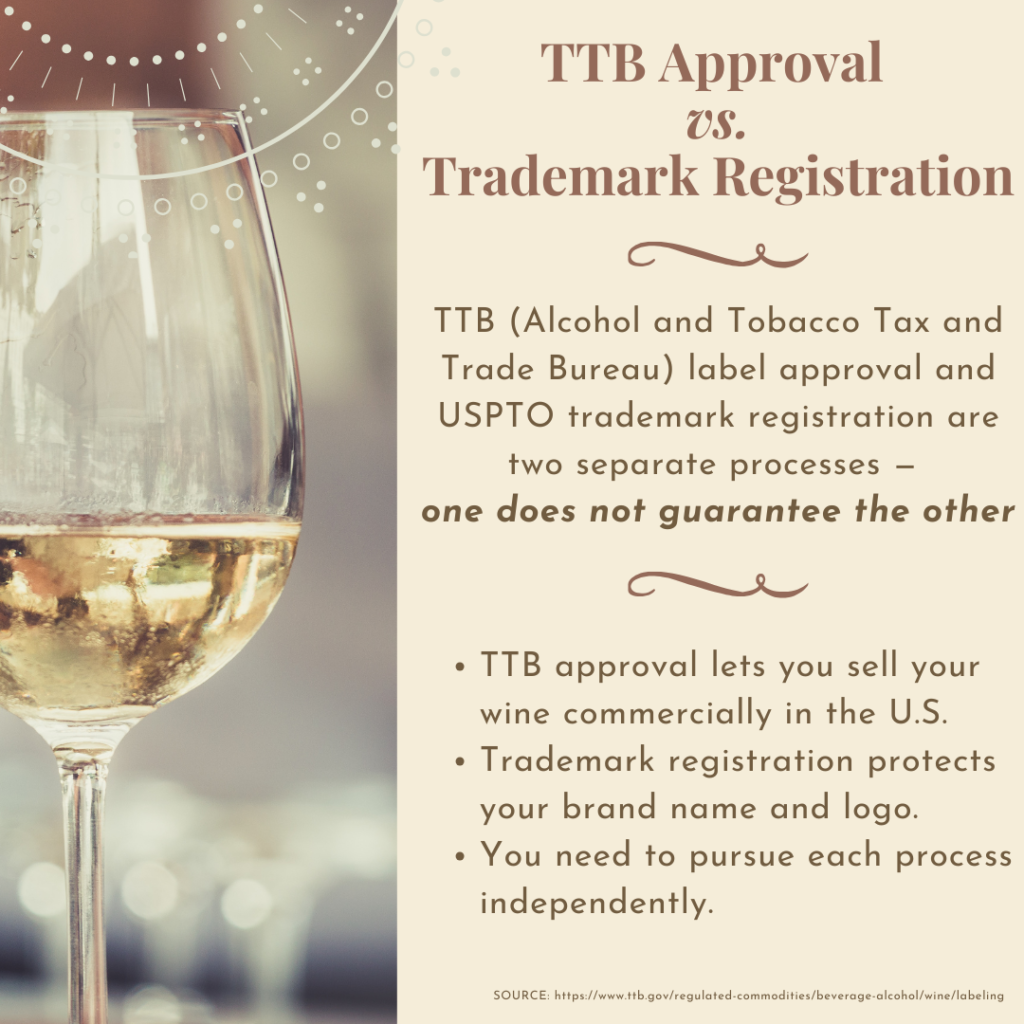
TTB label approval. Before a wine can be sold commercially in the United States, the label must be approved by the Alcohol and Tobacco Tax and Trade Bureau (TTB). TTB approval and USPTO trademark registration are entirely separate processes. Having one does not guarantee the other, and neither substitutes for the other.
AVA names and geographic certification. American Viticultural Area (AVA) designations are established by the TTB and define recognized wine-growing regions. An AVA name is essentially a geographic indicator of origin— it certifies that a percentage of the grapes came from that region. Because AVA names are geographic by definition, they are generally not registrable as individual trademarks on the Principal Register for wine. If you want to use a geographic term in a way that certifies regional origin rather than identifies a single commercial brand, a certification mark application may be the appropriate path.
International considerations. If you plan to sell in the European Union, Canada, or other markets, geographic indications are protected even more aggressively abroad than in the United States. Some terms that are generic in the U.S. are protected indications in the EU. This makes international trademark research an important part of global brand strategy for wine producers.
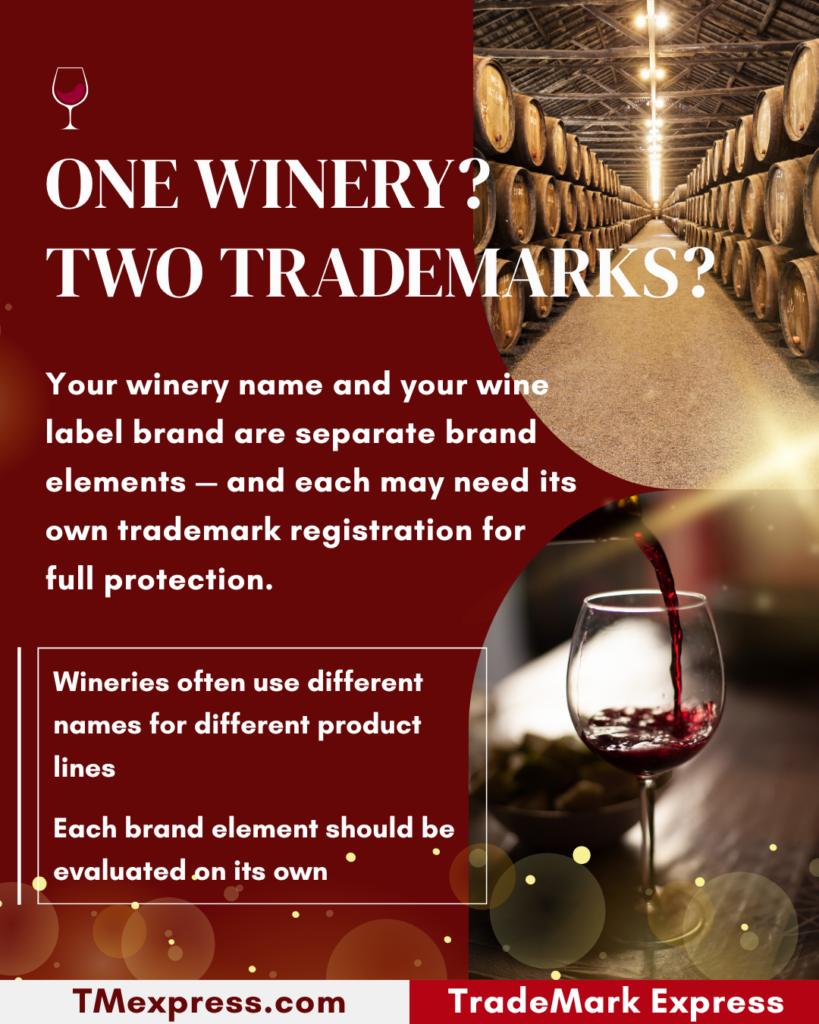
Winery name vs. wine label brand. It’s common for wineries to use different names for different product lines. Your winery’s corporate name and your wine label brand may each benefit from separate trademark registrations to achieve full protection. Evaluate each brand element individually when building your filing strategy.
NICE Classification for Wine Trademark Applications
Trademark applications filed with the USPTO are organized by NICE class — an international system that groups goods and services into 45 categories. Choosing the right class is essential because your registration only protects you in the classes you file in.
For wine brand registration, the relevant NICE class is:
Class 33 — Alcoholic beverages, except beers; wines, sparkling wines, and fortified wines.
This is the primary class for wine. It covers still wines, sparkling wines, rosé wines, and fortified wines such as port and sherry.
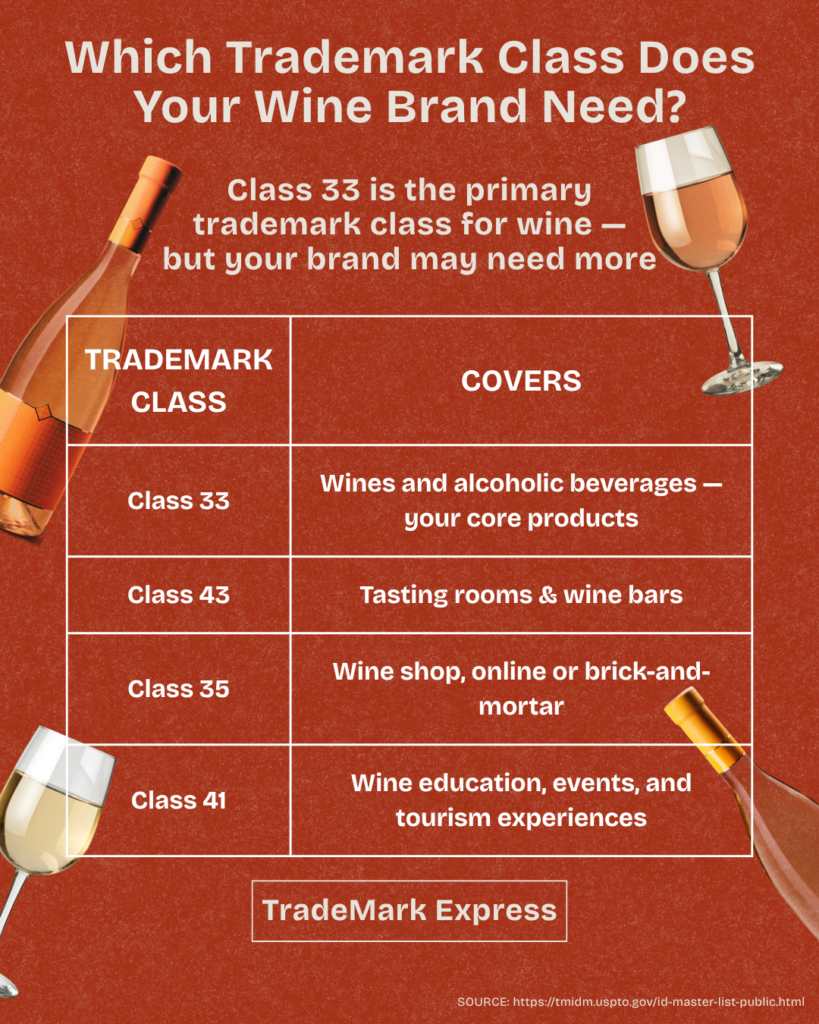
If your brand extends beyond wine itself, you may need to consider additional classes. Here are the most commonly relevant ones for wine businesses:
NICE Class | What It Covers | Wine Brand Application |
Wines and other alcoholic beverages (except beers) | Your core wine products | |
Restaurant and hospitality services; wine bar services | Tasting room, wine bar, or hospitality services offered under your brand | |
Retail store services, online or brick-and-mortar | Online wine shop or branded retail services | |
Education and entertainment services | Wine education classes, events, and wine tourism experiences |
Filing fees at the USPTO are currently $350 per class. Each additional class requires an additional filing fee.
How to File a Wine Brand Trademark Application
Once your comprehensive search is complete and you’ve confirmed your mark is clear, the process follows the standard USPTO filing steps.
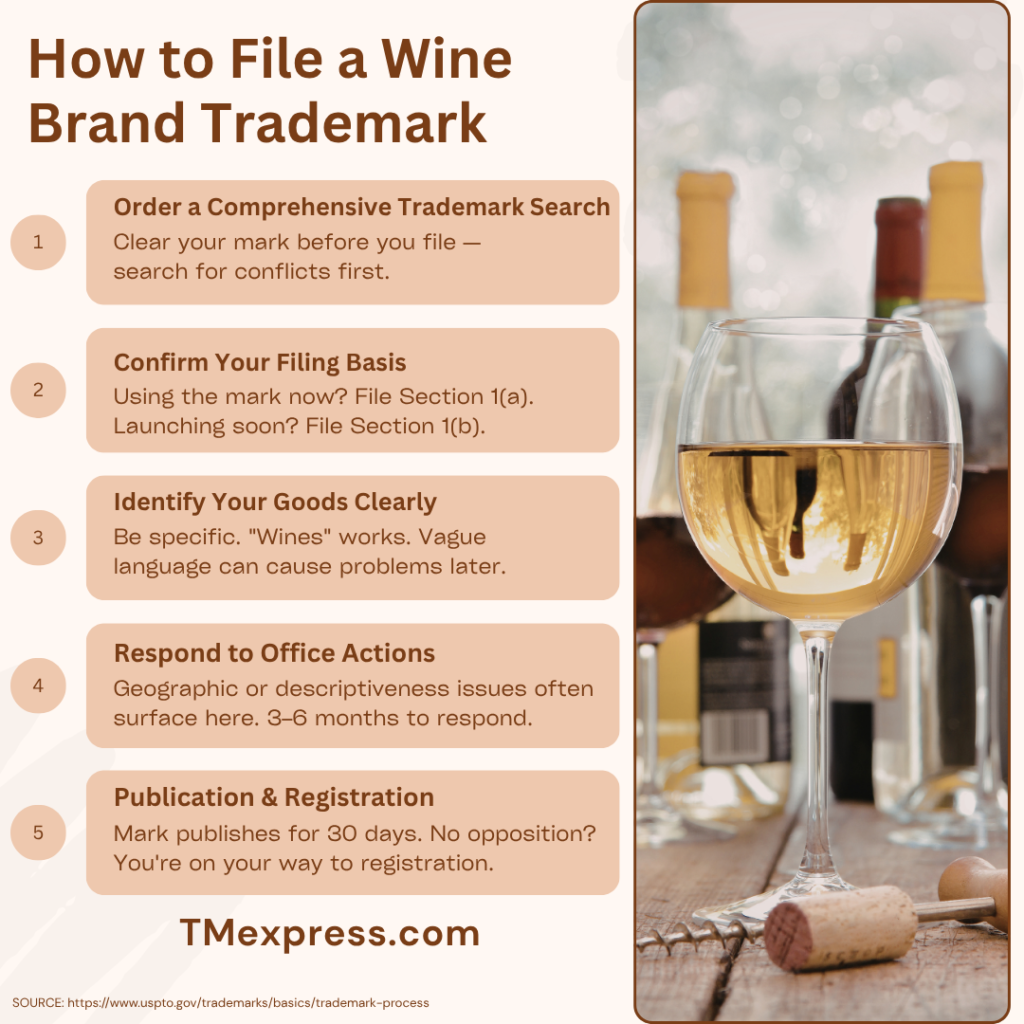
Step 1 — Confirm Your Basis for Filing
You’ll file under either Section 1(a) if you’re already using the mark in commerce, or Section 1(b) if you have a bona fide intent to use it. For wine brands, use in commerce generally means the mark appears on wine bottles or labels sold or shipped in interstate or international commerce.
Step 2 — File Application at the USPTO Trademark Center
The USPTO’s current filing system is the Trademark Center at trademarkcenter.uspto.gov. You’ll enter your mark, identify your goods, select your NICE class, and either submit a specimen (for use-based applications) or declare your intent to use.
Your specimen for a wine brand is typically a photograph of the actual wine label as it appears on a bottle in commerce. The mark must be visible on the specimen as used.
Step 3 — Write a Clear Identification of Goods
Your identification of goods should be specific enough to accurately describe your products and narrow enough to avoid unnecessary scope. A broad, vague identification can create problems during examination. For wine, an identification like “wines” is acceptable, but “wine” alone has also been accepted. Avoid language that could bleed into goods you don’t actually sell.
Step 4 — Respond to Office Actions
After filing, a USPTO examining attorney will review your application. If the examiner identifies issues — a likelihood of confusion with an existing mark, a geographic refusal, a descriptiveness rejection, or a specimen problem — you’ll receive an Office Action. You typically have three months to respond (extendable to six months for a fee).
This is the stage where geographic issues under TMEP § 1210.08 most commonly arise. If your mark includes a place name associated with wine, expect the examining attorney to raise a question about it.
Step 5 — Publication and Registration
If the application clears examination, the mark is published in the Official Gazette for a 30-day opposition period. If no opposition is filed, a use-based application proceeds to registration. An intent-to-use application receives a Notice of Allowance, and you then have time to submit a Statement of Use once the mark is in commerce.
Protect Your Wine Brand Before Someone Else Does
The wine industry is competitive, and strong brands drive consumer loyalty. A comprehensive trademark search followed by a well-prepared federal application gives you the foundation to build and defend your brand for years to come.
At TradeMark Express, we specialize in comprehensive trademark research and application preparation assistance. We help wine brand owners understand the landscape before they file — so they can move forward with confidence.
Ready to protect your wine brand? Contact TradeMark Express today to get started with a comprehensive trademark search.
The information provided on this site is for general informational purposes only. All information on the Site is provided in good faith; however, we make no representation or warranty of any kind, express or implied, regarding the accuracy, validity, or completeness of any information on the Site. The Site cannot and does not contain legal advice. The legal information is provided for general informational and educational purposes only, and is not a substitute for legal advice. Consult a licensed attorney for legal advice.