How Restaurant Owners Can Protect Their Brand with a Trademark
Why a Trademark Matters for Your Restaurant
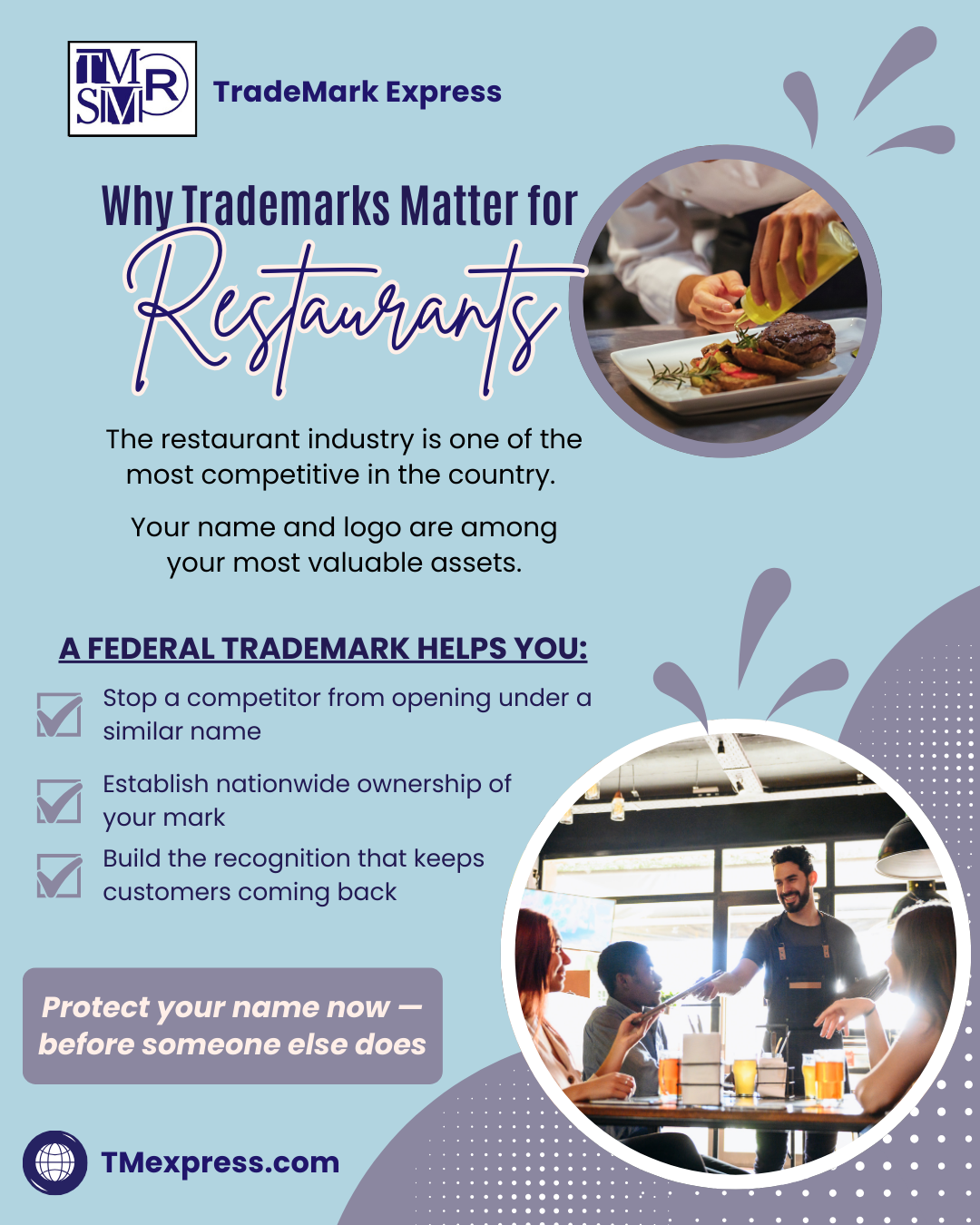
The restaurant industry is one of the most competitive in the country. According to the National Restaurant Association, the U.S. restaurant industry generates over $1 trillion in annual sales and employs more than 15 million people. With that level of competition, brand identity is everything.
Step-by-Step: How to Trademark a Restaurant
Step 1: Choose a Strong Restaurant Name
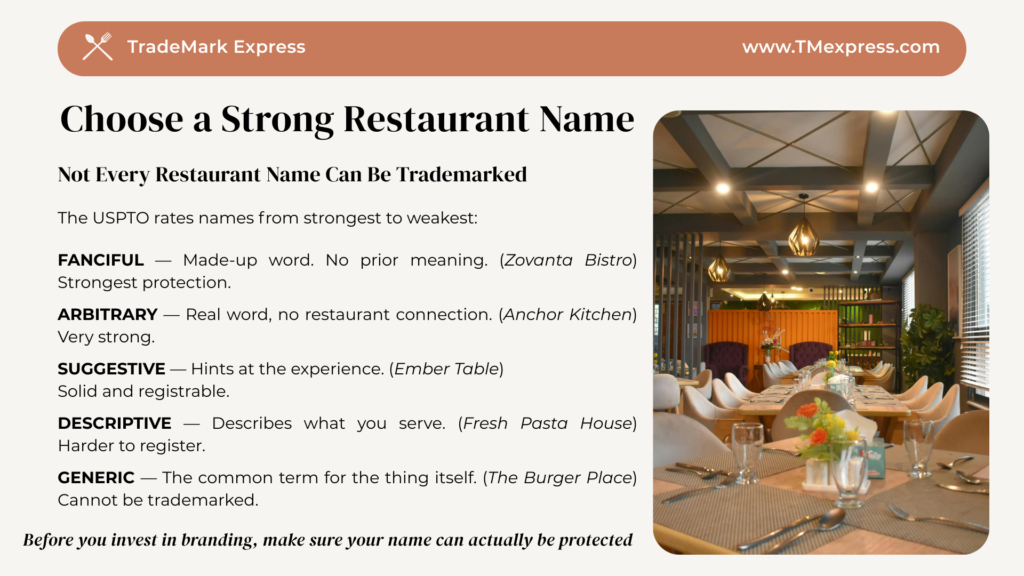
Understanding the Distinctiveness Spectrum
- FANCIFUL: A completely made-up word with no prior meaning. Zovanta Bistro is a strong example—no dictionary definition, high protection. These are the strongest marks.
- ARBITRARY: A real word with no connection to restaurants. Anchor Kitchen uses a common word in an unrelated context. Also very strong.
- SUGGESTIVE: A name that hints at the experience without describing it directly. Ember Table suggests warmth and gathering without stating it outright. These are registrable and solid choices.
- DESCRIPTIVE: Names that directly describe what you offer. Fresh Pasta House tells customers what you serve. These are difficult to register unless you can prove the name has acquired distinctiveness over time.
- GENERIC: Names that are simply the common term for the product or service. The Burger Place is an example. Generic terms cannot be trademarked.
Why Name Choice Matters for Restaurants
In the restaurant world, descriptive names are common—owners naturally want customers to know what they’re getting. But a name like Coastal Seafood Grill may face a tough road at the USPTO. Before you commit to a name or spend money on branding, it’s worth evaluating whether your name can actually be protected.
Step 2: Conduct a Comprehensive Trademark Clearance Search
Why a Thorough Search Is Non-Negotiable
A trademark search is the most important thing you can do before filing. The USPTO won’t automatically catch every conflict—that’s your responsibility. A comprehensive search goes beyond the USPTO’s Trademark Search database to include state trademark registries, common law sources, business directories, social media, and domain registrations.
Conflicts aren’t always obvious. The USPTO evaluates similarity in sound, appearance, and meaning. A restaurant named BluAnchor Grill could conflict with an existing mark called Bistro de Bleu Anchor even if the names aren’t identical. If you skip this step and file anyway, you risk rejection, wasted filing fees, or a cease-and-desist letter down the road.
Step 3: File Your USPTO Trademark Application
Selecting Your Goods and Services
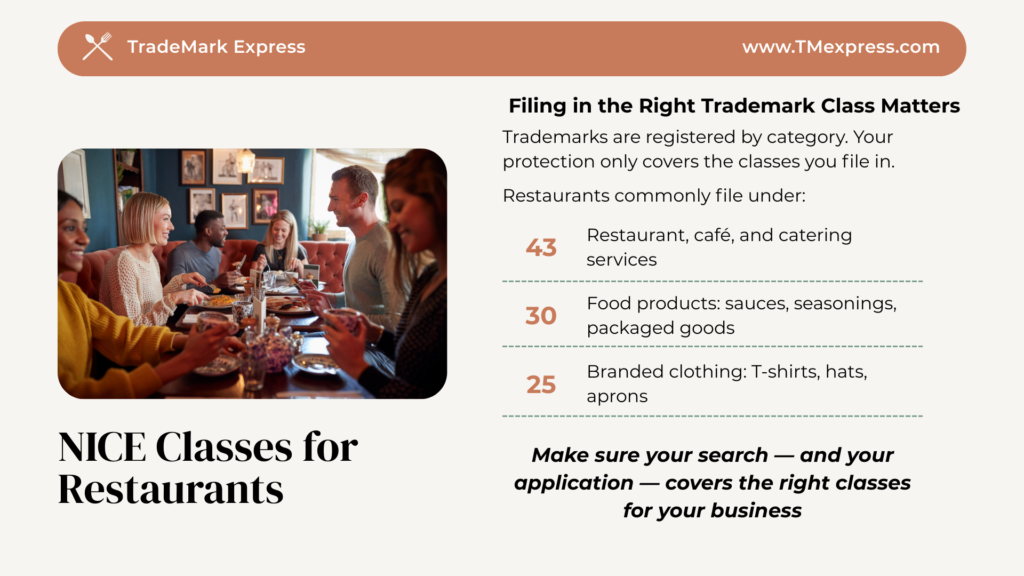
When you file, you’ll need to describe the specific services your trademark covers. For a restaurant, this typically means services in Class 43 such as “restaurant services” or “pop-up restaurant services.” The description needs to be specific enough to pass USPTO review but broad enough to cover your business activities.
The USPTO provides an Acceptable Identification of Goods and Services Manual (ID Manual) to help you choose language that’s already been approved. Using this resource—or working with a trademark professional—reduces the chance of an office action related to your identification.
Filing with the USPTO
You’ll file your application through the USPTO’s Trademark Center. As of January 2025, the base filing fee is $350 per class. Additional surcharges may apply if your application is incomplete or uses a custom identification of goods and services rather than a pre-approved description from the USPTO’s ID Manual.
Intent-to-Use (ITU) vs. Use in Commerce
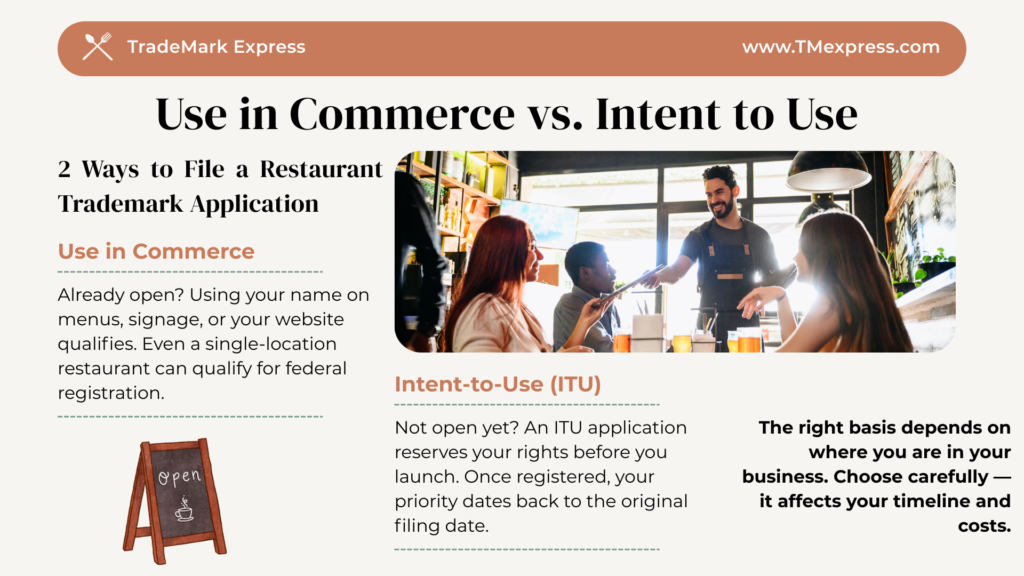
Use in Commerce means you’re already using the mark in your restaurant’s day-to-day operations—on menus, signage, uniforms, packaging, or your website. For restaurants, this is often the applicable basis.
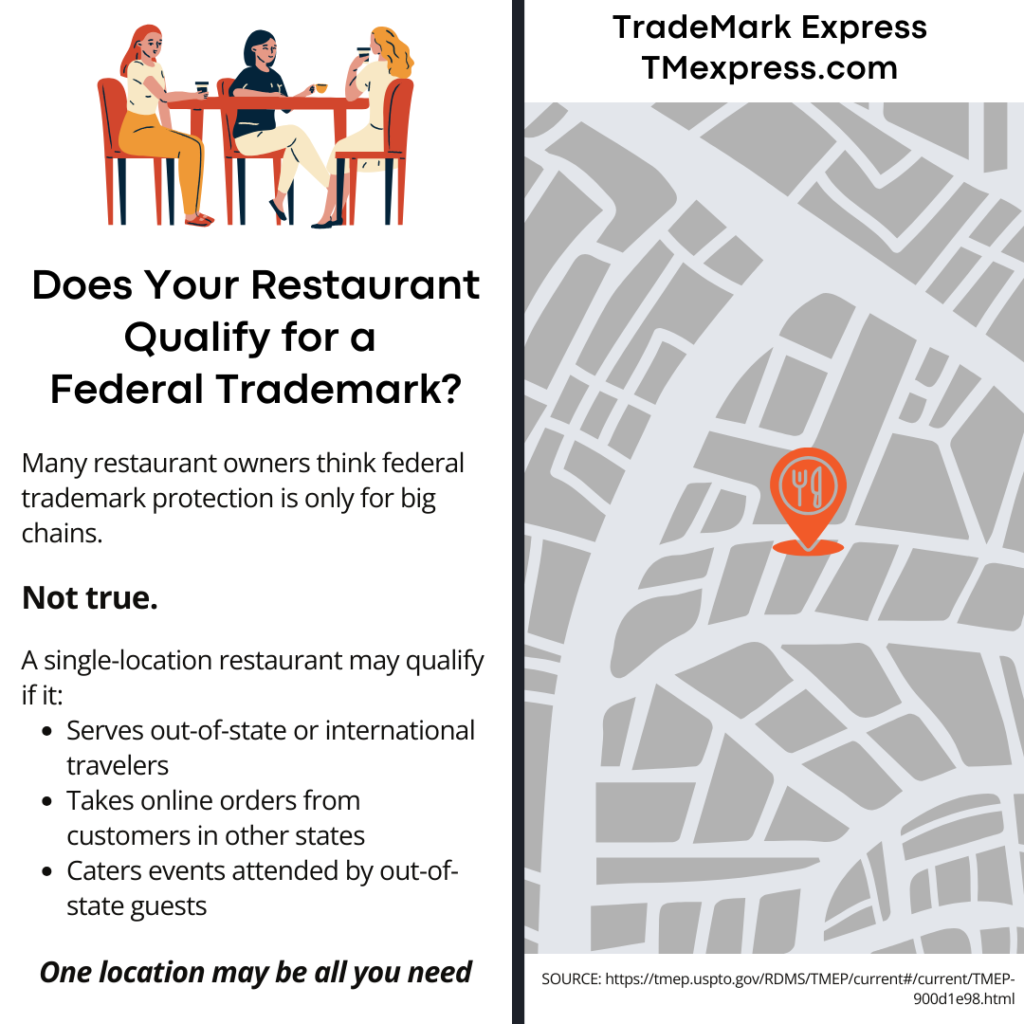
Notably, even a single-location restaurant can qualify for federal trademark registration. According to the Trademark Manual of Examining Procedure (TMEP), intrastate use of a mark may qualify as “use in commerce” if it would, taken in the aggregate, have a direct effect on interstate commerce—for example, when a restaurant serves interstate travelers. The advantages: your application is based on real, documented use, which can strengthen your overall filing.
Intent-to-Use (ITU) is for situations where you’ve chosen a name but haven’t opened yet. An ITU application reserves your rights to the mark before you launch. The advantage is that once the mark is registered, your priority rights date back to your filing date—not the date you opened your doors. The downside: you’ll need to file a Statement of Use (and pay additional fees) once you begin using the mark, which adds time and cost to the process.
Step 4: Monitor Your Trademark Application
Staying on Top of the Process
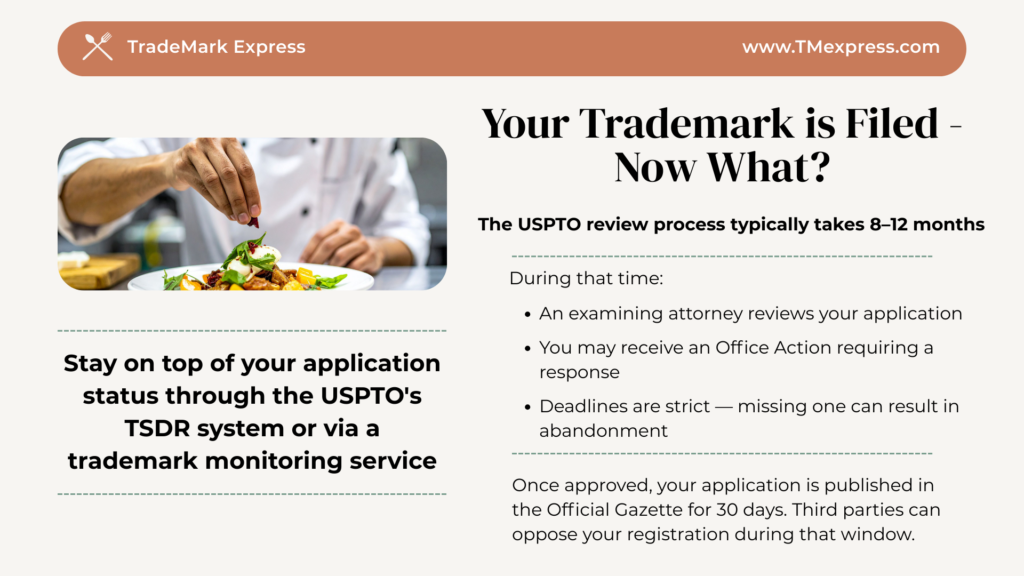
After you file, the USPTO assigns an examining attorney to review your application. The review process typically takes 8–12 months from the filing date, though timelines vary. During this time, the examining attorney may issue an Office Action—a written request for clarification or a rejection based on an existing conflict or a technical issue with your application.
Responding to an Office Action promptly and accurately is critical. Deadlines are strict, and missing one can result in abandonment of your application. Checking your application status regularly through the USPTO’s Trademark Status and Document Retrieval (TSDR) system keeps you informed at every stage.
Or hire a trademark monitoring service to keep your application on track AND to monitor for potential infringing trademarks.
Watching for Potential Conflicts
Once your application is approved for publication, it appears in the Official Gazette for 30 days. During that window, third parties can oppose your filing if they believe it conflicts with their existing mark. Monitoring the publication stage—and understanding how to respond if an opposition is filed—is an important part of protecting your investment in the trademark process.
Step 5: Maintain Your Registered Trademark
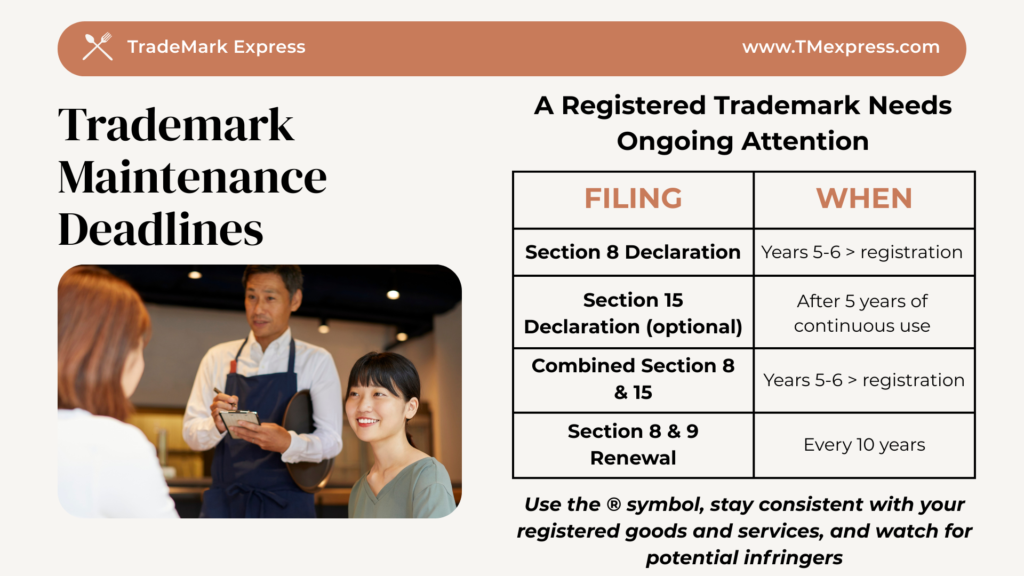
Registration isn’t permanent on its own. The USPTO requires you to file maintenance documents to keep your trademark active. Missing these deadlines means your registration can be cancelled.
Filing | When | Purpose |
Years 5–6 | Confirm the mark is still in use | |
After 5 years of continuous use (optional) | Achieve incontestable status | |
Years 5–6 | File both at the same time to save time and fees | |
Every 10 years | Renew registration and confirm continued use |
Always use your trademark consistently with the goods and services listed in your registration. Use the ® symbol once your mark is registered. And continue monitoring for potential infringers—unauthorized use of a confusingly similar mark by a competitor can dilute your brand and weaken your legal position over time.
Industry-Specific Considerations for Restaurant Trademarks
Your Single Location May Already Qualify
Many restaurant owners assume they need multiple locations or national reach to qualify for a federal trademark. That’s not the case.
Logo Trademarks Matter Too
Most restaurant owners think of trademarking their name—but your logo deserves protection as well.
If your mark includes a distinctive design, font, or color combination, you can file a separate application for the design element. A word mark and a logo mark work together to give you the broadest possible coverage. If someone copies your font or icon without using your exact name, a logo mark helps you respond.
Menu Items and Specialty Products
If you’ve developed a signature product—a bottled hot sauce, a branded spice blend, or a packaged food item you sell online or in stores—that product may need its own trademark filing under Class 30.
Your restaurant service mark (Class 43) doesn’t automatically extend to goods. As you grow and diversify, it’s worth evaluating whether additional filings are needed.
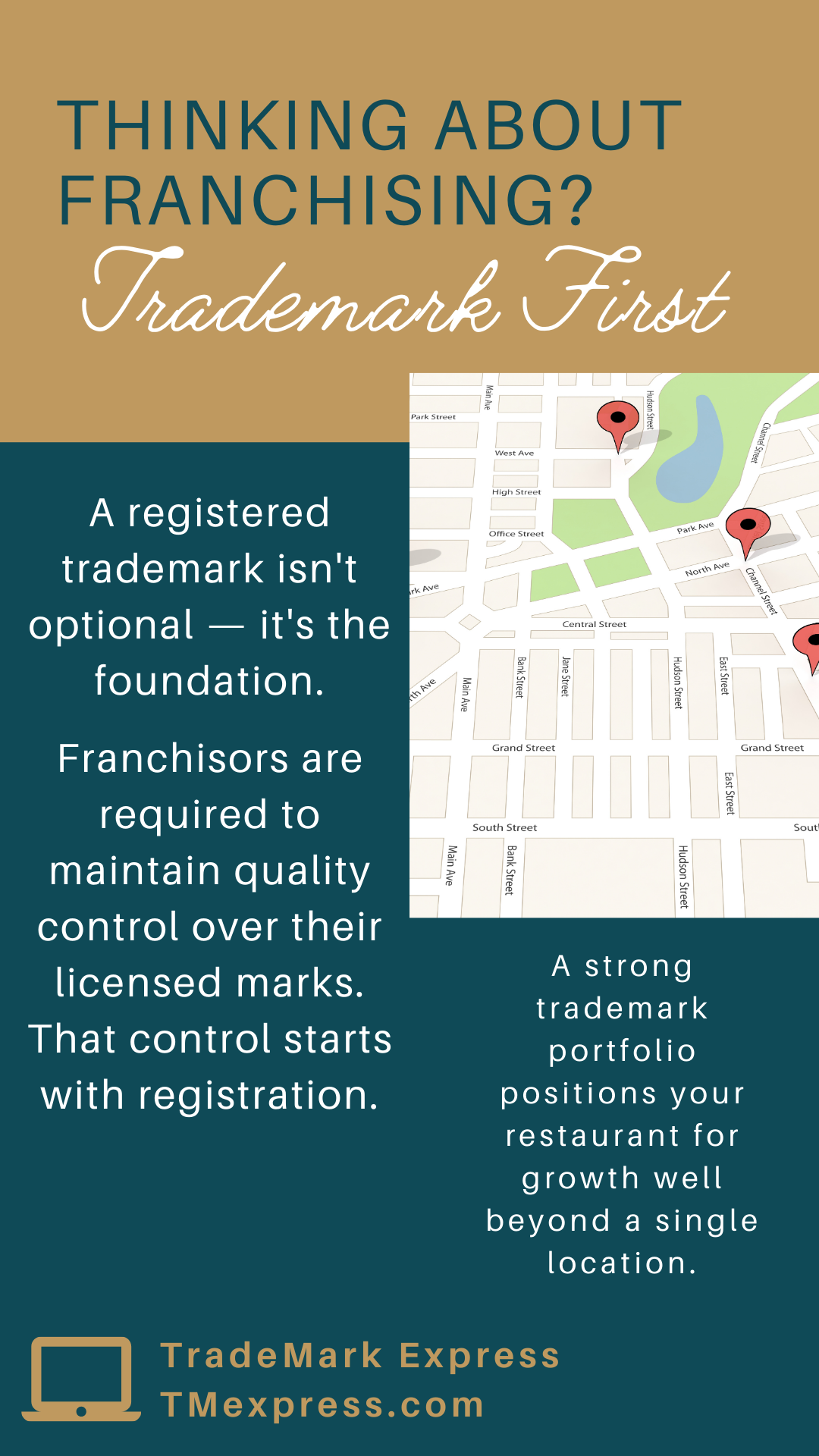
Franchise and Licensing Potential
Protect Your Restaurant Brand with TradeMark Express
Trademarking your restaurant is one of the most valuable investments you can make in your brand—and the process doesn’t have to be overwhelming.
At TradeMark Express, we provide comprehensive trademark research, application preparation using USPTO tools and guidelines, and referrals to experienced trademark attorneys when you need professional legal counsel.
Order your restaurant trademark today to secure your brand and start building protection immediately. Our team is ready to help you take the next step with confidence.